Parent’s guide
Practical answers to the questions parents ask most often. Short, no theory.
November 13, 2026
Syllables in Reading: How to Chunk Longer Words
Syllables can help children tackle longer English words, but phonics and blending remain the foundation. Teach your child to decode graphemes, break an unfamiliar multisyllabic word into manageable chunks, blend the whole word, and reread it in a sentence. Here is a clear progression, a 10-minute routine, and signs that chunking has become overused.
Read moreNovember 12, 2026
Reading Aloud or Silently: When to Practise Each
Reading aloud is especially useful in the early primary years because children practise accuracy, fluency and expression while you can hear where decoding breaks down. Silent reading should grow gradually as word reading becomes more automatic. Below are practical Grade 1–4 / Year 2–5 proportions and a 10-minute repeated-reading routine.
Read moreNovember 11, 2026
English Verbs: Tenses, Regular and Irregular Forms
English verb practice is easier when children ask three questions: who or what is the subject, when does the action happen, and what verb form fits? Start with present, past and future, then compare regular verbs such as play–played with irregular forms such as go–went–gone. Below are tables, examples and exercises with answers.
Read moreNovember 10, 2026
Number Sequences: How to Find the Rule
Solve number-sequence problems in the same order every time: find the rule first, then calculate the missing or next terms. Check differences between neighbouring numbers, then multiplication or division, then changing differences and alternating rules. Always test your rule against every term. Below are five questions, worked examples and seven problems with answers.
Read moreNovember 9, 2026
Silent Letters in English: kn, wr, mb and gh
Silent letters become easier to remember when children learn patterns rather than isolated word lists. In English, k is silent at the start of kn- words, w in many wr- words, b at the end of many -mb roots, while gh has several patterns. Here is a practical way to group the spellings, practise them, and know when to check a dictionary.
Read moreNovember 8, 2026
3D Shapes: Cubes, Rectangular Prisms and Nets
3D shapes include cubes, rectangular prisms, cylinders and spheres. In Grade 4–6 / Year 5–7, a key solid is the rectangular prism: it has 6 rectangular faces, 12 edges and 8 vertices. A cube is a rectangular prism whose faces are congruent squares. Here is a shape table, a paper cube model, and formulas for surface area and volume.
Read moreNovember 7, 2026
Narrator vs Author: What Is the Difference?
The narrator and the author are not the same thing. The author is the real person who wrote the work and whose name appears on the cover. The narrator is the voice telling the story inside the text. A character is someone who takes part in the events. Below are three questions that help children tell them apart, familiar examples, and a short exercise with answers.
Read moreNovember 6, 2026
Phonemic Awareness: Blending and Segmenting Games
Phonemic awareness means hearing how spoken words can be broken into syllables and individual sounds, then blended back together. It is an important foundation for reading and is best practised through listening and movement before letters are added. Here is a 5–10 minute daily progression from syllables to phonemes, with ready-to-use games and clear stages.
Read moreNovember 5, 2026
How to Build a Child’s Vocabulary Through Everyday Talk
How can you build a child’s vocabulary without extra lessons? Ask open questions, name things precisely, expand what your child says with one new word, and read aloud together every day. Below are conversation techniques, age-appropriate word ideas for ages 5–12, five-minute word games, and signs that it may be useful to speak with a language professional.
Read moreNovember 4, 2026
Division for Kids: Show the Link With Multiplication
Division is easiest to explain as the inverse of multiplication: if 3 × 4 = 12, then 12 ÷ 3 = 4 and 12 ÷ 4 = 3. Start by sharing blocks equally, then show the same situation with a dot array, and finally write it as a multiplication sentence with a missing number. Here is a four-stage plan, games, and common mistakes.
Read moreNovember 3, 2026
How to Improve a Child’s Handwriting Without Copying Pages
How do you improve handwriting? Not by copying whole pages, but through short daily practice focused on one feature at a time: spacing, letter size, alignment, or the shape of a few difficult letters. First identify what makes the writing hard to read, then practise that feature for a week for 5–10 minutes a day. Here is a legibility checklist, a four-week plan, and signs to discuss with the teacher.
Read moreNovember 2, 2026
How to Build Consistent Study Habits in Children
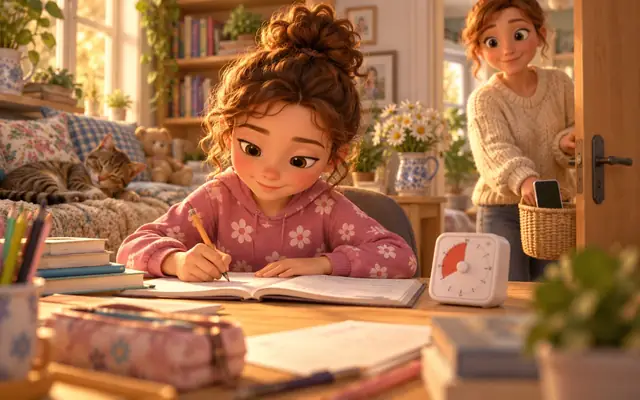
How do you teach a child to be consistent? Turn study into a habit: use the same time and place each day, begin with a very small step such as 5 minutes, and let the child tick a habit tracker. Habits grow through repeating a simple action in the same context, not through constant reminders. In an adult study, habit automaticity took about two months on average, so this plan runs for 10 weeks.
Read moreNovember 1, 2026
How to Teach a Child to Study Independently Step by Step
How do you teach a child to study independently? Show three steps: plan before studying, monitor progress while working, and evaluate afterwards—then gradually hand each step over. Independence is a skill that can be taught, not a personality trait. Here are questions for each step, three stages for parents to step back, and techniques children aged 8–14 can use on their own.
Read moreOctober 31, 2026
Memory Activities for Kids Who Forget Instructions
When a child forgets instructions or loses track halfway through a task, working memory may be overloaded—the mind’s short-term “notepad”. The most useful support is to reduce that load with shorter instructions, have the child repeat them, and keep visual reminders in sight. Here are common signs, better ways to give instructions, practical supports, and five-minute memory games.
Read moreOctober 30, 2026
How to Improve a Child’s Memory After Reading
When a child says “I don’t remember anything” after reading a chapter, they may have read too passively. Memory improves when the book is closed and the child tries to retrieve what they just learned: read a short section, spend 2–3 minutes writing or explaining from memory, then check what was missing. Here is the technique step by step, useful questions, and a spaced-review plan.
Read moreOctober 29, 2026
How to Teach Addition to 10: From Blocks to Mental Maths
How do you teach a child addition to 10? Start with objects the child physically adds and counts, then move to drawings, and introduce written equations last. Practise number pairs that make 10 separately. Below are three learning steps, games for number bonds to 10, and a three-week plan for 10 minutes a day.
Read moreOctober 28, 2026
Maths Games With Blocks: Counting, Patterns and More
Maths games with blocks can teach counting, comparing, patterns, symmetry and measurement when you add one good question to the building. Below are 15 ideas for children aged 4–8, grouped by skill, a one-week plan for 10 minutes a day, and prompts that turn ordinary block play into mathematical thinking.
Read moreOctober 27, 2026
How to Teach Your Child English If You Are Not Fluent
How can you teach your child English at home if you are not fluent yourself? Use recordings as the pronunciation model and focus on routine and play: 15 minutes a day at a regular time, five new words, a movement song, and one simple game. Here is a ready-made 15-minute plan, grammar-free games, and ways to notice progress without quizzing.
Read moreOctober 26, 2026
How to Limit Phone Use During Study Time
How can you limit a child’s phone use during study time with rules that last longer than a week? Put the phone outside the room rather than simply silencing it on the desk, write a short agreement together with clear exceptions, and plan a five-minute phone window during a break. Here is a sample agreement, age-based rules for 9–14, and a calm response when the agreement is broken.
Read moreOctober 25, 2026
How to Build Concentration in Preschool-Age Children
How can you build concentration in a preschool-age child? Keep it short, active, and playful: 3–10 minute tasks, stop-and-go games, mazes, sorting and puzzles, with one task at a time and no television in the background. Below are movement and table activities, a one-week plan for 10 minutes a day, and signs that extra support may be useful.
Read moreOctober 24, 2026
How to Help a Child Study Without Doing the Work for Them
How can you help with schoolwork without doing it for your child? Start with a question rather than the answer, give the smallest hint that is enough, and leave planning and checking to the child whenever possible. Below is a five-step hint ladder, ready-to-use phrases for difficult moments, and guidance for ages 6–14.
Read moreOctober 23, 2026
Educational Coloring Pages in Grade 1–3: How to Use Them
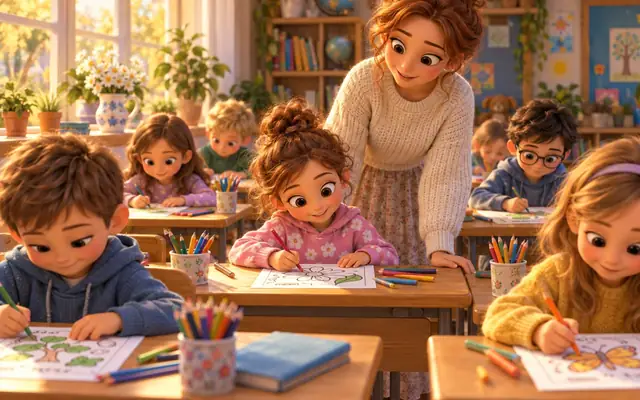
Educational coloring pages support learning in Grade 1–3 / Year 2–4 when they contain one task linked to the lesson goal and end with a quick check. Here are six task types to build into a coloring page, three ways to use it in a lesson, how to adjust difficulty, and how to assess the learning without judging the colors.
Read moreOctober 22, 2026
How to Improve a Child’s Concentration While Studying
How can you improve a child’s concentration? Start with short study blocks suited to their age, one task at a time, and movement breaks. A consistent workspace without a phone, enough sleep, and brief daily attention games such as mazes or picture sudoku can also help.
Read moreOctober 21, 2026
English for Kids: From Words to Sentences at Age 6
For a 6-year-old learning English as an additional language, it is possible to move beyond single words without turning grammar into desk work. The easiest route is to reuse a few sentence patterns in play—“I like…”, “I can…”, “This is…” and “Where is…?”. Short role-play, songs and movement help children use them naturally.
Read moreOctober 20, 2026
Maths Puzzles for Kids: Build Logical Thinking
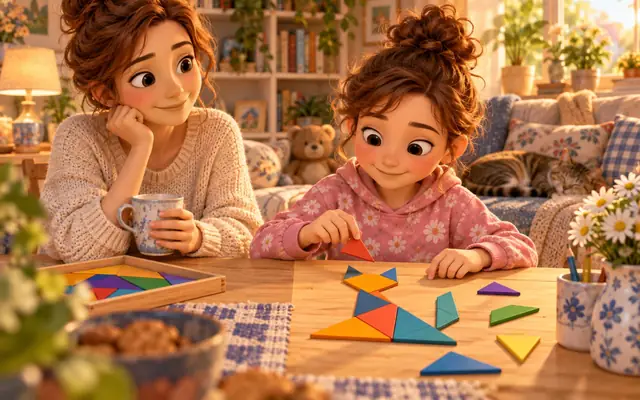
Maths puzzles build logical thinking when children have to spot a rule, eliminate possibilities, test an idea, and explain why it works. From Grade 1–8 / Year 2–9, useful formats include sudoku, sequences, balance puzzles, shapes, matchsticks, and logic problems. The key is choosing a level where your child can make the first move independently.
Read moreOctober 19, 2026
How to Teach a Child to Write Essays Independently
How do you teach a child to write essays independently? Instead of composing sentences for them, help them follow a repeatable process: understand the task, brainstorm, plan, draft, and revise. Parents can support best with questions, brief organisational prompts, and a checklist that gradually hands responsibility for the text back to the child.
Read moreOctober 18, 2026
How to Help a Child Catch Up With Schoolwork
When a student in Grade 4–8 / Year 5–9, roughly ages 9–14, is behind in several subjects, start with a calm audit: list missing work, deadlines, and gaps that block new learning. Then set priorities and spread catch-up work over four weeks, using short 25–30 minute blocks and no more than two subjects a day.
Read moreOctober 17, 2026
How to Teach a Child to Count to 10 Without Pressure
How do you teach counting to 10 between ages 3 and 6? Start with real objects: count blocks, steps, grapes, and toy cars instead of quizzing your child on numerals. Understanding “how many” comes first, then comparing groups; written numerals can come later, once number has real meaning.
Read moreOctober 16, 2026
How to Calm an Angry Child: 5 Simple Strategies
When a preschool-age child becomes very angry, start with safety and your own calm tone. Do not try to hold a long discussion or force an apology in the middle of the outburst. Once the strongest tension begins to ease, help your child regulate with one of five simple strategies: calm presence, naming feelings, breathing, a calm space, or movement.
Read moreOctober 15, 2026
Teaching Letters With Phonics: What Order Works Best?
Teaching letters does not have to start with A, B, C. For children aged 4–6, a phonics-based sequence is often more useful because it lets them connect letters with sounds and build simple words quickly. One common starting order is s, a, t, p, i, n, followed by groups such as m, d, g, o, c and k.
Read moreOctober 14, 2026
How to Teach Reading Comprehension: Questions That Work
To teach reading comprehension, first show your child how to read the question, return to the relevant part of the text, underline the evidence, and answer in a full sentence. Start with “who?”, “where?” and “when?”, then move to sequence, causes, inference, and vocabulary.
Read moreOctober 13, 2026
Grade 1 / Year 2 at Home: Four Learning Priorities
In Grade 1 / Year 2, around ages 6–7, home does not need to become a second school. The biggest gains usually come from short, regular practice in four foundations: daily reading, everyday maths, comfortable handwriting, and independent organisation. Around 15–20 minutes of well-chosen practice is often more useful than long extra worksheets.
Read moreOctober 12, 2026
How to Teach Subtraction to 20 Step by Step
Teach subtraction to 20 in stages: start with real objects up to 10, then ask “how many more?”, move to subtraction within 20 without crossing 10, and finally subtract across 10. Only when your child understands the operation and can explain their strategy is it worth shifting more of the work into mental calculation.
Read moreOctober 11, 2026
Learning Through Play: One Task, Movement and Talk
How can you turn one activity into learning through play for a child aged 3–6? Take a worksheet, game, or picture, add a short movement connected to the theme, then finish with one question or a tiny story. The same activity can involve the hands, the whole body, and language without adding more worksheets.
Read moreOctober 10, 2026
What Should a 6-Year-Old Be Able to Do? A Practical Guide
A 6-year-old does not need to read fluently or write like an older schoolchild. It is more useful to support independence, cooperation, speaking and listening, early reading and writing, mathematical thinking, and movement. Expectations vary across English-speaking school systems, so treat these as areas to support rather than a pass-or-fail checklist.
Read moreOctober 9, 2026
Creative Activities for Kids: 20 Ideas for 5-Year-Olds at Home
At home with a 5-year-old, you can play with rhymes and sounds, count to 10, compare quantities, copy patterns, draw, move, and build simple structures. Most activities take 5–15 minutes and need only paper, blocks, bottle tops, crayons, or everyday household items. Choose one or two activities a day.
Read moreOctober 8, 2026
20 Activities for 3-Year-Olds at Home – Simple Learning Ideas
What learning activities can you do at home with a 3-year-old? Keep them short—about 3–10 minutes—use simple materials, and take away the pressure to get a result. Everyday play, cooking, and tidying can build language, early maths, fine motor skills, movement, sensory awareness, and independence. The adult adjusts the level, keeps things safe, and stops when the child has had enough.
Read moreOctober 7, 2026
How to Motivate a Child to Study When They Say “I Don’t Feel Like It”
When your child says “I don’t feel like it,” don’t start with a lecture or punishment. First check whether they are tired, hungry, confused, bored, or afraid of making a mistake. Then offer the smallest first step, a choice of what to do first, and 10 minutes of work. The goal is to get started, not to win an argument.
Read moreOctober 6, 2026
Maths for Kids in the Kitchen: Measuring and Ratios
Cooking lets children practise maths without a separate lesson: ages 6–7 can count, compare and measure; ages 8–9 can convert grams, kilograms, millilitres and litres and divide portions; ages 10–12 can scale recipes, calculate ratios, discounts and cost per portion. Choose one maths task for each cooking session.
Read moreOctober 5, 2026
What Should a 5-Year-Old Be Able to Do? A Practical Parent Guide
A 5-year-old is usually becoming more confident in conversation, telling simple stories, counting to 10, recognising some letters and numbers, following rules in play, doing simple chores, buttoning some buttons and hopping on one foot. Treat this as a guide for observing everyday development, not as a test.
Read moreOctober 4, 2026
What Should a 3-Year-Old Be Able to Do? Development Without a Race
What can a 3-year-old usually do? They are becoming more confident in conversation, noticing other children, practising independence and refining hand movements. Development does not follow one identical timetable, so the best support comes through everyday meals, dressing, walks, bath time and play, without comparing children.
Read moreOctober 3, 2026
What Should a 4-Year-Old Be Able to Do? Learning Through Play
A 4-year-old is usually speaking more freely, enjoying pretend play, recognising some colours, developing hand control and movement, becoming more independent and learning to cooperate with others. The best support comes through everyday play and calm observation, without racing, comparing with other children or testing at home.
Read moreOctober 2, 2026
Brackets in Maths for Beginners: Simple Rules
With brackets, calculate what is inside first, then follow the usual order of operations: multiplication and division before addition and subtraction. Brackets can change the answer: 20 – (5 + 3) = 12, while 20 – 5 + 3 = 18. Below are step-by-step examples, word problems and practice with answers.
Read moreOctober 1, 2026
How to Teach a Child to Write: Hand Preparation Step by Step
How can you prepare a 4–7-year-old's hand for writing? Start with large shoulder and arm movements, then strengthen the hand and fingers, move on to large shapes and pre-writing patterns, and only then introduce letters on handwriting lines. Five to 10 minutes of playful practice a day is enough, without forcing a perfect pencil grip or rushing.
Read moreSeptember 30, 2026
How to Teach Spelling Without Memorising Long Lists
How can you teach spelling in the primary years without long word lists? Start with patterns, base words and word families so your child learns how to work out a spelling. Then keep genuinely irregular words in a personal error dictionary. Short daily practice works best when children explain the pattern they are using.
Read moreSeptember 29, 2026
How to Encourage a Child to Read When Screens Win
How can you encourage a child to read when they would rather use a screen? Give reading a short, regular place in the day, start with topics they already enjoy in games and shows, and let them choose books, comics and short texts. Take turns reading, and sometimes use a screen as a reading tool rather than a reward for every page.
Read moreSeptember 28, 2026
Worksheets or Online Practice for Kids — Which Should You Choose?
Worksheets or online practice? A worksheet is better when a child in Grades 1–3 / Years 2–4 needs to write by hand, show calculation steps, or think through a task slowly. Online practice works well for short review with immediate feedback. In most cases, the best approach combines both: paper for writing and reasoning, screens for quick reinforcement.
Read moreSeptember 27, 2026
Second Grade Math: What to Practice Regularly
Second grade math is best practiced in short, regular sessions: 10–15 minutes a day, focusing on addition and subtraction within 100, tens and ones, multiplication and division, word problems, clocks and measurement. Revisit calculations almost every day and rotate the other skills 2–3 times a week.
Read moreSeptember 26, 2026
First Grade Math: How to Choose the Right Level
Start first grade math at a level where your child understands the method and makes few mistakes. Check counting with real objects and calculations within 10 first, then raise the difficulty only when your child solves similar examples independently. If you see a run of errors or guessing, step back one level.
Read moreSeptember 25, 2026
Coloring Pages for 6-Year-Olds — Letters, Numbers & Tasks
Coloring pages for 6-year-olds can include letters, numbers, and simple tasks when your child shows interest: asking about letters, recognizing their name, or counting objects. Start with recognition, move to color-by-letter or color-by-number, and add simple sums to 10 only after the basics feel comfortable.
Read more