
In Short: What Should You Practise at Home in Grade 1 / Year 2?
In Grade 1 / Year 2, around ages 6–7, there is no need to recreate the school day at home. It is better to focus on 3–4 areas that support many school tasks at once: reading, everyday maths, handwriting skills, and independent organisation.
A useful home routine is:
- 5–10 minutes of shared reading or reading aloud;
- a few minutes of counting during shopping, cooking, or play;
- a short piece of writing, drawing, or hand-strength activity;
- independently checking the school bag and supplies.
Altogether, around 15–20 minutes of short practice beyond school-assigned work is usually enough. This is a practical routine, not a fixed rule.
Materials for this age are collected in our Grade 1 / Year 2 section.
Priority | 5–10 Minutes a Day | Sign It Is Helping |
|---|---|---|
Reading | shared reading, phonics, short sentences | your child is more willing to try and guesses less often |
Maths | counting objects, simple calculations in real life | your child explains more often how they reached an answer |
Writing and hand skills | a few letters, a short word, drawing and pattern work | the hand tires less and writing feels easier |
Independence | school bag, supplies, plan for tomorrow | your child needs fewer reminders |
Why Does Daily Reading Help So Much?
Reading supports more than reading technique. Your child also practises understanding instructions, vocabulary, concentration, and talking about what a text means.
It does not need to be a long session. In five minutes, you can:
- take turns reading one sentence each;
- read a short passage to your child and ask them to tell you what happened;
- spot three familiar sound patterns or words;
- go back to one sentence that was difficult.
If your child is still blending words, try early phonics and blending practice. For more on developing reading calmly, see how to teach a child to read.
The Education Endowment Foundation identifies reading at home as one of the better-evidenced ways families can support learning. What matters is giving parents clear guidance and matching help at home to what the child is currently learning at school.

How Can You Practise Maths Without an Extra Workbook?
Use situations where the numbers have a purpose. A Grade 1 / Year 2 child does not need another full page of similar examples after school if the same idea can be practised at the table or while shopping.
Examples:
- “We have 8 grapes. We ate 3. How many are left?”
- “Put out 6 blocks and add 2 more.”
- “Which number is larger: 7 or 9?”
- “We need 10 spoons. We have 4. How many more do we need?”
If the teacher says your child needs more practice, choose material at exactly that level. In our Grade 1 / Year 2 maths section, online practice uses sets of 10 questions with immediate feedback.
Our separate guide to Grade 1 / Year 2 maths tasks – how to choose the right level focuses on adjusting difficulty. If one skill is the problem, such as subtraction, see subtraction to 20 step by step.

How Much Writing and Hand Practice Is Enough?
A short session at home is enough, especially if your child has already done a lot of writing at school. The aim is not to fill a whole page but to make hand movements more controlled and comfortable.
Choose one activity:
- write 3–5 letters or two short words;
- copy one sentence;
- draw a pattern with loops and curves;
- make a few small shapes from modelling dough;
- cut out a simple shape.
If forming letters is difficult, use letter writing for Grade 1 / Year 2. If the hand tires quickly or pencil grip makes writing harder, see how to prepare a child’s hand for writing.
Do not correct every letter. Pick one focus, such as direction of formation or letter size, and work on that during the short session.
Why Are the School Bag and Organisation Part of Learning?
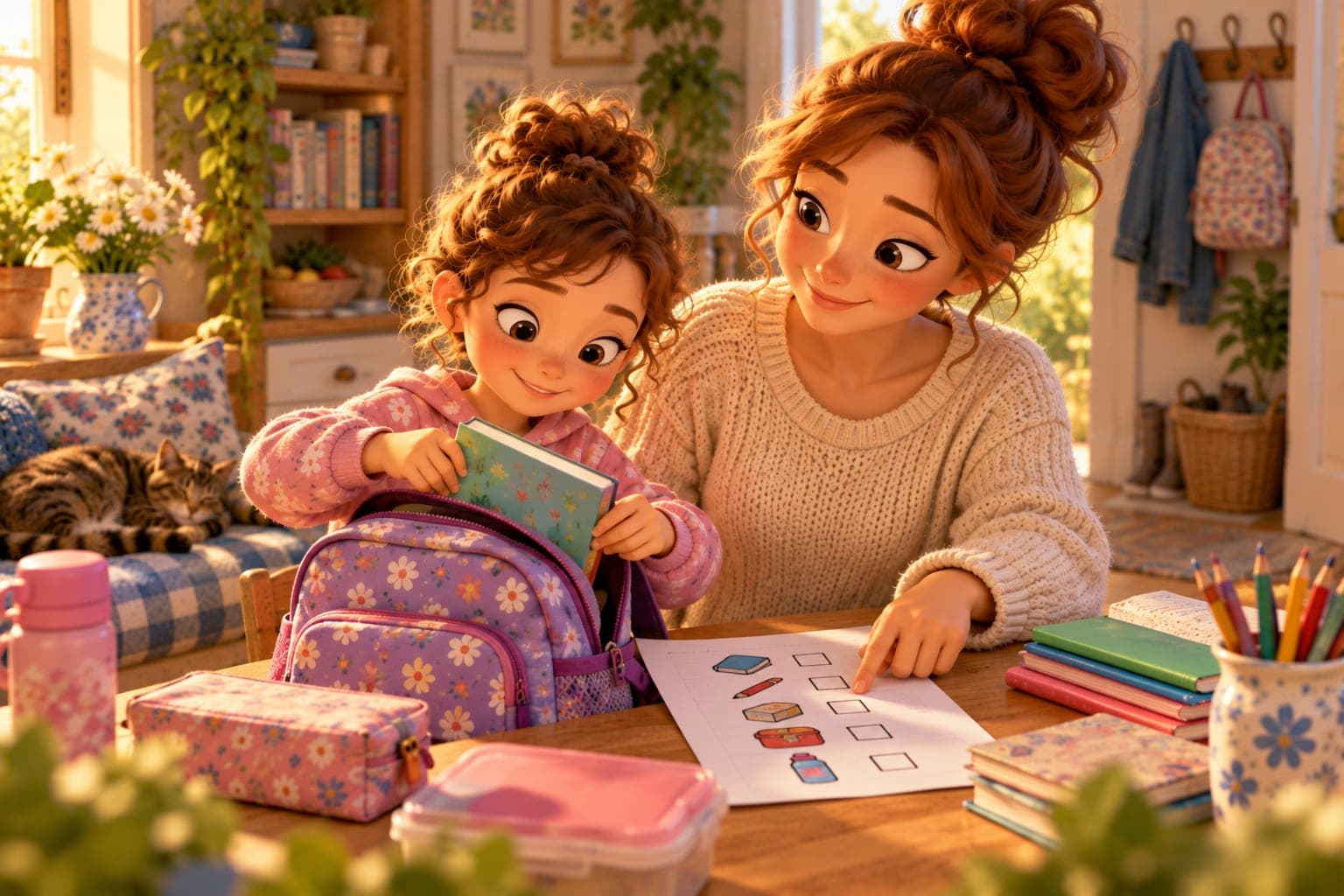
Independence reduces the small problems that use up attention at school. A child who knows where their notebook is, can check what is needed, and prepares supplies can start the real task more easily.
Three questions in the evening are enough:
- What do you have tomorrow?
- What do you need?
- Is everything in your school bag?
At first, a parent can check the plan together with the child. Then gradually hand over more of the steps.
In Labugen, you can also use the daily plan for children: it is designed for about 10 minutes, includes review, and gives a parent report. It should not replace the teacher’s guidance, but it can help maintain a short routine.
How Do You Work Out What Your Child Actually Needs?
Do not judge from one difficult evening. The best starting points are your child’s work, school feedback, and a conversation with the teacher.
Check:
- whether the same type of mistake appears several times;
- whether the teacher points to one specific difficulty;
- whether your child understands the instruction but works slowly;
- whether the problem is reading technique or understanding;
- whether the difficulty also appears when your child is rested.
The Education Endowment Foundation emphasises two-way communication between school and family and giving parents specific information about successes and next steps. Instead of practising “everything,” ask: “What one thing would make the biggest difference right now?”
For language and literacy practice, choose from English and literacy for Grade 1 / Year 2.
What Could a 15–20 Minute Weekly Routine Look Like?
Every day does not need to look the same. Returning regularly to the foundations matters more than completing lots of extra worksheets.
Day | Short Routine |
|---|---|
Monday | 10 min reading + 5 min school bag |
Tuesday | 10 min maths through play + short writing |
Wednesday | 10 min reading + 5 min hand skills |
Thursday | 10 min maths + 5 min organisation |
Friday | reading for pleasure or no extra practice |
Weekend | one short review only if it is needed |
If school has assigned homework or your child has a specific teacher recommendation, shorten this routine accordingly. Extra practice should not automatically add another full lesson.
What Should You Avoid After School?
A common mistake is turning home into a second classroom. A child in Grade 1 / Year 2 has already spent hours handling new expectations, social demands, and concentration.
Avoid:
- several long worksheets one after another;
- working ahead “just in case”;
- correcting everything at once;
- quizzing the whole day’s material every evening;
- adding work just because another child does more.
Short practice should respond to a real need. If your child reads confidently but struggles with simple calculations, spend more time on maths. If maths is secure but reading is effortful, a short daily text may be the priority.
When Should You Talk to the Teacher or Another Professional?
Talk to the teacher if the same difficulty continues for a longer period despite calm, short practice, or if your child clearly avoids one type of task.
Useful questions are:
- what the teacher observes in class;
- whether the difficulty affects one skill or several;
- which activity would be most useful at home;
- what not to add yet.
If the school also sees persistent difficulties and recommends broader support, discuss the next steps with appropriate school support staff, an educational professional, or a healthcare professional. Do not try to diagnose your child from a single homework task.
Sources
- Education Endowment Foundation, Working with Parents to Support Children’s Learning, 2018.
- Education Endowment Foundation, Parental engagement – Teaching and Learning Toolkit, accessed 2026.
- Minister Edukacji, Rozporządzenie z 11 marca 2026 r. w sprawie podstawy programowej wychowania przedszkolnego oraz podstawy programowej kształcenia ogólnego dla szkoły podstawowej, Dz.U. 2026 poz. 378, 2026.