
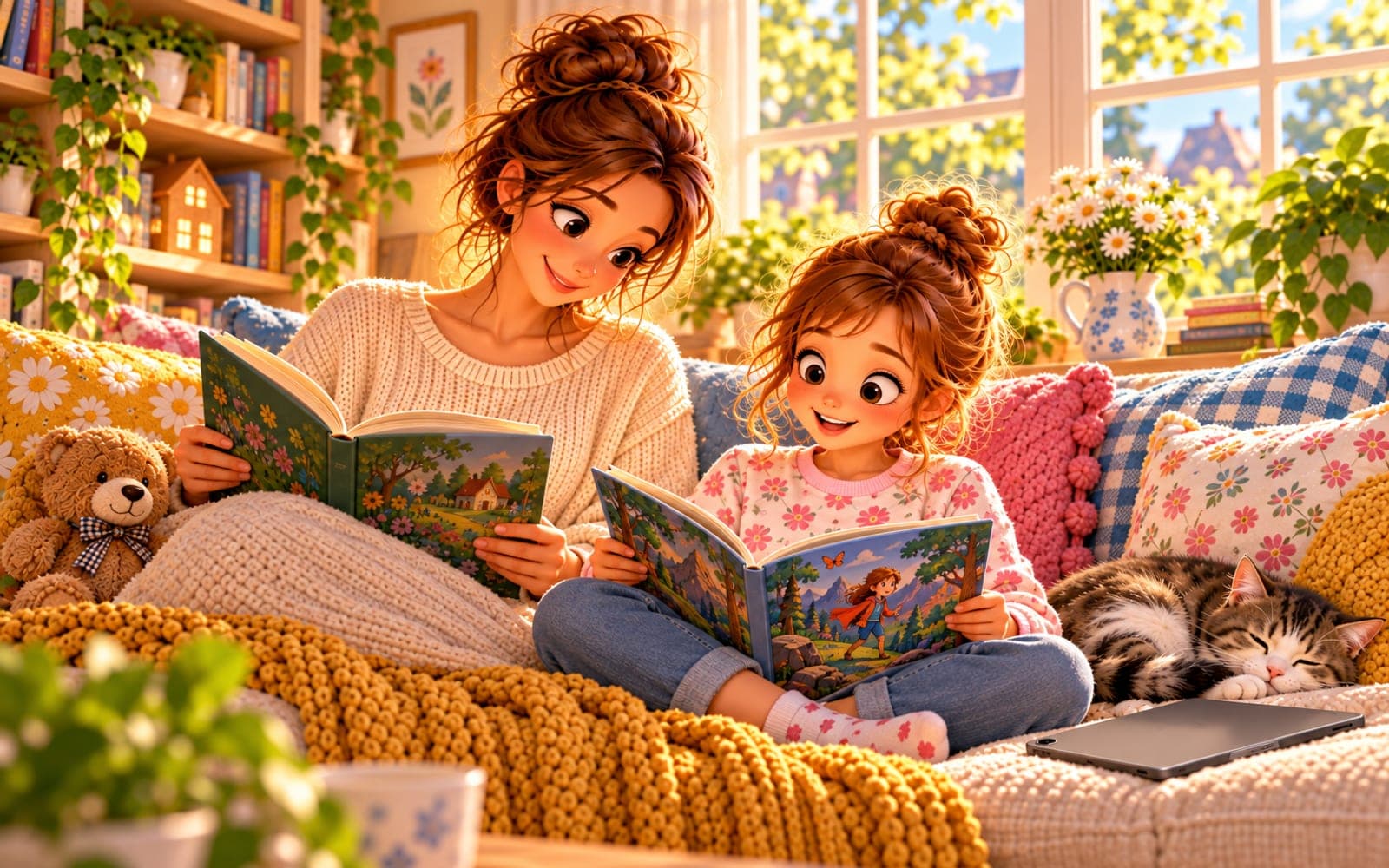
In short: how can you encourage a child to read when they prefer screens?
- Give reading a short, regular place in the day instead of negotiating it every time.
- Start with topics your child already enjoys in games, films and shows: favourite characters, sport, space or animals.
- Let your child choose the format: a book, comic, short text, e-book or an audiobook followed along with the printed text.
- Take turns reading if independent reading becomes tiring quickly.
- Do not pay for every page with screen time. Reading should be part of the day, not the price of a reward.
- If the resistance comes from difficulty with reading itself, return to the guide child won't read — what can you do.
Why do screens beat books so easily?
A screen is easy to start and immediately captures attention with movement, sound and changing images. A book asks for a calmer entry into the story, and a child who still reads slowly also has to work at recognising words and understanding sentences.
You do not need to create a war at home between books and screens. It is better to organise the day so that one does not crowd out the other. The American Academy of Pediatrics recommends family media rules, screen-free zones and room for other activities, including reading. Adult modelling matters too.
For a child aged 6–10, a useful starting point can be a short device-free window, for example after dinner or before the evening routine. If you also need to organise device rules, see screen time for children ages 4–9.
How can you organise the day so reading has its own place?
Choose one time you can repeat on most days. It does not need to be half an hour. At first, 10–15 minutes of calm reading is more practical than an ambitious plan that disappears after three days.
For example, after dinner phones stay away from the table, your child chooses a text, and the parent also picks up a book or reads together with the child. If evenings are difficult, move the routine to after school but before a game or show starts.
In Labugen, families can use the 10-minute daily plan, which includes review, badges and a parent report. A plan can organise learning, but it does not replace family reading for pleasure.

How can games, shows and films become a path towards books?
Screen interests can suggest what to read. The National Literacy Trust notes that personal interests, choice and books connected with films or television can support motivation to read.
Here are 9 ideas you can try without turning your home into a reading campaign:
- Find a book about the same world. Does your child love space stories? Try a short planet atlas, a science-fiction comic or an age-appropriate nonfiction book.
- Choose a character they already know from a screen. If there is a book or comic featuring a familiar character, the barrier to starting is lower.
- Offer a choice of two or three texts. “Which one do you want today?” usually works better than “You have to read this chapter.”
- Take turns reading. The parent reads a page and the child reads a paragraph or a few sentences. The story keeps moving even if the child reads more slowly.
- Choose short texts. A short story, fact page, comic or single encyclopedia page gives a quick sense of completion.
- Combine an audiobook with the text. Your child can listen while following the words on the page, especially when a longer story is still too hard to read independently.
- Stop at an interesting point. You do not have to push to the end of a chapter. Sometimes it is better to leave the story waiting for tomorrow.
- Talk, but do not quiz. Ask “Which scene was the strangest?” rather than testing details as if it were schoolwork.
- Show your own reading. A child is more likely to accept a routine that also applies to adults.

Can a screen become an ally for reading?
Yes, when the screen is used for reading rather than burying the text under more stimulation. The National Literacy Trust points out that print and digital formats coexist and that opportunities to read can be built in either format.
In Labugen, children around Grade 2 / Year 3 can use short online reading-comprehension texts, with similar materials for Grade 3 / Year 4. The texts are 60–120 words long, include 3–4 questions, keep the answers in the text and provide immediate feedback.
That is useful for a few minutes of practice, but do not turn it into another points-and-levels game. After a short online text, put the screen away and return to a paper book, comic or shared reading.
If your child is still blending words, a better starting point may be early decoding and word blending. Broader guidance on learning to read is also available in how to teach a child to read.
What can you do in a specific situation?
Situation | What to do | What to avoid |
|---|---|---|
Your child only wants a game or show | Look for a book, comic or facts about the same topic | Mocking the interest: “that game is silly” |
Your child puts the book down after 5 minutes | Choose a shorter text and agree on 10 minutes instead of a whole chapter | Extending the time because “that wasn't enough” |
Your child reads very slowly | Take turns: the adult reads a longer section and the child a shorter one | Correcting every word while they read |
Your child cannot choose a book | Offer two or three different formats | Imposing one book because “it's good for you” |
Your child only likes screens | Use a short online text and then move to a paper text | Turning reading into a stream of rewards and animations |
Your child protests every time | Check whether the reading level or decoding itself is the problem | Comparing them with siblings or classmates |
What does a simple 2-week plan look like?
The goal of the first two weeks is not a page count. It is to build a predictable routine and find a format your child wants to return to.
Days 1–3: set a regular 10-minute time. Your child chooses from two or three short texts. The parent stays nearby and does not use a phone.
Days 4–5: add turn-taking. The parent can take over the harder sections so the story does not get stuck on decoding.
Days 6–7: visit a library or choose a new book, comic or nonfiction title together based on your child's interests.
Days 8–10: use one day for a short online text with questions and the others for paper or an e-book without extra distractions.
Days 11–12: try an audiobook while following the text, or read aloud together.
Days 13–14: ask your child what they want to keep next week: the time, format and topic. Keep what works instead of adding more rules.
What mistakes should you avoid when books are losing to screens?
The most common mistake is making reading a ticket to screen time: “20 minutes of reading and then you can play.” That easily puts books on the chore side and screens on the reward side.
Also avoid rewards for every page, books that are too difficult, correcting every stumble and treating comics as if they were not “real reading.” Do not remove every screen from the day solely to force a book. Predictable order and room for different activities matter more.
When should you talk to a teacher or specialist?
Talk to the teacher when your child not only chooses a screen over a book but also becomes noticeably tired when reading age-appropriate text, frequently loses their place, has major difficulty recognising words or cannot understand a short passage they have read.
This is not a diagnosis. A teacher can compare what happens in class and suggest whether further support from a reading, language or child-development professional may be useful. If the main issue is resistance, frustration or decoding difficulty, return to the separate guide child won't read — what can you do.
Sources
- American Academy of Pediatrics, How to Make a Family Media Plan, updated 2026.
- National Literacy Trust, Reading for Pleasure, data and guidance updated in 2026.
- National Literacy Trust, Trends in children and young people's reading in print and digital formats, 2026.