
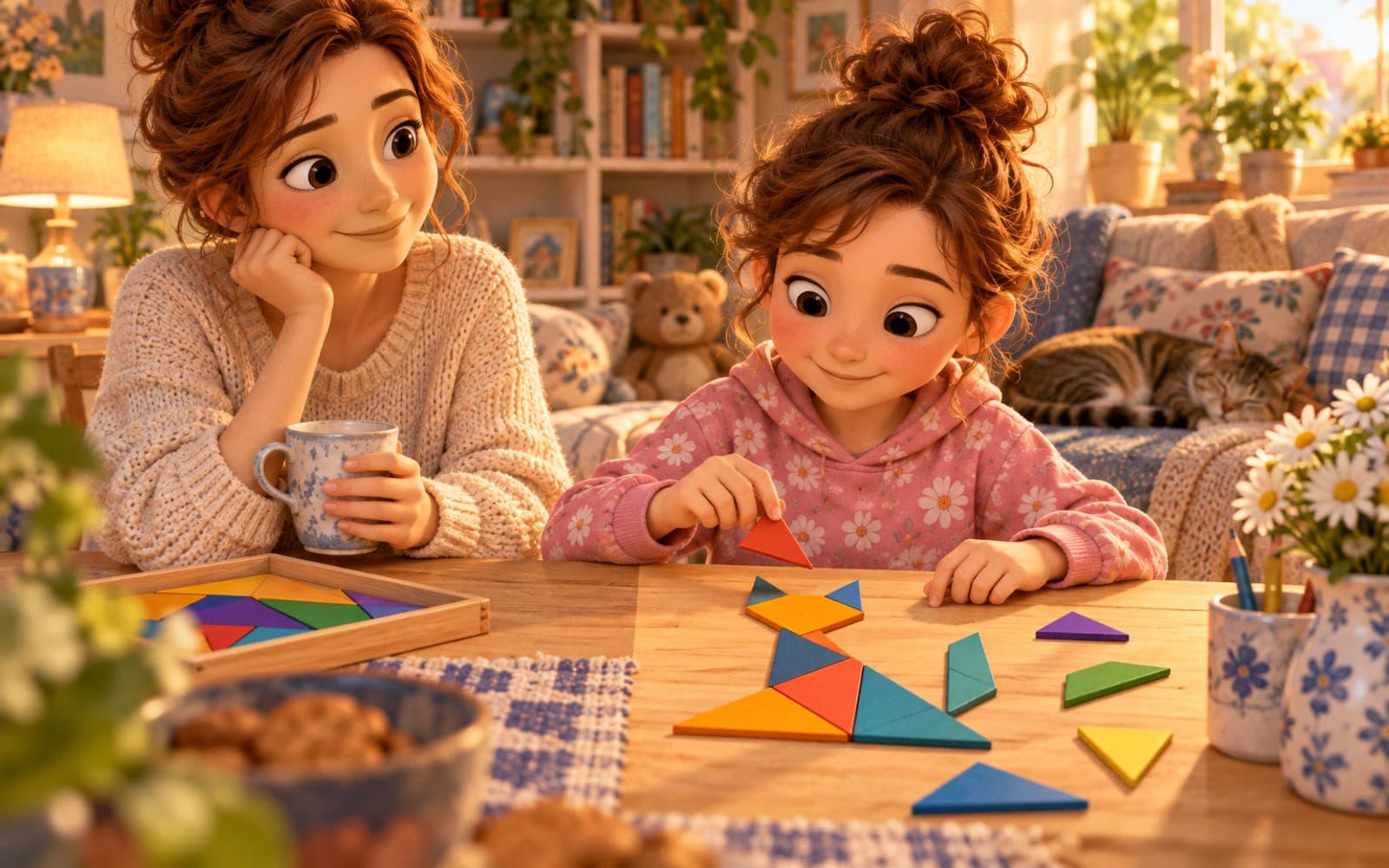
How Do You Use Maths Puzzles So Your Child Really Thinks?
The best puzzle is not a speed test. It asks your child to notice a rule, form a hypothesis, test it, and explain the solution. NRICH describes this kind of mathematical thinking through exploring, working systematically, visualising, generalising, and justifying.
In short:
- start with a puzzle that is slightly harder than routine practice but still gives your child a way to begin independently;
- give your child time to try their own idea before offering a hint;
- ask “What do you already know?”, “What can you rule out?” and “How will you check?”;
- after solving it, ask for a short explanation of why the answer is correct;
- stop before boredom turns into a string of random guesses.
If your child enjoys paper puzzles, try the sudoku generator for kids or maze generator. In Labugen sudoku, you can choose 4×4, 6×6 or 9×9 grids, numbers or pictures, and one of three difficulty levels. Each puzzle has one solution, with a separate answer key.
Which Maths Puzzles Work Well for Grade 1–3 / Year 2–4?
For Grade 1–3 / Year 2–4, roughly ages 6–9, short puzzles based on pictures, real objects, and simple rules work best.
4×4 picture sudoku. Suppose each row and column must contain exactly one cat, owl, fish, and butterfly. One row already has a cat, owl, fish, and an empty space. The missing picture is the butterfly. Check it twice: the row then has four different pictures, and the butterfly must not be duplicated in its column. You can also use ready-made 6×6 picture sudoku.
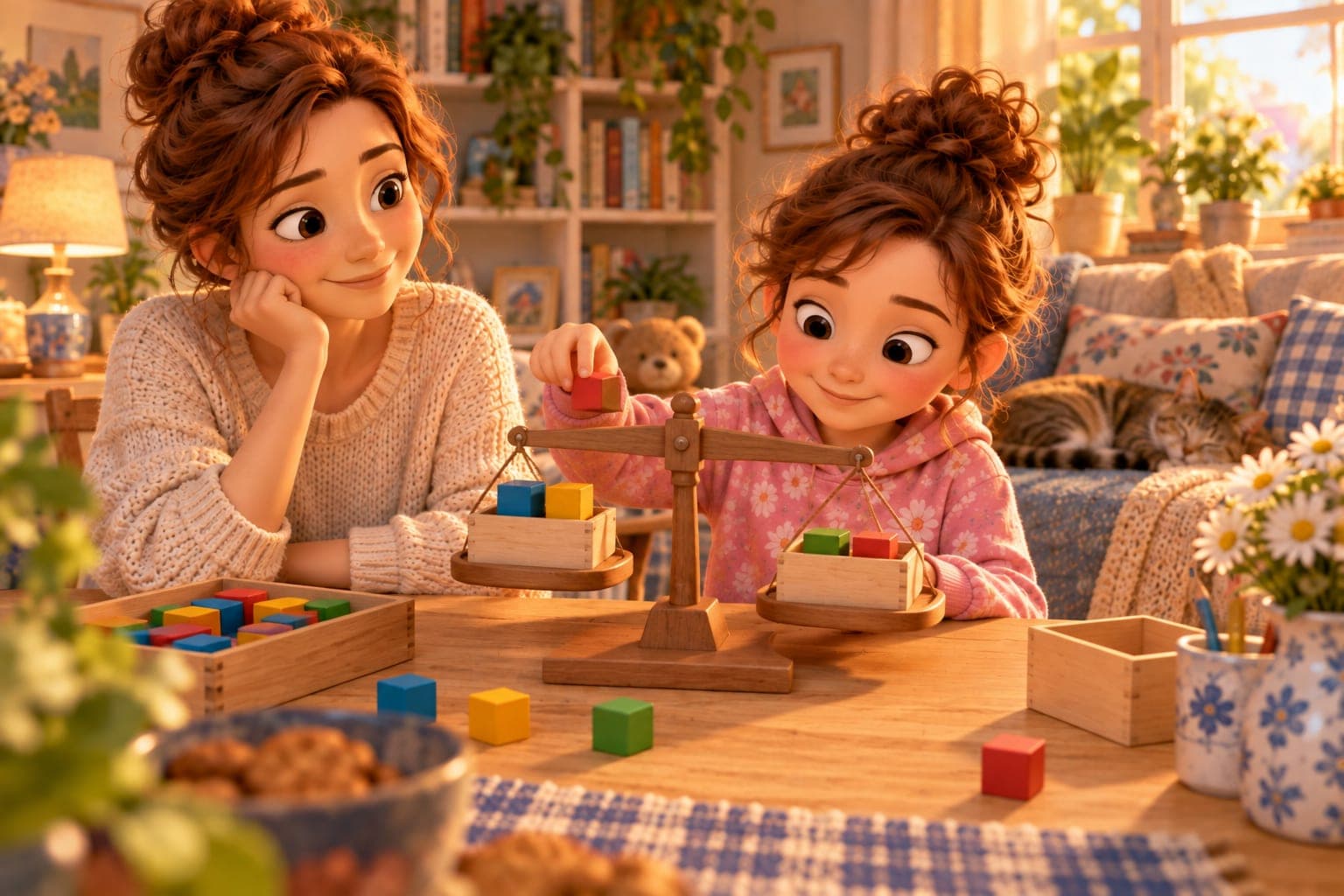
Balance puzzle. Two identical apples balance 8 blocks. How many blocks equal one apple? If 2 apples = 8 blocks, then one apple = 4 blocks. Check: 4 + 4 = 8.
Number sequence. 2, 4, 6, 8, ? The rule is add 2, so the next number is 10. Check backwards: 10 − 2 = 8.
At this stage, speed is not the goal. Your child should be able to explain how they noticed the rule.
Which Puzzles Work Well for Grade 4–6 / Year 5–7?
For Grade 4–6 / Year 5–7, roughly ages 9–12, you can increase the number of conditions and introduce problems that require several planned steps.
3×3 magic square. A classic arrangement is:
8 | 1 | 6 |
|---|---|---|
3 | 5 | 7 |
4 | 9 | 2 |
Each row, column, and diagonal totals 15. Check: 8+1+6=15, 3+5+7=15, 4+9+2=15; the columns total 15, 15 and 15, and the diagonals 8+5+2=15 and 6+5+4=15. This is a good example of a puzzle where the child is looking for structure, not just calculating.
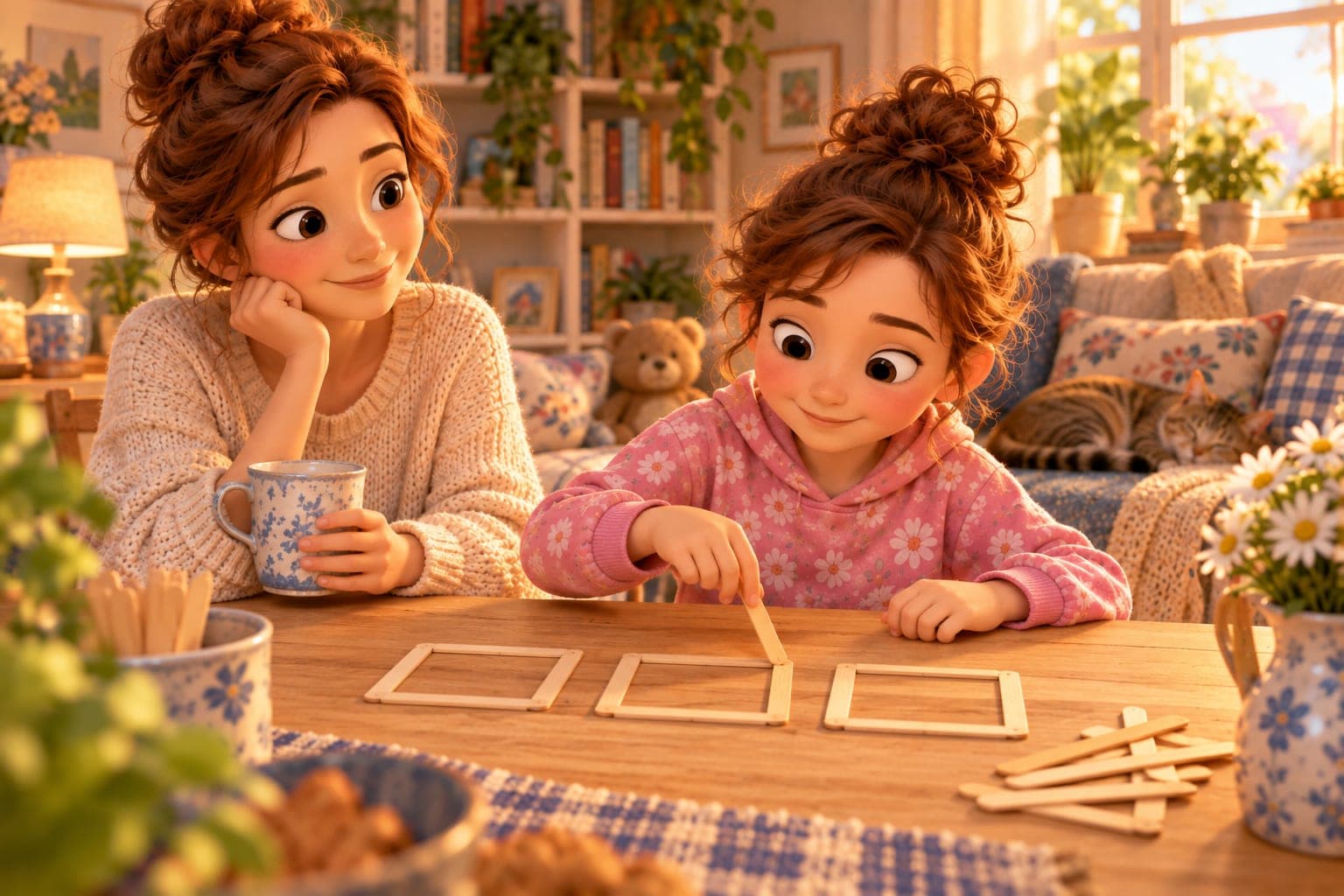
Matchsticks. Arrange 12 matchsticks as four small squares in a 2×2 grid. Remove two matchsticks so exactly two small squares remain. Solution: remove the outer top matchstick of the top-left square and the outer bottom matchstick of the bottom-right square. Two complete diagonal squares remain, while the large outer square is broken.
How Many Triangles? Divide one large triangle into four equal small triangles: three point upwards and one is inverted in the centre. There are 4 small triangles plus 1 large triangle, making 5 altogether. Check: there is no additional medium triangle with three complete sides.
For a student in Grade 3 / Year 4 or above, a useful next step is easy 9×9 sudoku.
Which Puzzles Build Logic in Grade 7–8 / Year 8–9?
Older students can work with puzzles that require writing relationships, ruling out possibilities, and justifying every step.
Who Is Lying? Anna says: “Ben is lying.” Ben says: “Chloe is telling the truth.” Chloe says: “Anna is lying.” Exactly one person is lying. Solution: Anna is lying. If Anna’s statement is false, Ben is telling the truth; his statement then means Chloe is also telling the truth. Chloe’s statement, “Anna is lying,” matches the assumption. So there is exactly one liar.
Algebraic thinking. If three identical boxes and 2 blocks weigh the same as 14 blocks, write 3x + 2 = 14. Subtract 2: 3x = 12. Divide by 3: x = 4. Check: 3 × 4 + 2 = 14. These puzzles are a natural bridge to algebra in Grade 6 / Year 7 and equations in Grade 7 / Year 8.
Rotating pipes. If a straight pipe segment is vertical while the inlet and outlet are on the left and right, rotate it by 90°. After one quarter-turn, the pipe lies horizontally and connects both ends. In Labugen’s Waterworks your child rotates pipes across the whole board; every layout is solvable and there is no timer.
How Do You Give Hints Without Taking Away the Solution?
A hint should trigger the next step, not provide the answer. The Education Endowment Foundation recommends supporting students in planning, monitoring, and evaluating their own approach.
Instead of “Put 5 here,” ask:
- “What do you know for certain?”
- “Which option can you rule out, and why?”
- “Can you work backwards?”
- “How could you draw the situation?”
- “How can you check the answer in a second way?”
If your child is stuck, make the problem smaller. Cover part of the grid, give one condition, or complete the first step together. Then hand the problem back to your child.
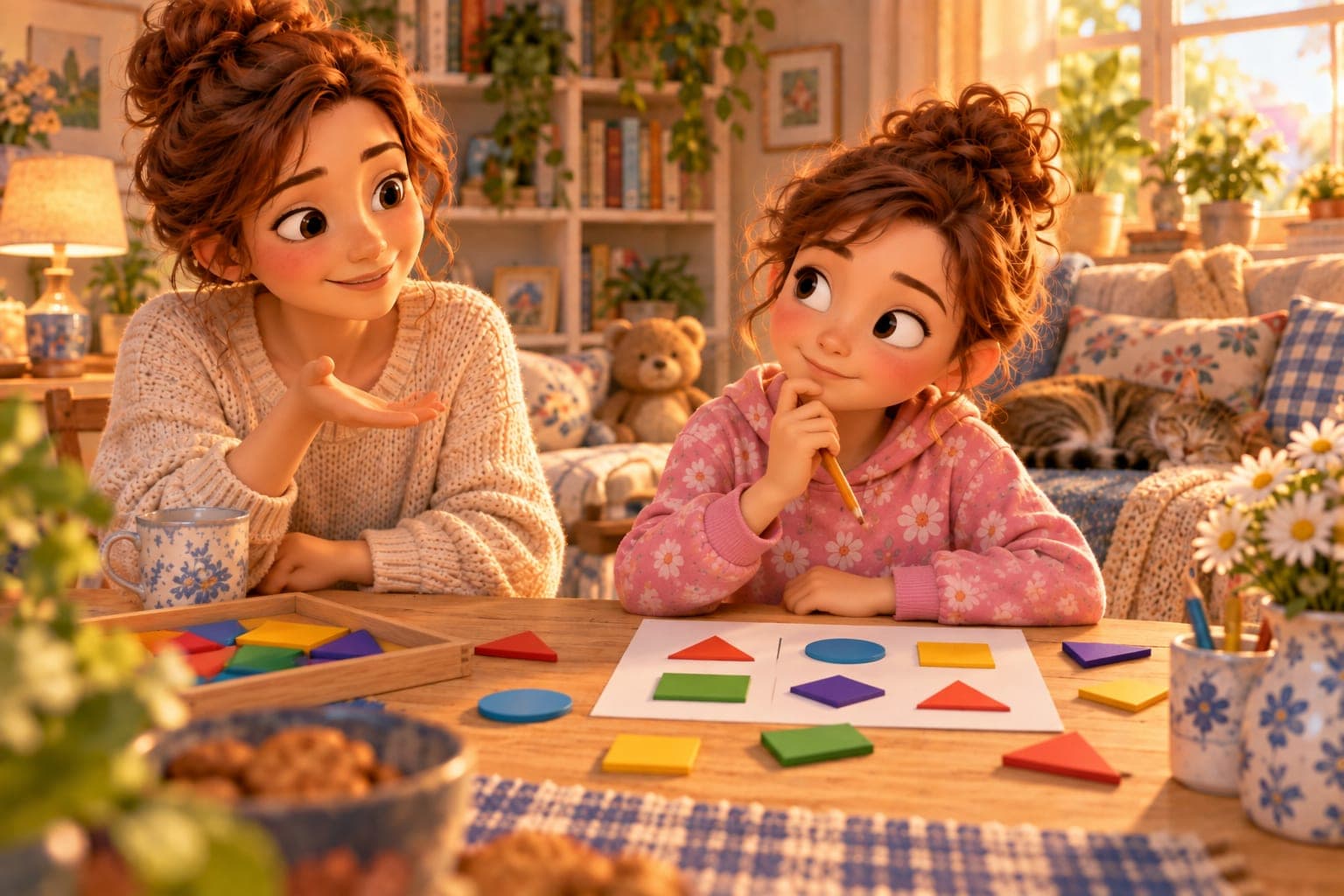
How Long Should a Child Spend on a Puzzle, and What About Frustration?
One short puzzle can be enough for a session. Do not impose a compulsory time limit when the goal is reasoning. Speed pressure can turn strategy-building into guessing.
If your child starts making random attempts, take a break or return to the last step you know is correct. A useful question is: “What do we know for certain?”. You can also switch to educational games for children if paper puzzles are becoming tedious.
What Do Different Puzzles Develop?
Puzzle | Typical Stage | Main Skill |
|---|---|---|
4×4 picture sudoku | Grade 1–3 / Year 2–4 | elimination and rule-following |
balance puzzles | Grade 1–4 / Year 2–5 | equivalence and relationships |
number sequences | Grade 1–6 / Year 2–7 | pattern recognition |
3×3 magic square | Grade 4–6 / Year 5–7 | systematic checking |
matchsticks and shape puzzles | Grade 4–6 / Year 5–7 | spatial visualisation |
counting triangles | Grade 4–7 / Year 5–8 | part–whole analysis |
“who is lying?” | Grade 7–8 / Year 8–9 | reasoning from conditions |
equation puzzles | Grade 6–8 / Year 7–9 | algebraic thinking |
rotating pipes | Grade 1–8 / Year 2–9 | planning and predicting consequences |
These stages are approximate. The same puzzle can be simplified or extended by changing the number of conditions.
What Mistakes Most Often Put Children Off Puzzles?
- Starting too hard: your child cannot see even the first possible move.
- Giving the solution after a few seconds instead of asking a useful question.
- Praising only speed rather than the reasoning process.
- Giving a long series of nearly identical puzzles after one success until the activity becomes routine.
- Not checking the answer. In a puzzle, “I’ve got it” matters less than “I know why it works.”
Well-chosen puzzles complement school maths because they require familiar ideas to be used in situations without a ready-made procedure. NRICH emphasises logical reasoning, systematic work, and explaining ideas, while the Education Endowment Foundation recommends analysing problem-solving strategies and discussing why a method works.
Sources
- NRICH, University of Cambridge — Thinking Mathematically: Primary Students, accessed 2026.
- NRICH, University of Cambridge — Developing Mathematical Thinking: Explaining, Convincing and Proving, accessed 2026.
- Education Endowment Foundation — Improving Mathematics in Key Stages 2 and 3, 2017.
- Education Endowment Foundation — Metacognition and Self-Regulated Learning, 2nd edition, 2025.