
In Short: What Can Children Learn From Maths Games With Blocks?
- Counting and comparing: more, fewer, the same.
- Patterns and sequences: red, blue, red… what comes next?
- Shapes and symmetry: a construction whose left side mirrors the right.
- Measurement: how many blocks tall is the chair?
- Spatial thinking: rebuild a tower from a drawing or from memory.
Ordinary wooden or plastic blocks and 10 minutes a day are enough.
Why Are Blocks Useful for Learning Maths?
Blocks can be touched, moved, and counted again. A child can see a quantity rather than only hear a number. The Education Endowment Foundation’s guidance on early mathematics recommends thoughtful use of manipulatives, including blocks, because they help children represent mathematical ideas and show how they are thinking.
The important word is “thoughtful.” Building a tower is valuable play in itself, but it becomes a focused maths activity when you add a purposeful question.
Counting and Comparing Games for Ages 4–6
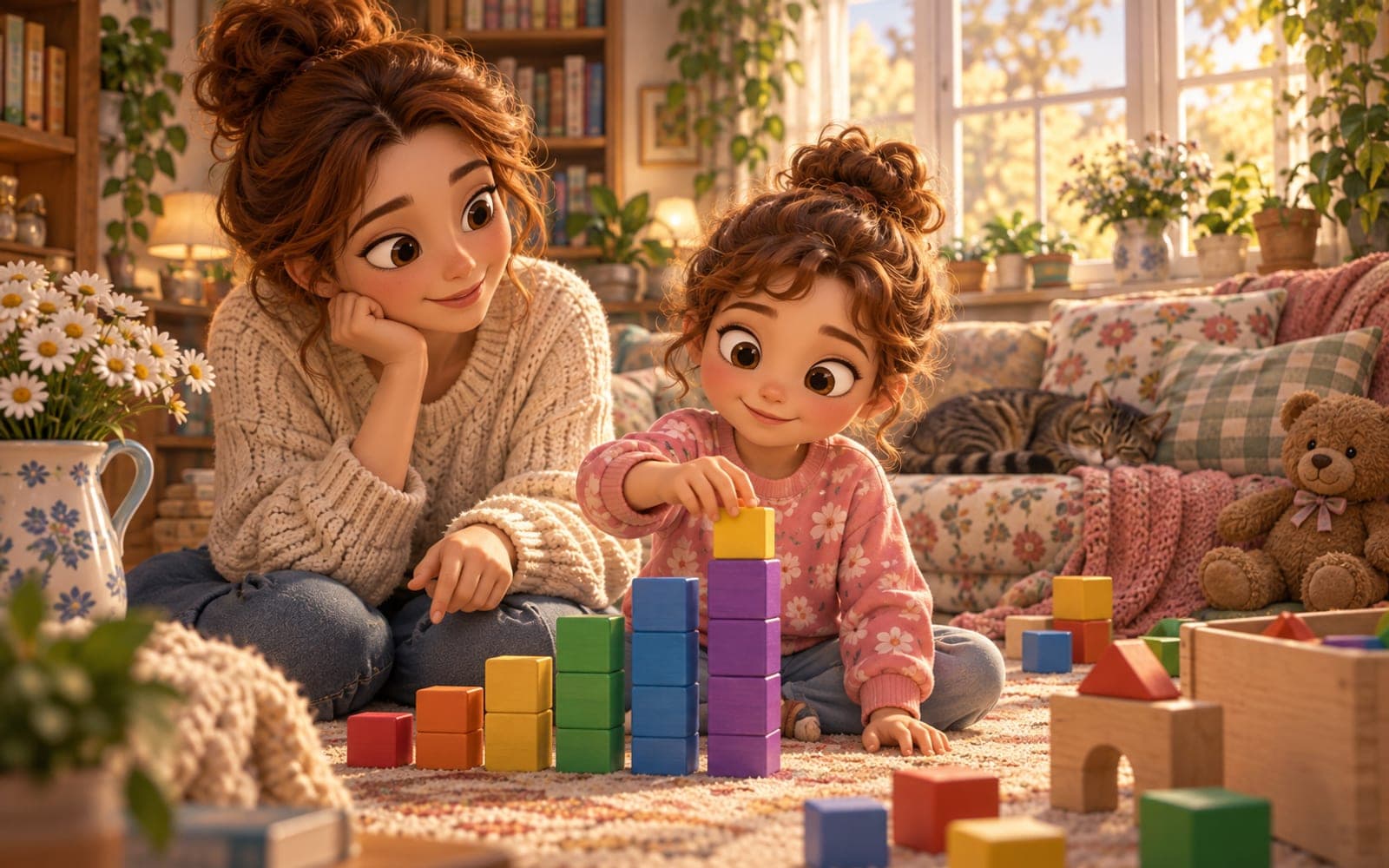
- Number Towers: build towers of 1, 2, 3, 4, and 5 blocks and arrange them from shortest to tallest. The staircase gives a visual model of consecutive numbers.
- More or Fewer? Put two towers side by side. Which is taller? How many blocks taller is it?
- Roll the Dice: roll a die and add that many blocks to a tower. Who reaches a tower of 15 blocks first?
- The Same Number: make a row of 6 blocks. Your child builds an equal row underneath, matching one block to one block.
For ready-made online comparison practice, see comparing numbers, and for more counting play see how to teach a child to count to 10.
Pattern and Sequence Games for Ages 4–7
Recognising and extending patterns is an early foundation for later algebraic thinking.
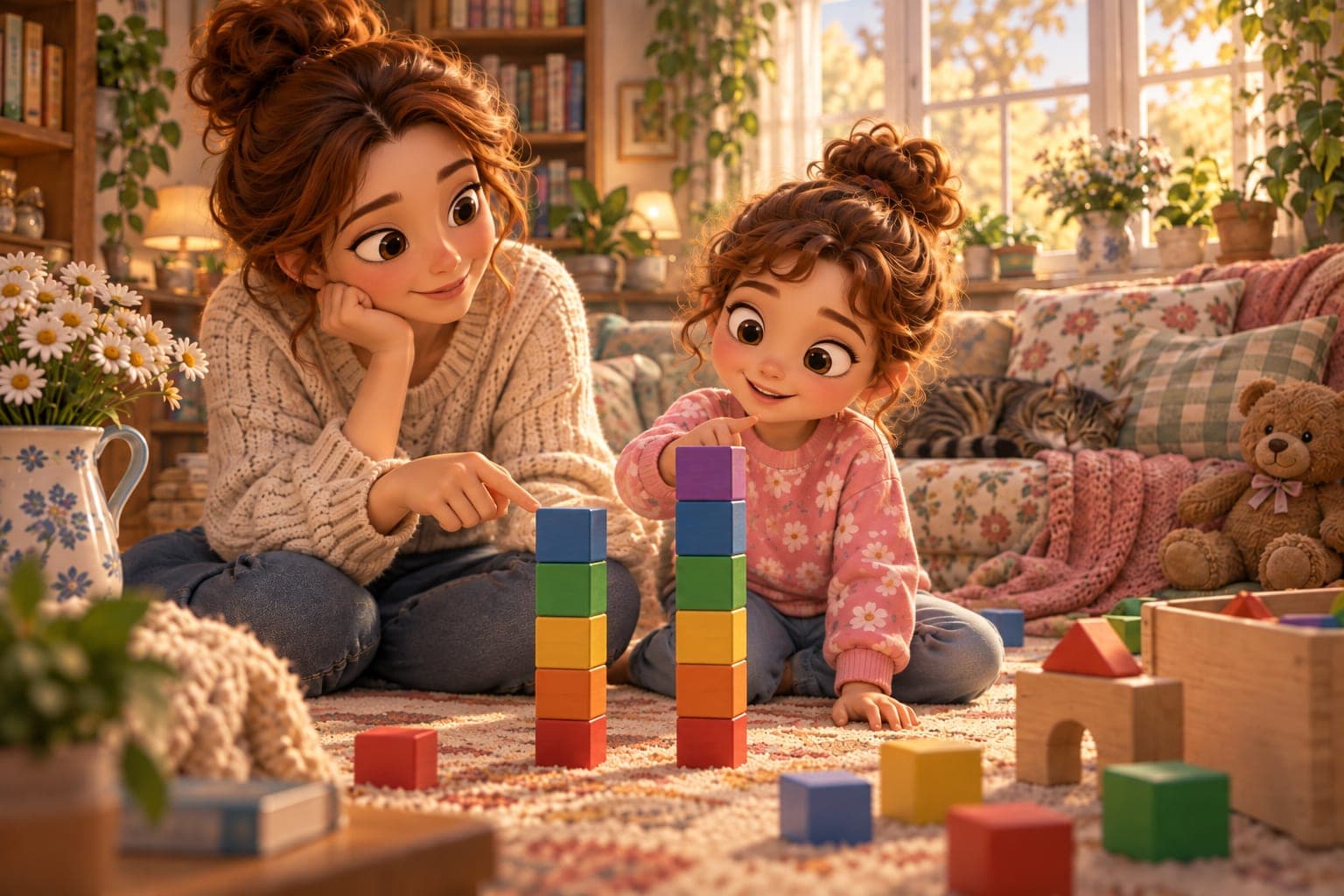
- Color Train: make “red, blue, red, blue” and ask your child to add the next three carriages.
- Find the Mistake: one block breaks the pattern. Your child finds it and fixes it.
- Harder Pattern: try “red, red, yellow” or a repeating sequence of three colors.
- Shape Pattern: cube, cylinder, cube, cylinder.
Older children can invent a pattern and let you guess what comes next. Reversing roles often makes the game more engaging.
Shape and Symmetry Games for Ages 5–8
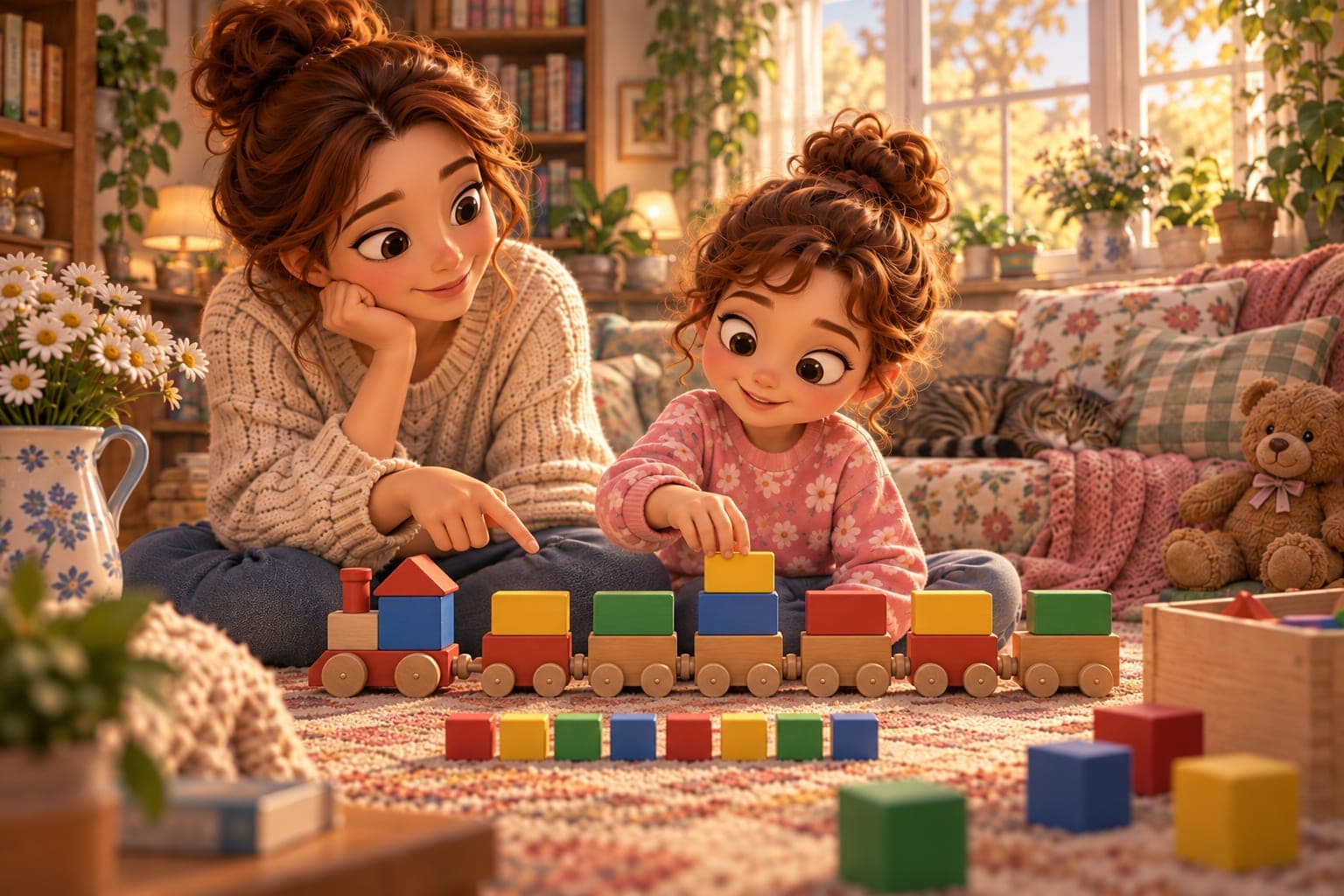
- Mirror: place a piece of string on the table as the “mirror line.” Build a shape on one side; your child builds its reflection on the other.
- Build From a Drawing: draw a simple construction made from 5–6 blocks and ask your child to copy it.
- Build From Memory: show a structure for 10 seconds, cover it with a cloth, and ask your child to rebuild it.
- Shape Detective: look around the home for objects shaped like cubes, rectangular prisms, and cylinders.
Measurement Games for Ages 6–8
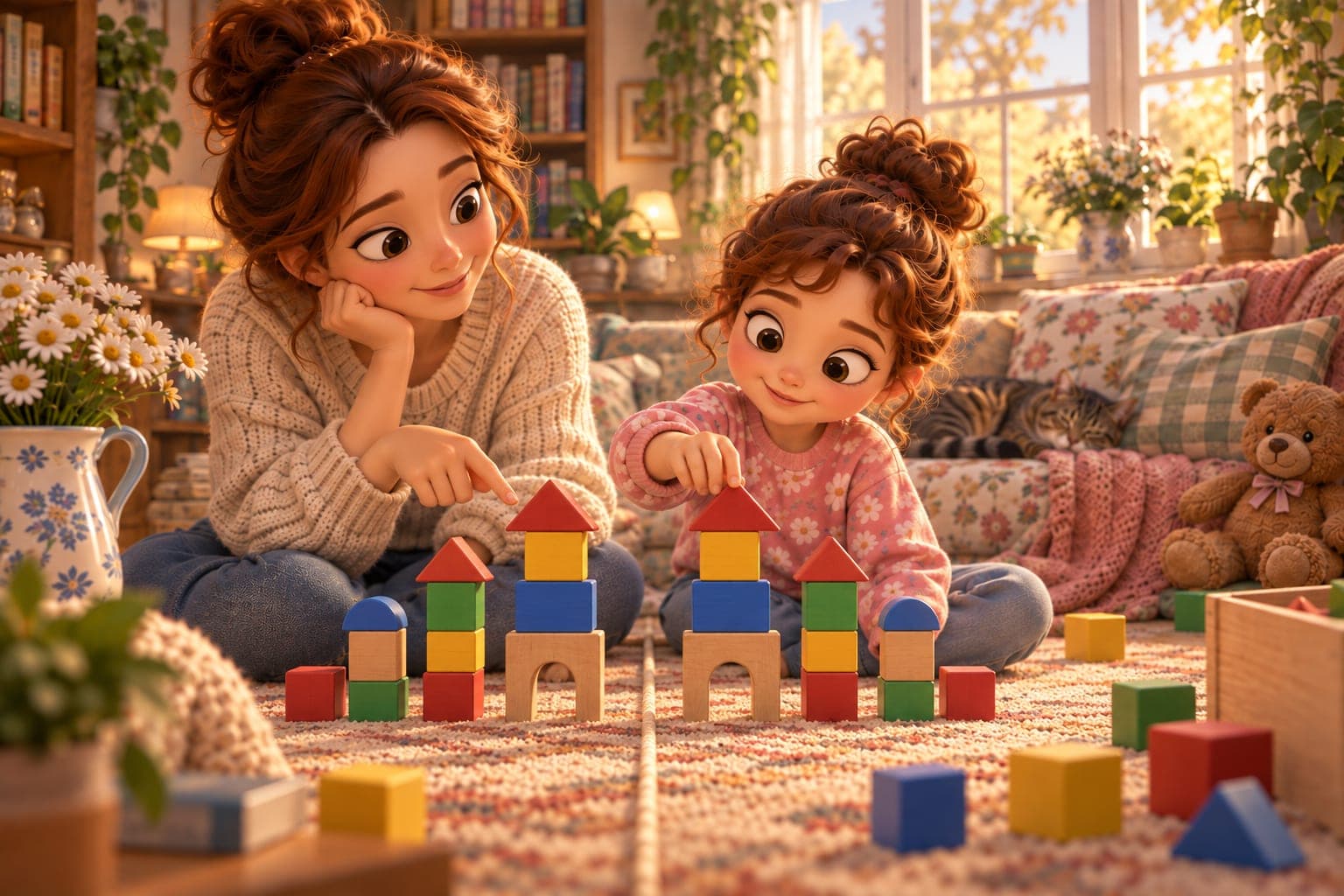
- How Many Blocks Tall Is the Chair? Measure the height of a chair, table, and teddy bear using blocks stacked as a tower.
- A Block as a Unit: which toy car is two blocks longer?
- Estimate and Check: first estimate how many blocks will fit across a plate, then test the estimate.
Estimating before measuring or counting is a useful habit that later helps children judge whether calculation answers are reasonable.
A One-Week Plan: 10 Minutes a Day
Day | Activity | Skill |
|---|---|---|
Monday | number towers | counting and order |
Tuesday | color train | patterns and sequences |
Wednesday | more or fewer | comparison |
Thursday | mirror | symmetry |
Friday | how many blocks tall is the chair? | measurement and estimation |
The following week, make each activity slightly more challenging. After block play, you can move to paper: create calculations and patterns with the maths worksheet generator, and find counting pictures in numbers and counting.
How Can Siblings of Different Ages Play With the Same Blocks?
Give each child a task at their level using the same structure. A 4-year-old can count the blocks in a tower, while a 7-year-old works out how many more are needed to reach twenty or builds a mirror image. They play together while practising different skills. The older child can also invent patterns for the younger one, reinforcing their own understanding.
What Questions Should You Ask During Block Play?
Questions turn building into mathematical thinking. Keep a few reusable prompts ready:
- “How many blocks do you need? Check.”
- “How do you know this tower is taller?”
- “What comes next in the pattern? Why?”
- “Can you build it another way using the same number of blocks?”
- “How many more do you need to make ten?”
“I don’t know” is an acceptable answer too. Then you investigate together.
What Mistakes Should You Avoid?
- Correcting your child’s construction. Ask how they made it instead.
- Too many rules at once. Focus on one mathematical idea per game.
- Counting without touching or moving. Younger children benefit from matching each number word to one block.
- Moving to worksheets too early. Start with blocks, then draw it, and only then use written symbols.
- Turning it into sibling competition. The goal is enjoyable thinking, not a ranking.
When Should You Talk to the Teacher?
If a school-age child repeatedly loses track while counting a few blocks, cannot compare which of two towers is taller, or becomes very distressed during simple number activities, talk with the teacher. Sometimes more time and hands-on materials are enough; if concerns persist, ask what educational or developmental support is available locally.
Sources
- Education Endowment Foundation — Improving Mathematics in the Early Years and Key Stage 1 (recommendations for teaching mathematics to children aged 3–7, 2020).
- Ośrodek Rozwoju Edukacji — Podstawa programowa wychowania przedszkolnego i edukacji wczesnoszkolnej z komentarzem (2017).