

In Short: When Does a Coloring Page Teach, and When Does It Just Fill Time?
- It teaches when it has one clear task linked to the lesson goal: read, calculate, match, or complete.
- It fills time when it is simply a reward “for anyone who finishes” and nothing follows from it.
- It works best briefly: 5–10 minutes as an introduction, review, or quick check for understanding.
- The result can be checked: the teacher can immediately see who calculated correctly and who confused the letters.
Why Use Educational Coloring Pages in Grade 1–3 / Year 2–4?
Children in Grade 1–3 / Year 2–4, roughly ages 6–9, still learn well through hands-on action and visual information. An educational coloring page combines both with lesson content: the child has to read, calculate, or recognise something before choosing a color. For the teacher, it can also be a quick way to see who understands the topic without adding another quiz.
Curriculum frameworks such as the National Curriculum in England combine subject knowledge with practical activity and problem solving in the early primary years. A well-designed coloring task can support that work when the task clearly serves the learning goal rather than simply keeping the class busy.
What Tasks Can You Build Into a Coloring Page?
Area | Task on the Coloring Page | What You Are Checking |
|---|---|---|
Reading | color green the spaces with words beginning with “c” | initial sounds and word reading |
Spelling | color words with one target spelling pattern yellow and another blue | spelling patterns in familiar words |
Maths | the color depends on the answer to a calculation within 20 | addition and subtraction |
Geometry | triangles red, squares blue | shape recognition |
Science | color only the animals that hibernate | knowledge from the current topic |
Reading comprehension | color only what is described in the short text beside the picture | understanding details |
You can find ready-made pictures with letters and numbers in alphabet and letters and numbers and counting. Dot-to-dot activities are also useful for practising number order and can be created with the dot-to-dot generator.

How Do You Fit a Coloring Page Into a Lesson Without Replacing the Lesson?
A coloring page works best at a specific point in the lesson. Three useful formats are:
- Lesson opener, 5 minutes. Use a picture linked to the new topic, for example an autumn tree before a lesson about seasons. Students color it and answer one question: “What has changed on this tree?”
- Review, 10 minutes. After teaching addition within 20, students color by answer. The teacher circulates and can immediately spot errors in specific spaces.
- Check for understanding, 5–8 minutes. At the end of the lesson, give a short text and picture: students color only what the text mentions. Keep the page as a simple record of progress.
In each version, the coloring should end with a quick discussion or check. Without that step, it becomes mainly an art activity.
Example: A Coloring Page in a Lesson on Addition Within 20
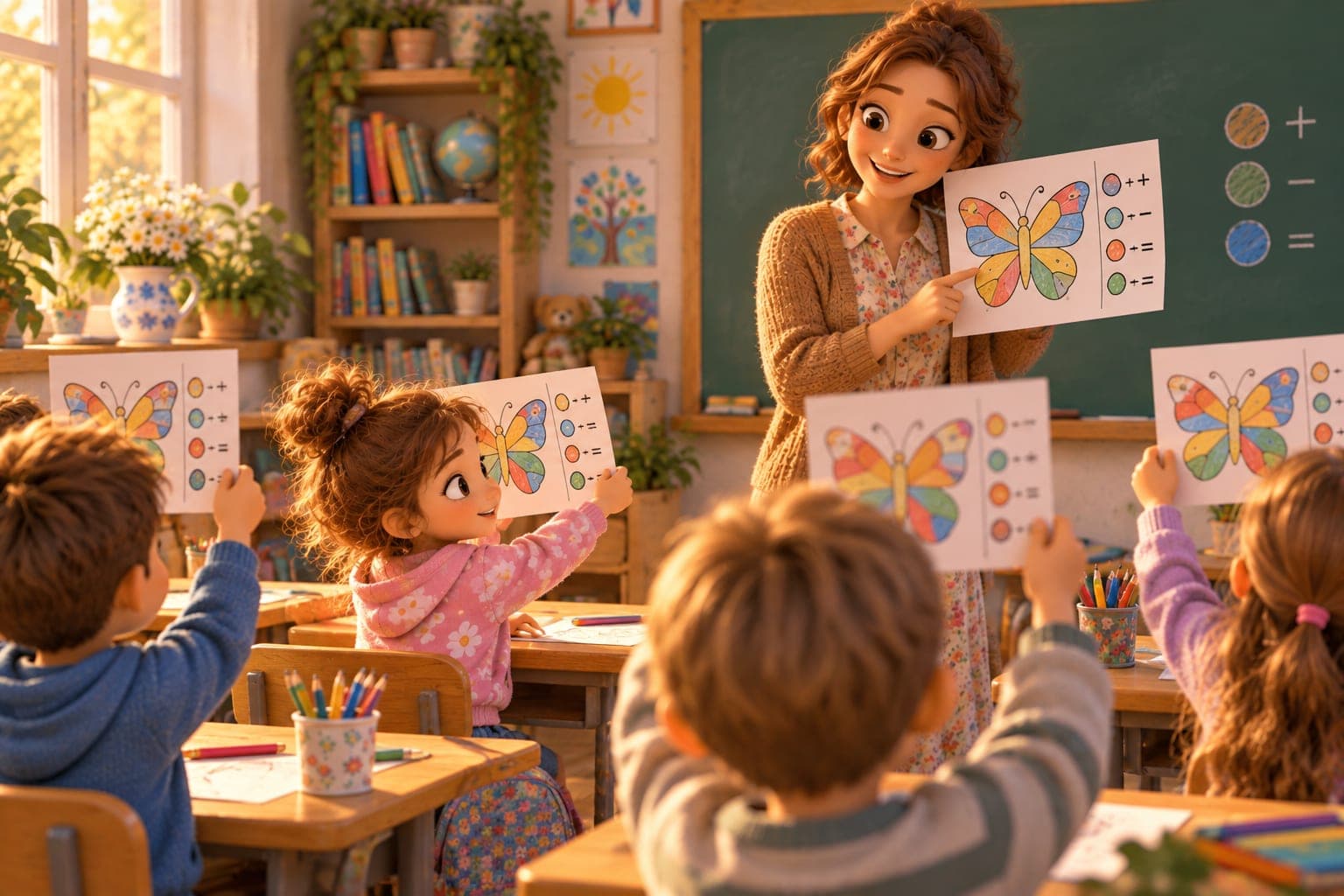
Grade 2 / Year 3, topic: addition across 10. Students receive a meadow picture with 12 sections. Each section contains a calculation such as 8 + 5 or 9 + 6. A key says: answer 13 = green, 14 = yellow, 15 = blue. After 8 minutes, the teacher asks which section was hardest, and two students show their method at the board. The picture also provides a visual check: if a student gets an answer wrong, the color may not fit the surrounding pattern, prompting them to review the calculation.
How Do You Adjust Difficulty by Grade?
- Grade 1 / Year 2: large spaces, 5–8 elements, tasks using a single letter, simple phonics pattern, or numbers to 10. A name coloring page can work well early in the year; make one with the name coloring page generator.
- Grade 2 / Year 3: 10–20 spaces, words rather than individual letters, calculations within 20 including crossing 10.
- Grade 3 / Year 4: smaller sections, a short text to read, calculations within 100, and first simple logic puzzles.
Within one class, it can help to have two versions of the same page. A student who finishes quickly gets a more challenging version rather than another page simply to stay busy. For more on how coloring-page difficulty changes with age, see coloring pages for 6-year-olds.
How Do You Assess the Work Without Assessing the Colors?
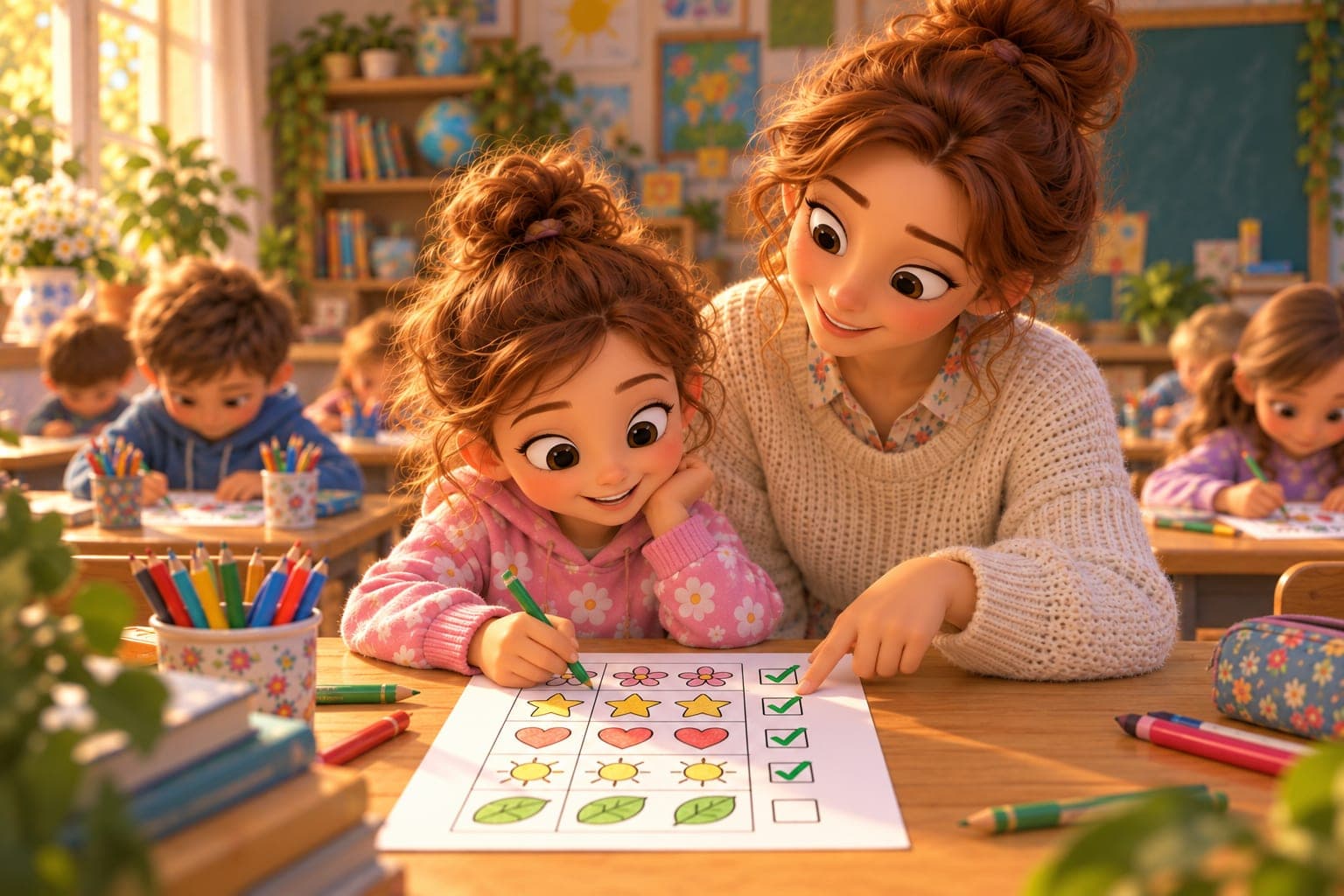
Assess the learning task, not the artwork. Color choice, going outside the lines, or leaving the background unfinished does not matter if the spaces linked to correct answers are identified accurately. A simple approach is:
- a green tick beside each correctly solved section,
- a dot beside a section to revisit, without crossing it out,
- brief verbal feedback : “Your addition is correct; check the subtraction spaces once more.”
A completed coloring task can also support a conversation with a parent because it shows specifically what the child can already do.
What Mistakes Should You Avoid?
- Using a coloring page as a reward for fast finishers with no learning task. It teaches that finishing quickly earns “free time” rather than extending learning.
- Too many instructions on one page. One learning task per picture is enough.
- Pictures with text that is too difficult to read independently in Grade 1 / Year 2. Read the instruction aloud when needed.
- Coloring for the whole lesson. After 10–15 minutes, the task may stop serving the learning goal.
- Assessing neatness instead of content. Students with weaker fine-motor control can lose motivation even when they understand the lesson.
Materials for whole-class use and home practice are available in the for teachers section.
Sources
- Ośrodek Rozwoju Edukacji — Podstawa programowa wychowania przedszkolnego i edukacji wczesnoszkolnej z komentarzem (2017).
- Internetowy System Aktów Prawnych — Rozporządzenie Ministra Edukacji Narodowej z 14 lutego 2017 r. w sprawie podstawy programowej… (Dz.U. 2017 poz. 356).