
Where Should You Start When Teaching Subtraction?
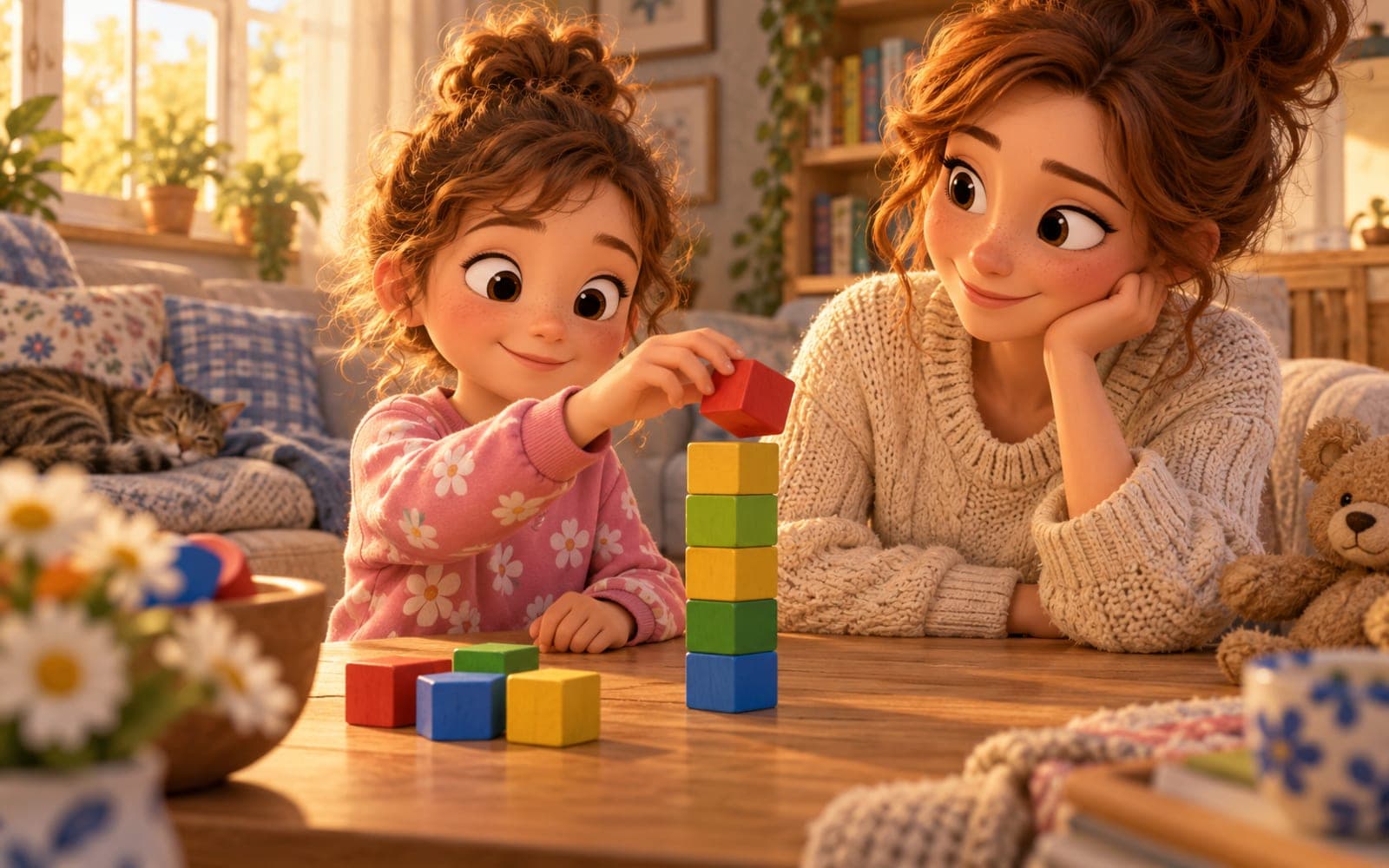
First, your child needs to see that subtraction can mean taking away or finding the difference between two numbers. Use blocks, bottle tops, buttons, or other objects that can be moved.
Put out 8 blocks and take away 3. There are 5 left, so 8 − 3 = 5. Check with addition: 5 + 3 = 8.
At first, choose calculations within 10. If your child still needs to recount every item from the beginning, stay with real objects. You can use subtraction to 10 practice and a subtraction to 10 worksheet.
In short:
- start by subtracting real objects;
- then ask “how many more are needed?”;
- next move to subtraction within 20 without crossing 10;
- only later practise crossing 10;
- you can always check a subtraction answer with addition.
How Can You Teach Subtraction as “How Many More?”
Subtraction is not only about taking away; it can also mean finding the difference. This strategy is especially useful when the two numbers are close together.
Example: 13 − 9. Instead of counting back nine steps, ask: “How much do we need to add to 9 to reach 13?”. From 9 to 10 is 1, and from 10 to 13 is another 3. Altogether that is 4, so 13 − 9 = 4. Check: 9 + 4 = 13.
Similarly, 15 − 12 = 3, because 12 needs 3 more to reach 15. Check: 12 + 3 = 15.
This shows the relationship between subtraction and addition. If your child knows 9 + 4 = 13, they can use that fact to work out 13 − 9 = 4.

How Do You Practise Subtraction to 20 Without Crossing 10?
Without crossing 10, your child subtracts ones while the answer stays within the same ten. This is a useful stage before harder calculations that bridge through 10.
Example: 17 − 4 = 13. Think of 17 as 10 and 7, then subtract 4 from 7: 7 − 4 = 3, so 10 + 3 = 13. Check: 13 + 4 = 17.
Another example: 18 − 5 = 13. Work out 8 − 5 = 3, so 10 + 3 = 13. Check: 13 + 5 = 18.
At this stage, use subtraction to 20 and a worksheet without crossing 10.
When your child can solve these calculations confidently and explain why the answer makes sense, you can begin subtraction across 10.
How Do You Subtract to 20 by Crossing 10?
When crossing 10, split the number being subtracted so that you first reach 10. This gives your child a familiar landmark.
Example: 14 − 6. Split 6 into 4 and 2: 14 − 4 = 10, then 10 − 2 = 8. So 14 − 6 = 8. Check: 8 + 6 = 14.
Similarly, 16 − 7. First subtract 6 to reach 10, then subtract 1 more: 16 − 6 = 10, 10 − 1 = 9. So 16 − 7 = 9. Check: 9 + 7 = 16.
Another example: 12 − 8. Subtract 2 from 12 to reach 10, then subtract the remaining 6: 12 − 2 = 10, 10 − 6 = 4. The answer is 4. Check: 4 + 8 = 12.
For table work, you can use a subtraction to 20 worksheet with crossing 10.
How Do You Use a Number Line for Subtraction?
A number line shows the direction and size of the change. Your child starts on the first number and moves left by the amount being subtracted.
For 15 − 9, start on 15. Move back 5 spaces to 10, then 4 more spaces to 6. Answer: 15 − 9 = 6. Check: 6 + 9 = 15.
For 11 − 3, make three moves to the left: 11 → 10 → 9 → 8. The answer is 8. Check: 8 + 3 = 11.
Make sure your child starts on 11 rather than treating the number before it as the starting point. A number line represents the calculation; it is not a race to count marks.
How Do You Move From Number Lines and Blocks to Mental Subtraction?
Reduce support gradually once your child can choose a strategy and explain what they are doing. There is no need to take the blocks away suddenly.
You can move through four stages:
- your child solves the calculation with objects;
- draws dots or uses a number line;
- explains the calculation in words without moving objects;
- works it out mentally and checks with addition.
Example: 13 − 5 = 8. Your child might think: 13 − 3 = 10, then −2 = 8. Check: 8 + 5 = 13.
If guessing starts when you move to mental work, go back to a representation. The Education Endowment Foundation notes that manipulatives and representations can support understanding of mathematical concepts; they are not a sign that a child has failed.
To make your own sets of calculations, use the maths worksheet generator. Our guide to Grade 1 / Year 2 maths tasks – how to choose the right level can also help you select difficulty.

How Do You Know When Your Child Is Ready for the Next Stage?
Do not look only at the number of correct answers. What matters is whether your child understands the method and can notice an error.
Stage | Example | Signs They Are Ready to Move On |
|---|---|---|
Objects within 10 | 8 − 3 = 5 | Your child takes away the right number of objects and no longer recounts the entire set from the beginning every time. |
Finding the difference | 13 − 9 = 4 | They can say how much is needed to get from the smaller number to the larger number. |
Within 20 without crossing 10 | 17 − 4 = 13 | They understand splitting a number into one ten and some ones. |
Across 10 | 14 − 6 = 8 | They split the subtrahend so they can reach 10 first. |
Mental calculation | 13 − 5 = 8 | They give the answer and can explain the strategy or check it with addition. |
What Mistakes Do Children Commonly Make With Subtraction?
1. Subtracting the “smaller digit from the larger digit” in the ones. With 13 − 8, a child may calculate 8 − 3 = 5, keep the ten, and write 15. Correctly, 13 − 8 = 5, because 13 − 3 = 10 and 10 − 5 = 5. In the same way, for 12 − 7 a child might wrongly write 15, although the correct answer is 5. A simple check is that a subtraction answer cannot be greater than the starting number.
2. Starting on the wrong number on a number line. With 11 − 3, a child may count 11 as the first “step” and stop on 9. The correct method is to start on 11 and make three moves: 10, 9, 8. The answer is 8.
3. Losing part of the number being subtracted when crossing 10. In 14 − 6, a child may subtract 4, reach 10, and stop. But only 4 of the 6 has been subtracted, so 2 is still left. Therefore 10 − 2 = 8.
4. Not checking whether the answer makes sense. If your child gets 14 − 6 = 10, check with addition: 10 + 6 = 16, not 14. That shows the subtraction needs correcting.
How Can You Practise Subtraction for 10 Minutes a Day Over 3 Weeks?
A short daily session can focus on one goal and a few examples. There is no need to finish a whole worksheet at once.
Week 1 — Objects and Finding the Difference
- days 1–3: subtraction to 10 with blocks;
- days 4–5: questions such as “how many are left?”;
- days 6–7: “how many more?”, for example 7 needs 3 more to reach 10.
Week 2 — To 20 Without Crossing 10
- calculations such as 17 − 4 = 13 and 18 − 5 = 13;
- connect 17 with “10 and 7”;
- check every answer with addition.
Week 3 — Crossing 10
- split the subtrahend, for example 14 − 6 = 14 − 4 − 2 = 8;
- try similar calculations on a number line;
- on the final days, let your child choose the strategy without a prompt.
If the next stage clearly produces more random answers, return to the previous one for a few days. There is no need to rush.

What Comes After Subtraction to 20?
Once subtraction to 20 is secure, move gradually to larger numbers while keeping the same ideas: partitioning numbers, finding the difference, using a number line, and checking with addition.
In Grade 2 / Year 3, around ages 7–8, children work with subtraction to 100. The strategy of bridging through a full ten is still useful; only the numbers are larger.
Sources
- Education Endowment Foundation, Improving Mathematics in the Early Years and Key Stage 1, 2020.
- Education Endowment Foundation, Use manipulatives and representations to develop understanding, materials accompanying the guidance report “Improving Mathematics in the Early Years and Key Stage 1”.