
In Short: How Do You Start Teaching Counting to 10?
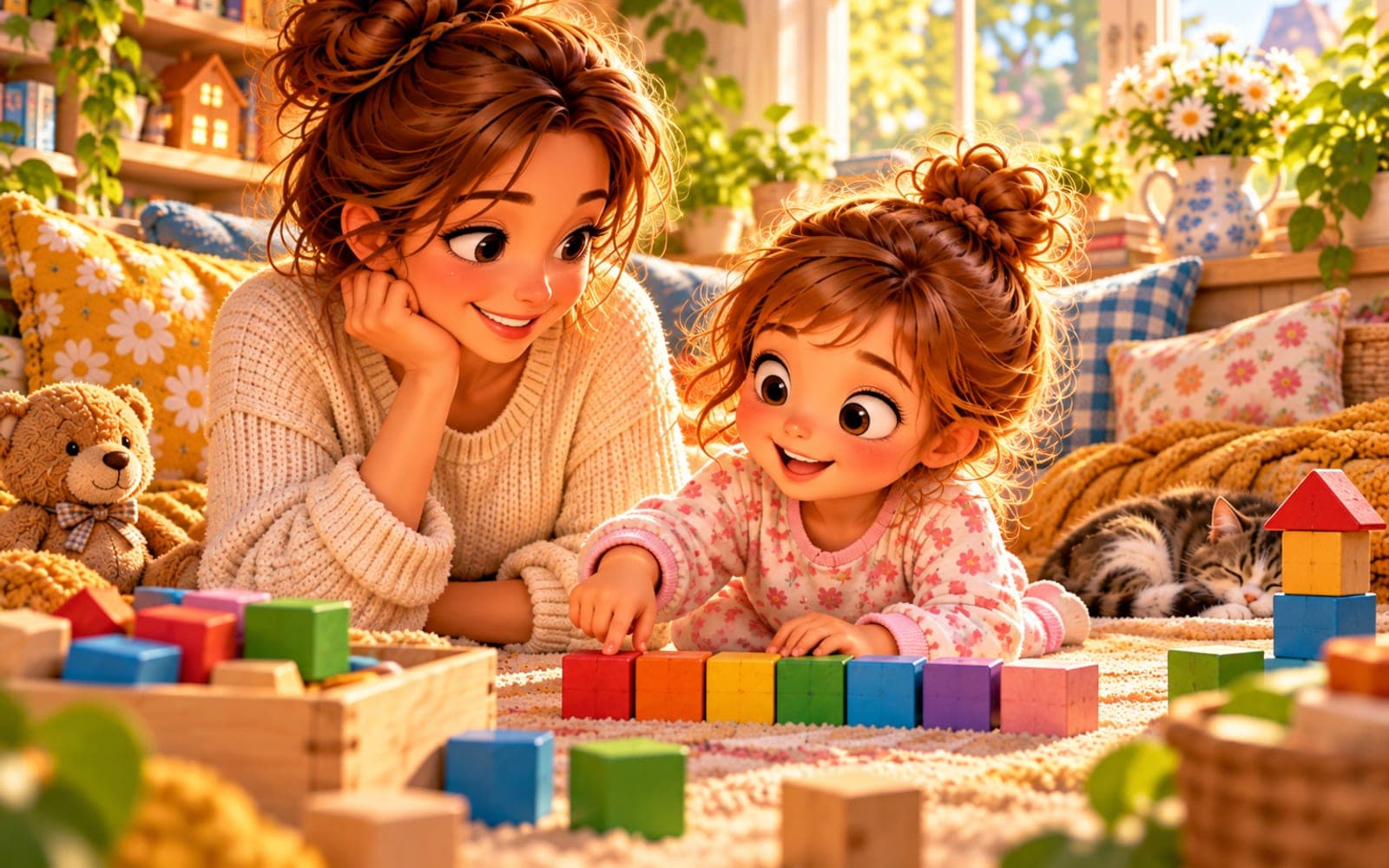
Start with short everyday situations rather than worksheets. Your child should first touch, move, and count real objects.
- Count small groups: 2 blocks, 3 spoons, 4 toy cars.
- Move each object only once and match it with one number word.
- Ask “How many are there altogether?” rather than only “Can you count to ten?”
- Compare groups: which has more, fewer, or the same number?
- Only later connect a quantity with the written numeral.
- Move gradually from groups up to 3, then 5, and finally 10.
The Education Endowment Foundation recommends weaving maths into everyday activities and using objects children can move. That fits well with low-pressure learning at home.
What Is the Difference Between Reciting Numbers and Really Counting?
Reciting “one, two, three…” shows that a child knows the sequence of number words, but it does not necessarily mean they understand quantity. Real counting requires several skills working together.
First, your child matches one number word to one object. When counting five blocks, each block should receive exactly one count: “one”, “two”, “three”, “four”, or “five”.
Second, your child keeps a stable order of number words. “One, two, three, four” should not change into a different sequence each time.
Third, your child begins to understand that the last number said tells how many objects are in the whole set. After counting 4 teddies, if you ask “How many are there?”, your child can answer “four” without starting again.
With very small groups, children may also recognise quantity at a glance without counting each item separately. Show 2 or 3 blocks and ask, “How many can you see?”
The next step is comparing: more, fewer, the same. Your child not only counts two plates and three cups but notices which group has more.
A numeral is only a written symbol for a number. It is useful to build the meaning of “five” first, then show the symbol 5.
How Do You Practise Counting to 3?
Groups up to 3 are a good starting point because a child can see them quickly and check them easily by touch. You do not need special equipment.
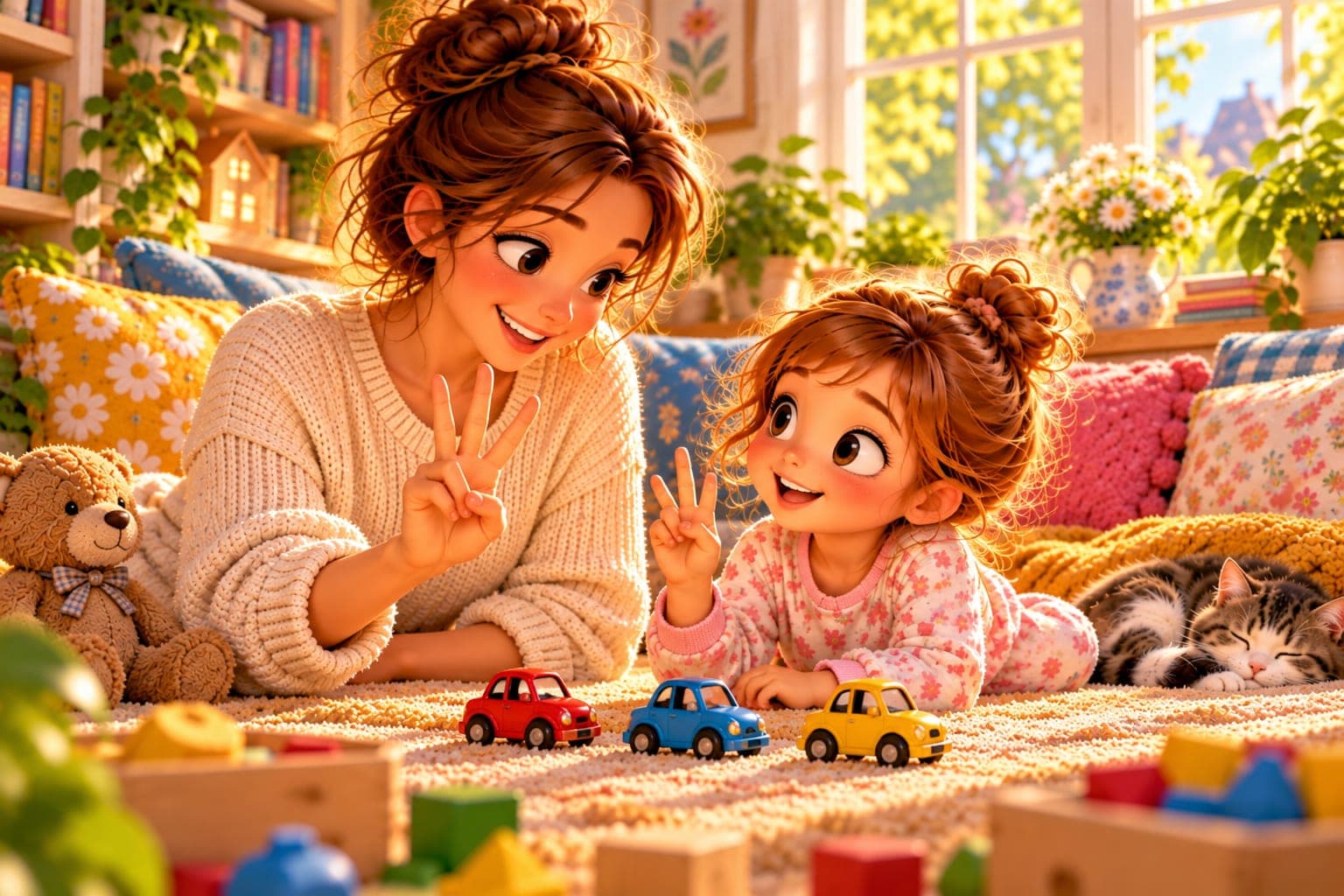
When setting the table, say: “Put out two forks.” During play, line up three cars and ask, “How many are there?”. On a walk, count three stones or three steps.
You can also place 1, 2, and 3 blocks in separate groups. Do not ask for the numeral straight away. First ask your child to point to the group with the most and the group with the fewest.
If a 3- or 4-year-old enjoys picture activities, you can later add a simple counting to 5 activity for 4-year-olds. A fish dot-to-dot for 3-year-olds can also bridge play and paper, but use it as an extra rather than the starting point.
How Do You Move From Counting to 3 to Counting to 5?
Move to 5 when your child can count a small set without frequently skipping or double-counting objects. The goal is not perfect recitation “to five” on command.
Everyday activities might look like this:
- put 4 blocks in a box and count them as you take them out;
- place 5 grapes on a plate and ask your child to give you 2;
- set out 3 teddies and 5 cars, then ask which group has more;
- make two groups of 4 buttons and check whether they have the same number.
At this stage, counting to 10 for 5-year-olds can also work if you choose only activities that match your child’s current level. To practise comparing sets, use more, fewer and the same.
How Do You Help a Child Reach Counting to 10?
Once counting to 5 feels fairly secure, increase the group size gradually to 6, 7, 8, 9, and 10. Keep using objects your child can touch or move.
Count 6 steps, 7 crayons, 8 blocks, or 10 clothes pegs. You can also split a set: “Here are 8 blocks. Give me 3. How many are left?”. If your child is not ready for subtraction, simply count the remaining blocks again.
In the Shoal game, your child counts creatures in groups and chooses the shoal with the requested quantity. This combines counting with comparing groups without turning it into a school-style quiz.
Children who enjoy drawing may like number and counting colouring pages. If a 6-year-old confidently counts real objects to 10, the next step could be addition to 10 with objects.
When Is a Child Ready for the Next Stage?
Do not look only at age. Watch how your child handles real sets of objects.
Stage | Activity | Signs They Are Ready to Move On |
|---|---|---|
To 3 | Count 1–3 blocks, teddies, or pieces of fruit | Each object gets one number word, and your child usually knows how many there are altogether |
To 5 | Give 4 crayons, compare groups of 3 and 5 | Your child counts without frequent skipping, understands more/fewer, and can make a small set on request |
To 10 | Count 6–10 objects and make a requested quantity | Your child keeps the number sequence and can say how many objects there are after counting |
Numerals | Match a numeral card to a counted set | The symbol begins to connect with a real quantity rather than only its visual shape |
The CDC lists counting to 10 as one milestone around age 5. That does not mean every younger or older child must follow exactly the same path at exactly the same time. For a wider picture of development, see what a 4-year-old can typically do and what a 5-year-old can typically do.
When Should You Introduce Written Numerals?
Introduce numerals when your child already understands the quantity in small sets. The symbol “4” should carry meaning: four blocks, four fingers, four steps.
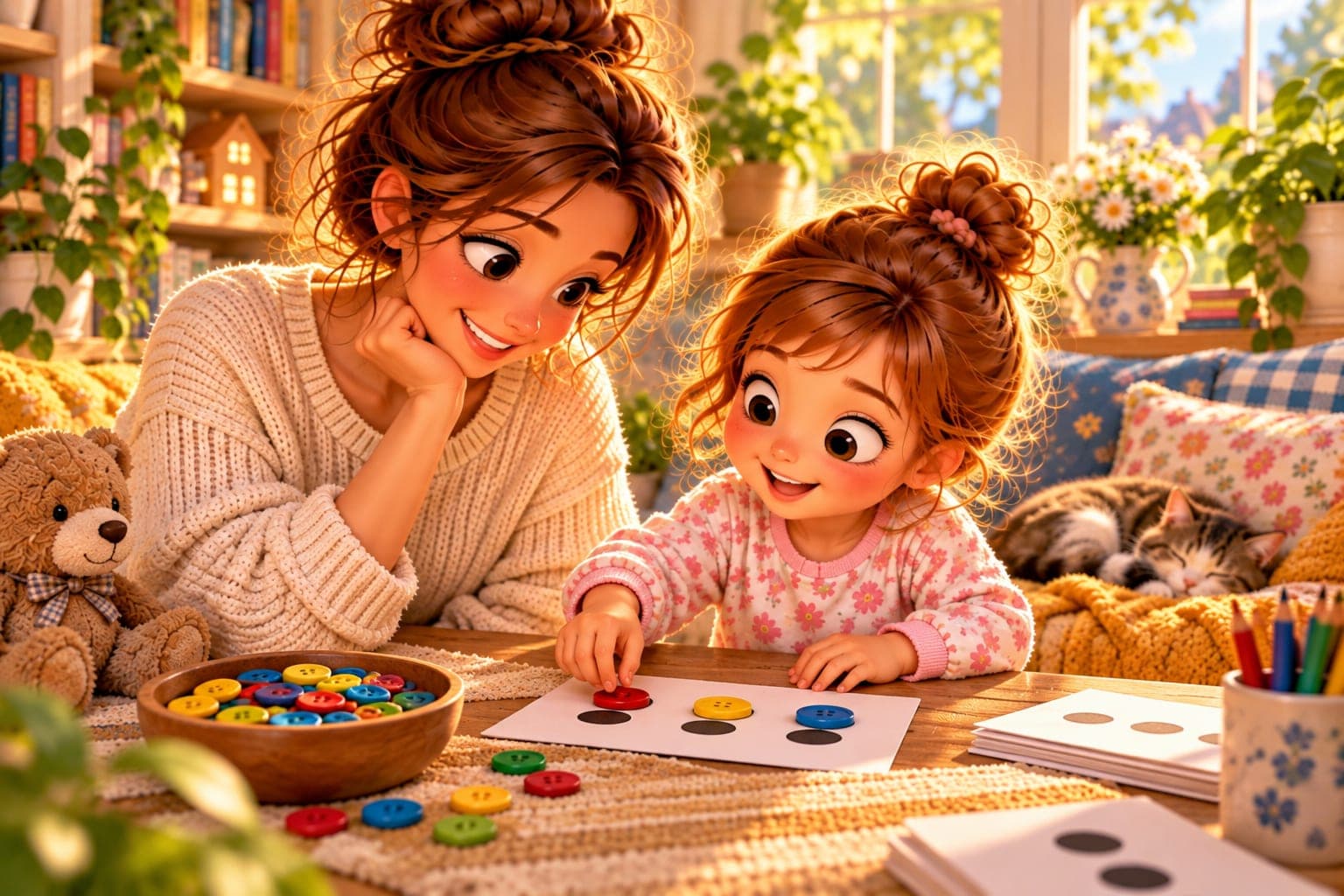
Put 5 buttons beside a card showing the numeral 5. Then change the number of buttons and ask your child to choose the matching card. Reverse the activity by showing a numeral and asking for that many objects.
You do not need to require correct pencil formation immediately. Recognising a numeral and matching it to a set is an earlier and very useful step.
What Mistakes Should You Avoid When Teaching Counting?
A common mistake is turning play into a stream of test questions. A child may start guessing or avoiding the activity even though counting itself is within reach.
- Do not keep asking “How many is that?” as if it were a test.
- Do not begin with numeral cards and written symbols if your child cannot yet count objects confidently.
- Do not interrupt halfway through every counting mistake. It is usually better to ask for a calm recount from the beginning.
- Do not pile on dozens of worksheets. One activity with spoons at dinner can tell you more about number understanding.
- Do not treat reciting to 10 as proof that your child can count 10 objects.
When Should You Ask for Extra Support?
Occasional counting errors are part of learning. Talk to the teacher or another appropriate education professional if difficulties persist for a long time and affect even very small sets despite calm, regular hands-on practice.
It can also be useful to seek advice if counting difficulties appear alongside other developmental concerns. A conversation is not a diagnosis; it is a way to work out what support may help.