
In Short: How Do You Teach Addition to 10?
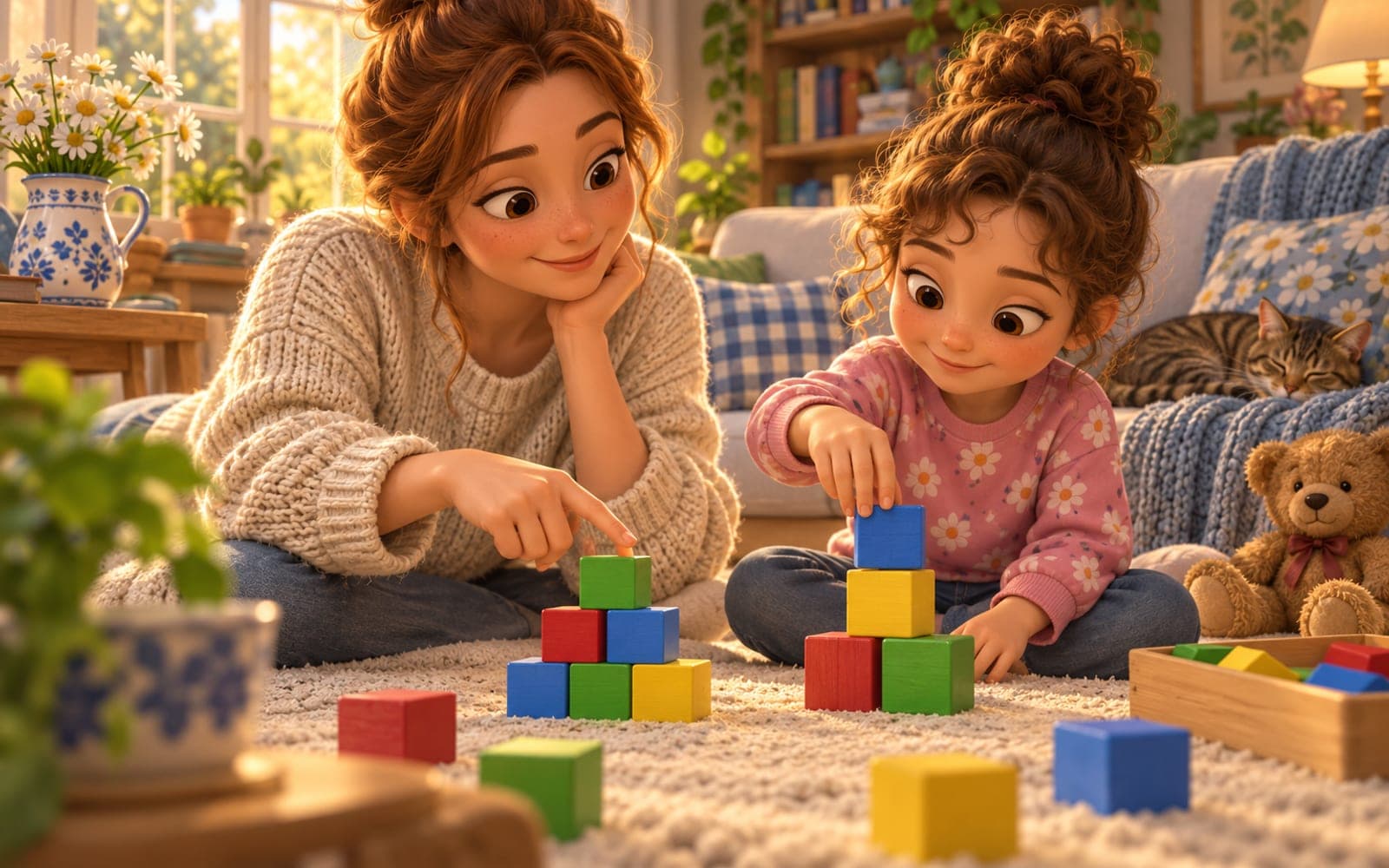
- Start with real objects: blocks, buttons, fingers. Your child adds objects and counts the new total.
- Then use pictures: dots, tally marks, drawings, or a number line.
- Introduce written equations last: 3 + 4 = 7, once your child understands what “add” means.
- Practise number bonds to 10 separately because they support addition within 20 and later mental maths.
- 10 minutes a day, kept short and playful, is better than long pages of calculations.
Where Should You Start With Addition?
Before beginning addition, your child should be able to count objects to 10 reliably and understand that the last number said tells how many there are. If that is still difficult, return briefly to how to teach a child to count to 10.
The first form of addition is simply putting more objects into a group. “You have three blocks. I’ll give you two more. How many do you have now?” At first, your child may recount every object from one, and that is a completely valid stage.
Three Steps: Object, Picture, Equation
The UK Education Endowment Foundation recommends thoughtful use of manipulatives and representations such as drawings and number lines in early mathematics. These help children represent mathematical ideas before working only with symbols.
Step | What Your Child Does | Example |
|---|---|---|
| adds and counts | 4 blocks and 2 blocks make 6 |
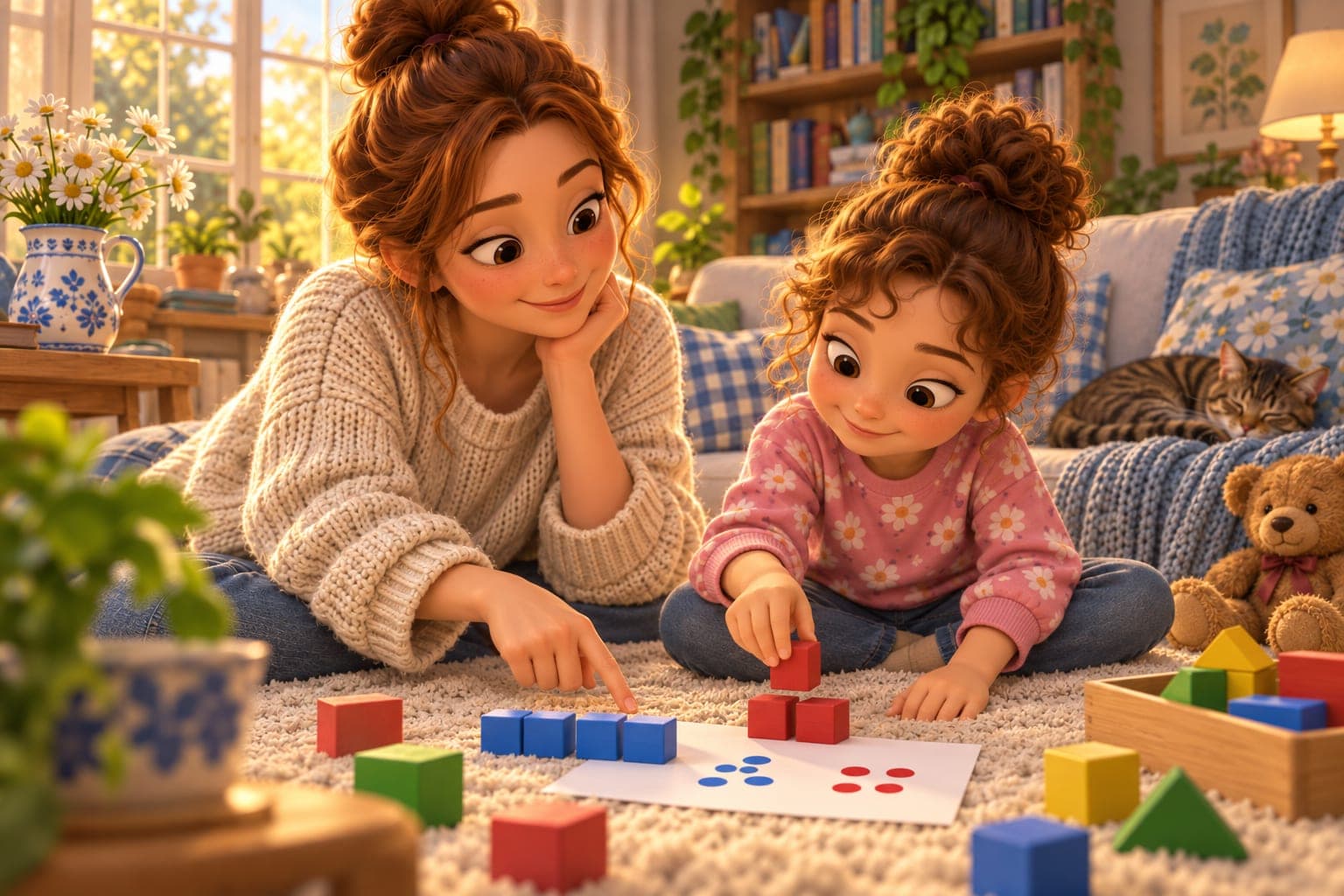
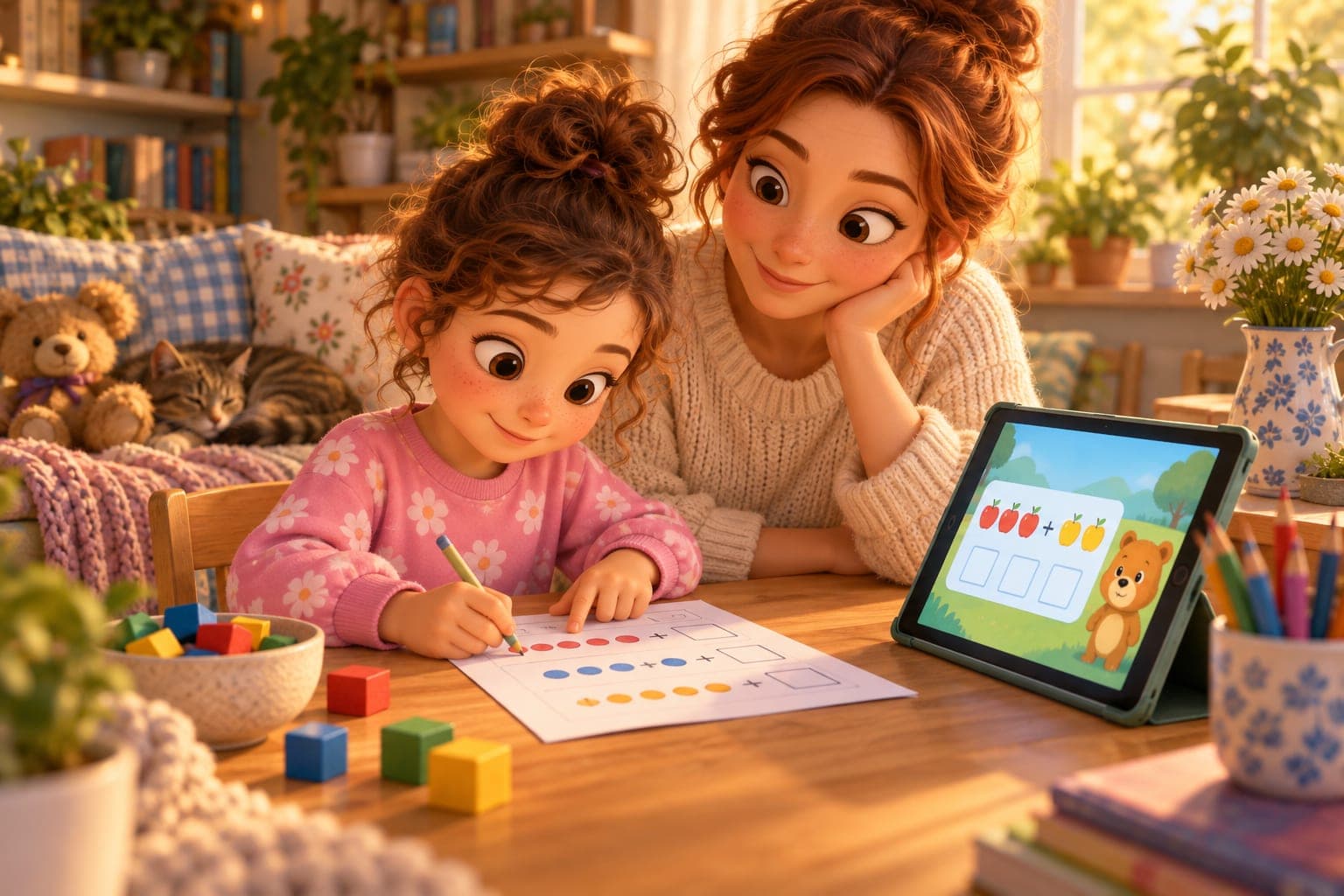
| draws dots or marks | ●●●● and ●●, then counts all |
| writes the calculation | 4 + 2 = 6 |
Do not rush into written notation. A child who writes equations without understanding what the symbols represent may start relying on guessing or memorised answers.
How Do You Teach Counting On From the Larger Number?
Once your child can add by recounting everything, show a shortcut. Instead of saying “1, 2, 3, 4, 5, 6” for 4 + 2, keep four in mind and count on two: “four… five, six.”
An even more efficient strategy is to start with the larger addend. For 2 + 5, it is easier to say “five… six, seven” than “two… three, four, five, six, seven.” Show this with two groups of blocks and begin from the larger group.
Why Are Number Bonds to 10 So Important?
The pairs that make 10—1 and 9, 2 and 8, 3 and 7, 4 and 6, 5 and 5—are useful for addition within 20 and later mental calculation. Practise them until they become increasingly quick and familiar without requiring a full recount every time.
Games for number bonds to 10:
- Ten Fingers: hold up 3 fingers and ask how many more are needed to make 10.
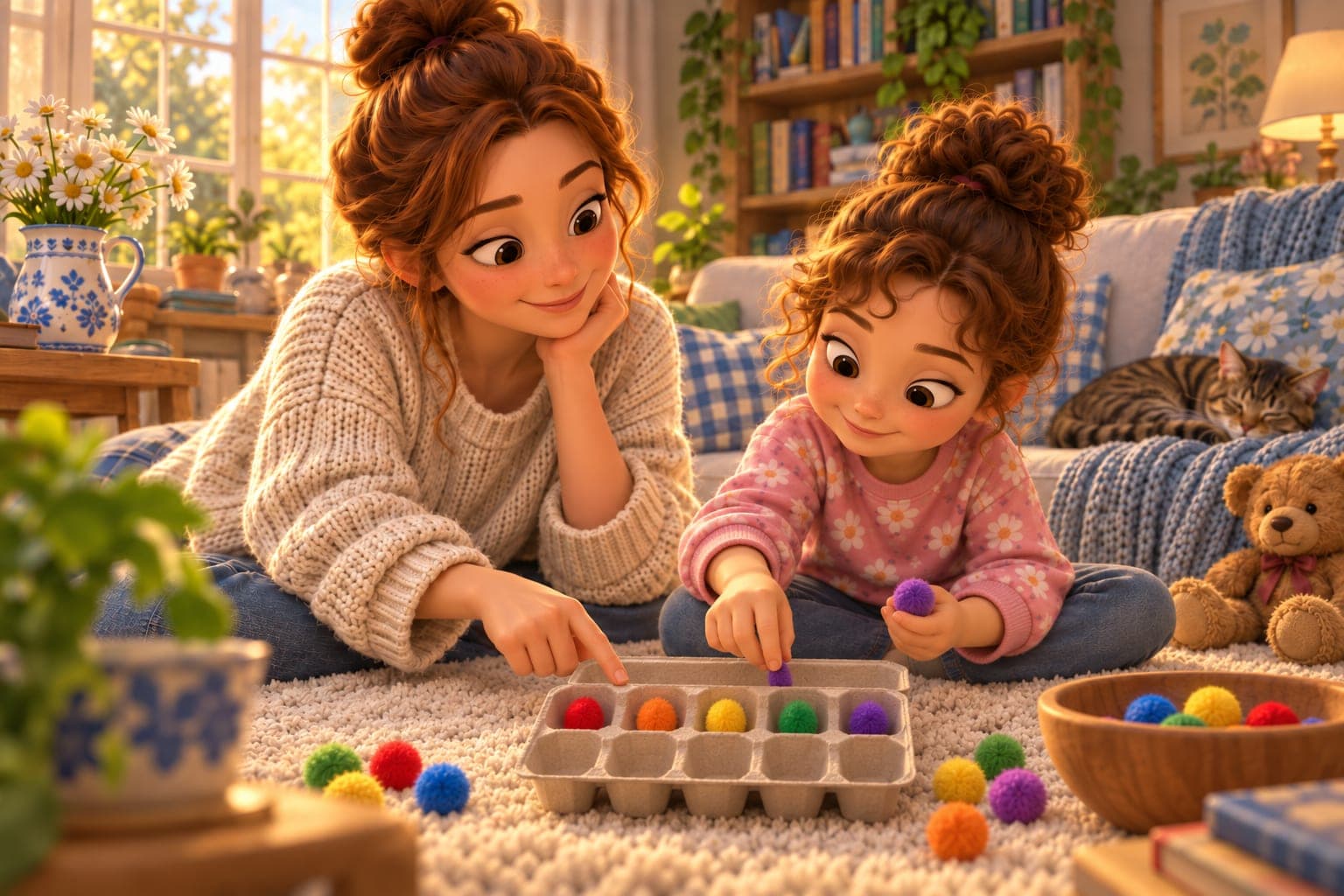
- 10-Space Egg Carton: fill some spaces and ask how many empty spaces are left.
- Number-Bond Memory: use number cards; a matching pair is two cards that total 10.
You can find online practice in making 10, and the wider topic in addition to 10 in Grade 1 / Year 2.
A 3-Week Plan: 10 Minutes a Day
Week | What You Practise | Materials |
|---|---|---|
1 | adding objects and counting totals to 10 | blocks, buttons, fingers |
2 | drawings and equations, counting on from the larger number | paper, crayons, dice |
3 | number bonds to 10 and simple word problems | 10-space carton, cards, online practice |
In week three, add everyday word problems: “There were 5 people on the bus and 3 more got on. How many are there now?”. You can find ready-made examples in addition word problems to 10. To print practice at the right level, use the maths worksheet generator.
How Do You Check Whether Your Child Really Understands Addition?
Ask for an explanation, not only an answer. Useful prompts include:
- “Show me 3 + 4 with blocks.”
- “Draw this addition.”
- “Make up a story where you have to add 2 and 5.”
- “Is 4 + 3 the same as 3 + 4? Check.”
If your child can represent the calculation with objects and describe it as a simple story, they understand what addition means. Speed can develop later.
What Mistakes Should You Avoid?
- A worksheet with 50 calculations at once. It can overwhelm a beginner. Use 5–10 examples instead.
- Banning finger counting. Fingers are a natural early support. Children often stop relying on them as number facts become familiar.
- Jumping straight to written equations. Without objects and pictures, “+” and “=” can remain empty symbols.
- Rushing and timing every answer. Stress can make it harder to think clearly.
- Only practising bare calculations, with no real situations. Your child should understand why addition is useful.
Once addition feels secure, the next step is subtraction. See how to teach subtraction to 20.
When Should You Talk to the Teacher?
If, after several weeks of regular practice, your child still cannot combine two small groups using blocks, repeatedly loses track while counting, or becomes very distressed by number tasks, talk with the teacher. Together you can decide whether your child needs more time, different representations, or additional educational support.
Sources
- Education Endowment Foundation — Improving Mathematics in the Early Years and Key Stage 1 (a report with recommendations for teaching mathematics to children aged 3–7, 2020).
- Ośrodek Rozwoju Edukacji — Podstawa programowa wychowania przedszkolnego i edukacji wczesnoszkolnej z komentarzem (2017).