
Crater-Covered Mercury Near the Sun
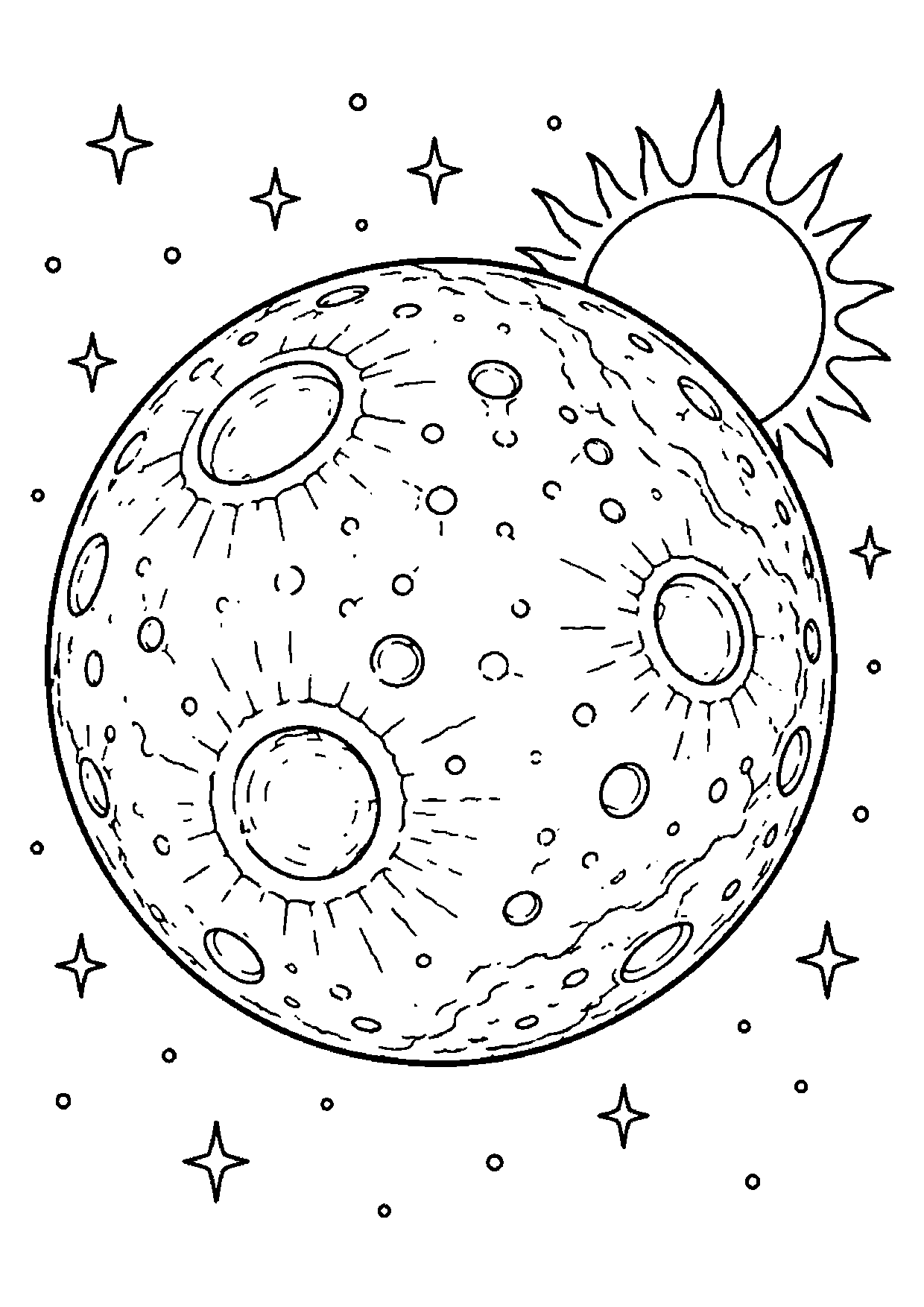
A large crater-covered Mercury fills most of the scene, with part of the Sun visible behind it and small stars and dots scattered across the background.
A4 format (portrait), black outlines on a white background · for home and classroom use
All coloring pages: Planet and Solar System Coloring Pages
Similar coloring pages: Planet and Solar System Coloring Pages



What else can you print? Free, no account needed
Custom Name Coloring Pages
Enter your child's name to generate a custom coloring page featuring large outline letters to color and decorate.
Open generator →Connect the Dots Generator
Eight connect-the-dots pictures across three difficulty levels. Features faint outline guides for younger children and dots only for older kids.
Open generator →Printables
Worksheets, tracing lines, mazes and dot-to-dots in A4.
Browse printables →
What is in the scene
The planet Mercury dominates the picture and is drawn as a large round world covered with several visible impact craters. Behind the planet, part of the Sun appears with wavy rays extending outward. Small stars and dots are scattered across the otherwise plain background, keeping the space setting simple and easy to read. The composition focuses strongly on Mercury's rough, cratered surface and its position close to the bright Sun.
Mercury facts
Mercury is the closest planet to the Sun and the smallest planet in the Solar System. Its surface is heavily covered with impact craters, many of which formed when asteroids and comets struck the planet over billions of years. Mercury has only a very thin exosphere rather than a thick atmosphere, so it does not have weather like Earth. One orbit around the Sun takes about 88 Earth days. Because Mercury rotates slowly and has little atmosphere to move heat around, temperatures can differ greatly between its sunlit and dark sides.
Color ideas
- Gray, charcoal, silver, or pale brown for Mercury's rocky surface
- Darker gray around some crater rims and crater floors
- Yellow, gold, or orange for the partly visible Sun
- White or pale yellow for small stars
- Deep blue, black, or purple tones for a space-inspired background