
Milky Way Traveler
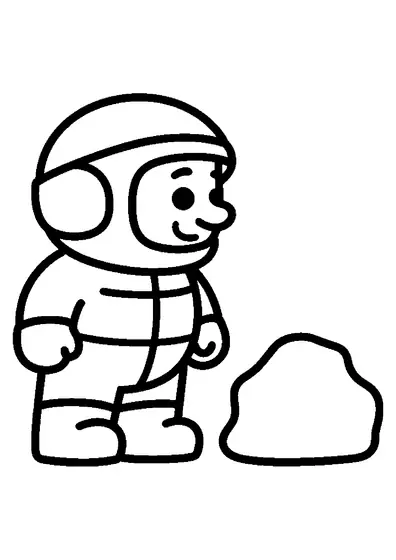
A galactic voyager equipped with an expedition backpack journeys along the sweeping arm of our star system.

A4 format (landscape), black outlines on a white background · for home and classroom use
All coloring pages: Planet and Solar System Coloring Pages
Similar coloring pages: Planet and Solar System Coloring Pages



What else can you print? Free, no account needed
Custom Name Coloring Pages
Enter your child's name to generate a custom coloring page featuring large outline letters to color and decorate.
Open generator →Connect the Dots Generator
Eight connect-the-dots pictures across three difficulty levels. Features faint outline guides for younger children and dots only for older kids.
Open generator →Printables
Worksheets, tracing lines, mazes and dot-to-dots in A4.
Browse printables →
Galactic Voyagers and the Milky Way
Interstellar travelers rely on heavy-duty backpacks to store essential life-support supplies and navigation equipment. The Milky Way galaxy contains hundreds of billions of stars arranged in a massive spiral structure spanning vast distances across space. From a side perspective, galactic spiral arms appear as sweeping luminous arcs composed of dust lanes and glowing star clusters.
Structure of the Milky Way Galaxy
Our home galaxy is a barred spiral galaxy measuring roughly one hundred thousand light-years across its main disk. The bright arc seen in night skies consists of light emitted by countless distant stars blending together. Solar systems rotate around the supermassive galactic center at incredible speeds over millions of years.
Colors of Galactic Arcs and Traveler Gear
- Traveler backpack: Forest green, dark khaki, or tactical gray
- Expedition suit: Bright white, royal blue, or safety yellow
- Galactic arc nebula gas: Violet, magenta, and cyan gas clouds
- Background space stream: Deep indigo, midnight black, and golden star dust