
Pterodactylus Carrying a Leaf to a Resting Hollow
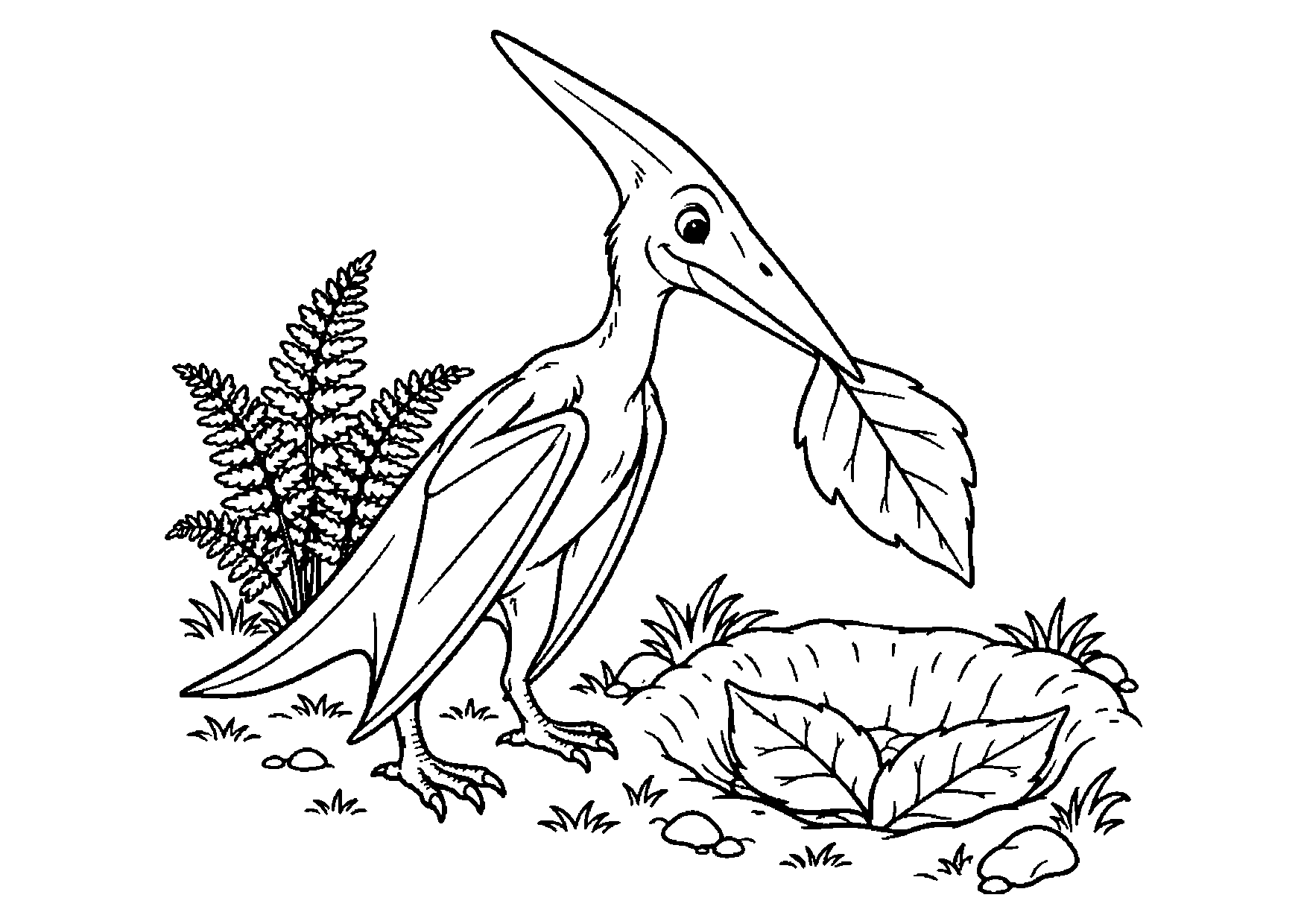
A friendly Pterodactylus carries a broad fallen leaf in its beak toward a shallow resting hollow lined with two more leaves.
A4 format (landscape), black outlines on a white background · for home and classroom use
All coloring pages: Flying and Sea Reptile Coloring Pages
Similar coloring pages: Flying and Sea Reptile Coloring Pages


What else can you print? Free, no account needed
Custom Name Coloring Pages
Enter your child's name to generate a custom coloring page featuring large outline letters to color and decorate.
Open generator →Connect the Dots Generator
Eight connect-the-dots pictures across three difficulty levels. Features faint outline guides for younger children and dots only for older kids.
Open generator →Printables
Worksheets, tracing lines, mazes and dot-to-dots in A4.
Browse printables →
A simple resting place on the ground
The pterosaur stands with its wings folded neatly along the sides of its body. One broad leaf is held in its beak, and the animal faces a shallow hollow on the ground where two other broad leaves are already visible. A low fern grows behind it. Small rocks and tufts of grass are scattered around the hollow, while the rest of the background remains open. The scene clearly separates the animal, the carried leaf, the resting hollow, the fern, and the small ground details.
Pterodactylus facts
Pterodactylus was a pterosaur, not a dinosaur. It lived during the Late Jurassic, around 150 million years ago, and many well-known fossils come from limestone deposits in what is now Germany. Pterodactylus had a long, narrow skull, a pointed snout with teeth, and a relatively short tail. Its wings were supported by an extremely elongated fourth finger. Fossils reveal much about its skeleton and growth, but scientists do not know its exact colors.
Color ideas for the scene
- Try warm gray, tan, brown, or muted green for the Pterodactylus.
- Use olive, ochre, rusty brown, or deep green for the broad leaves.
- Make the fern fresh green, yellow-green, or dark olive.
- Give the small rocks gray, beige, or sandy brown tones.
- Use a lighter shade inside the resting hollow to keep it distinct from the ground.