
Pteranodon Receiving a Flower from a Youngster
A large pterosaur lowers its long beak toward a much smaller youngster that holds up one large flower, with a rock, fern-like plants, pebbles, and grass nearby.
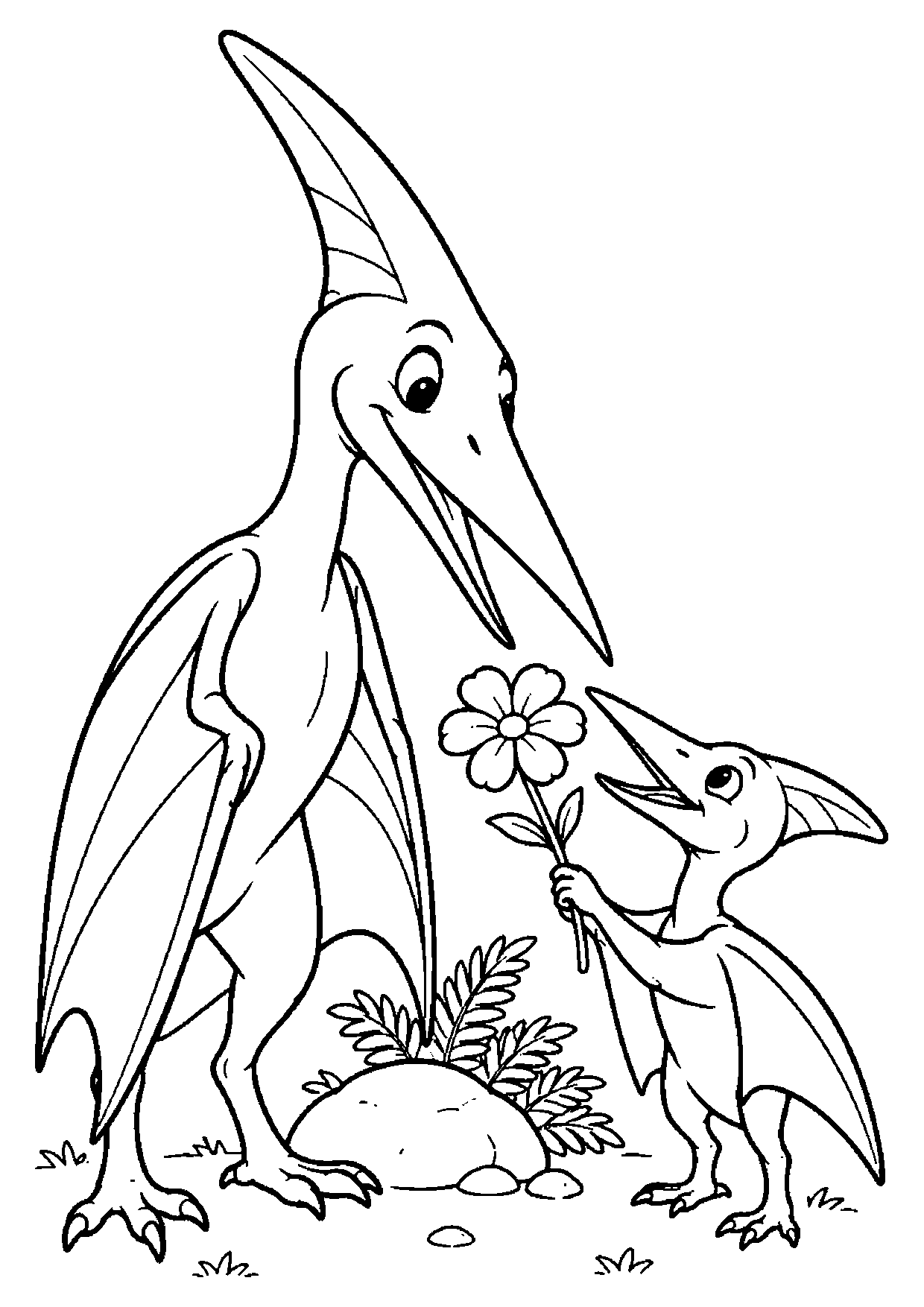
A4 format (portrait), black outlines on a white background · for home and classroom use
All coloring pages: Flying and Sea Reptile Coloring Pages
Similar coloring pages: Flying and Sea Reptile Coloring Pages


What else can you print? Free, no account needed
Custom Name Coloring Pages
Enter your child's name to generate a custom coloring page featuring large outline letters to color and decorate.
Open generator →Connect the Dots Generator
Eight connect-the-dots pictures across three difficulty levels. Features faint outline guides for younger children and dots only for older kids.
Open generator →Printables
Worksheets, tracing lines, mazes and dot-to-dots in A4.
Browse printables →
What is in the scene
The larger pterosaur stands on the left and bends its long beak down toward the smaller youngster on the right. The young pterosaur raises a single broad-petaled flower toward the adult. Between and around them are one rounded rock, several fern-like plants, small pebbles, and a few tufts of grass. The rest of the background is plain, so the interaction between the two flying reptiles remains the clear focus of the picture.
Pteranodon facts
Pteranodon was a large pterosaur, which means it was a flying reptile rather than a dinosaur. It lived during the Late Cretaceous period and is known from fossils found in North America. Pteranodon had a long toothless beak and a distinctive bony crest at the back of the skull. Its wings were formed by a membrane supported mainly by an extremely elongated fourth finger. Scientists do not know the exact colors of Pteranodon, so any color scheme used for an illustration is speculative rather than confirmed by fossils.
Color ideas
- Tan, brown, gray, cream, or muted green for the larger pterosaur
- A lighter or contrasting shade for the youngster
- Pink, yellow, red, purple, or blue for the large flower
- Green for the fern-like plants and grass tufts
- Gray, beige, or brown for the rock and small pebbles