
Tapejara Placing a Twig in a Ground Nest
A crested Tapejara bends over a simple ground nest and uses its beak to place a curved twig along the nest edge.
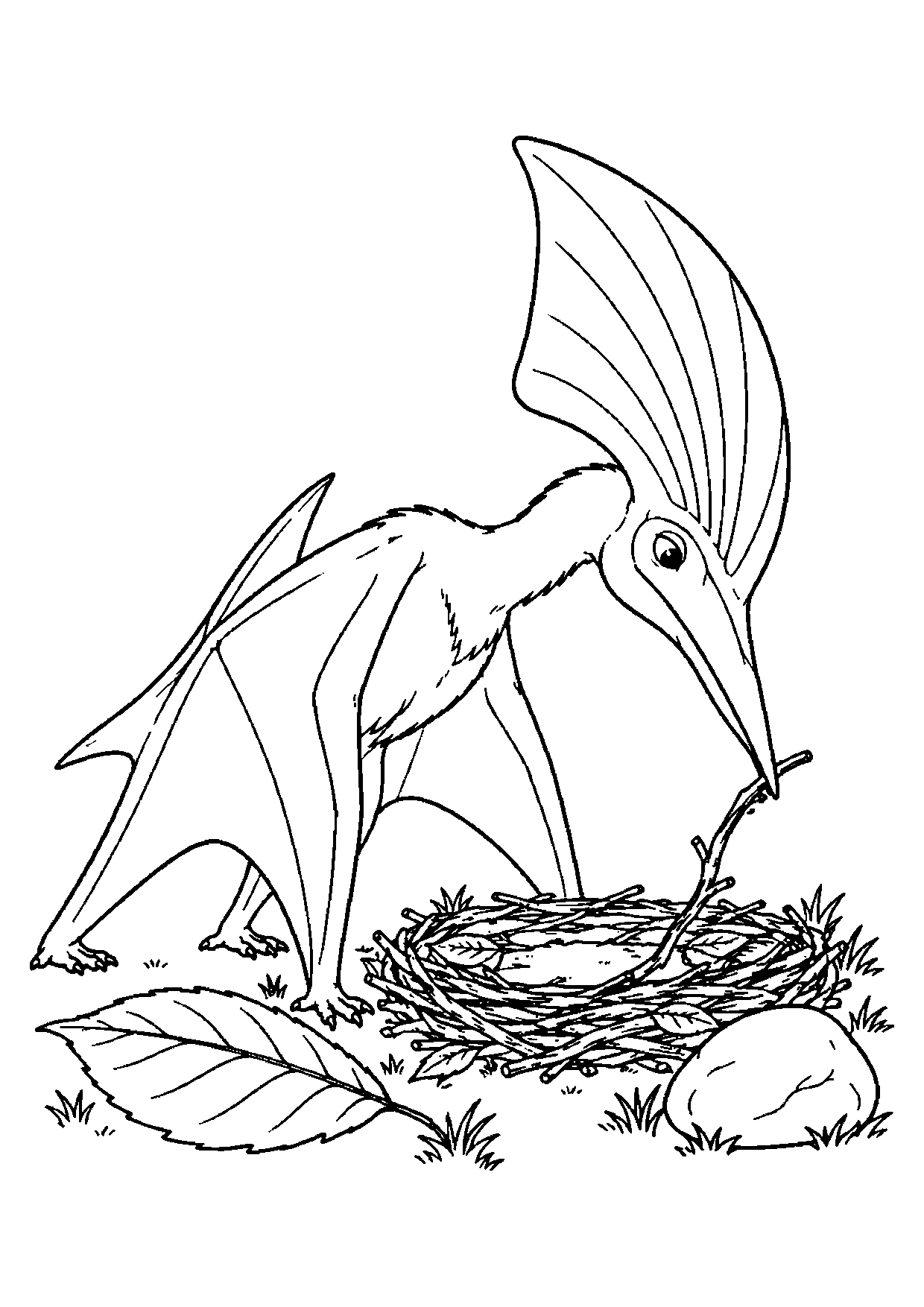
A4 format (portrait), black outlines on a white background · for home and classroom use
All coloring pages: Flying and Sea Reptile Coloring Pages
Similar coloring pages: Flying and Sea Reptile Coloring Pages


What else can you print? Free, no account needed
Custom Name Coloring Pages
Enter your child's name to generate a custom coloring page featuring large outline letters to color and decorate.
Open generator →Connect the Dots Generator
Eight connect-the-dots pictures across three difficulty levels. Features faint outline guides for younger children and dots only for older kids.
Open generator →Printables
Worksheets, tracing lines, mazes and dot-to-dots in A4.
Browse printables →
A careful nest-building moment
The pterosaur leans forward over a shallow nest on the ground. Its very large upright head crest is the most striking feature in the scene, while the beak points down toward the curved twig. One broad fallen leaf lies in the foreground, and a rounded stone sits beside the nest. A few small grass tufts appear around the nest, with the rest of the background left open. The simple arrangement keeps the crest, beak, twig, leaf, stone, and nest clearly separated.
Tapejara facts
Tapejara was a pterosaur, not a dinosaur. It lived during the Early Cretaceous in what is now Brazil and is known for an unusually large head crest. Tapejara had a toothless beak and belonged to a group of pterosaurs with distinctive skull shapes. Fossils help scientists reconstruct its bones and crest, but they do not reveal the exact colors of the animal. The precise details of how Tapejara nested are not known, so the nest-building action in this picture is an imaginative scene rather than a confirmed behavior.
Color ideas for the scene
- Try warm brown, tan, gray, or muted green for the body.
- Give the large crest a stronger accent such as rust, ochre, teal, or deep red.
- Use olive, yellow-green, or brown for the fallen leaf and grass.
- Make the twig light brown, reddish brown, or gray-brown.
- Color the rounded stone in gray, beige, or sandy tones.