
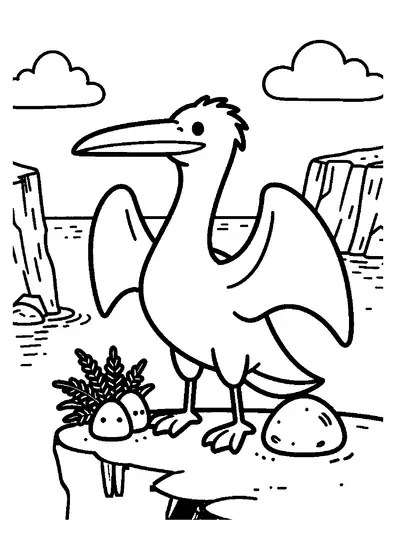
Pteranodon on a Sunny Seaside Cliff
Coastal cliffs provided ancient flying reptiles with elevated perches near rich marine feeding grounds.

A4 format (portrait), black outlines on a white background · for home and classroom use
All coloring pages: Flying and Sea Reptile Coloring Pages
Similar coloring pages: Flying and Sea Reptile Coloring Pages



What else can you print? Free, no account needed
Custom Name Coloring Pages
Enter your child's name to generate a custom coloring page featuring large outline letters to color and decorate.
Open generator →Connect the Dots Generator
Eight connect-the-dots pictures across three difficulty levels. Features faint outline guides for younger children and dots only for older kids.
Open generator →Printables
Worksheets, tracing lines, mazes and dot-to-dots in A4.
Browse printables →
Flying Reptiles of the Coastal Cliffs
Pteranodons inhabited rocky shorelines overlooking open ocean waters. These prehistoric creatures roosted on high cliff edges where coastal winds helped them take flight easily while watching the water below for swimming prey.
Coastal Life and Hunting Habits
Pteranodons lacked teeth and relied on long, pointed beaks to scoop up fish near the ocean surface. Roosting high above the waves allowed them to launch into gliding flights without expending excessive energy. Ocean breezes rising against steep rock faces provided natural thermal currents that kept these large reptiles aloft for hours.
Natural Colors of a Pteranodon
- Pteranodon skin: neutral tones like beige, tan, or gray
- Head crest: subtle shades of brown or reddish-brown
- Beak: light yellowish-brown or horn color
- Rocky cliff: dark gray or brownish granite
- Ocean water: deep blue or greenish-blue