

In short: how can you help a child learn multiplication tables without rote memorisation?
First show your child what multiplication means, and only then work on recalling the facts. A simple order works well:
- start with multiplication as repeated addition and equal groups;
- learn ×2, ×5 and ×10 first, then ×3 and ×4, and finally ×6, ×7, ×8 and ×9;
- use the commutative property, for example 3 × 7 = 7 × 3, to reduce the number of new facts;
- practise for about 10 minutes a day, mixing calculation, a game and a short worksheet;
- check progress without a timer: accuracy, understanding and needing fewer prompts matter most.
You do not need to begin by reciting the entire multiplication table. A child should first be able to work out an answer and only gradually move toward recalling it from memory.

How can you explain what multiplication means to a child?
The clearest way to introduce multiplication is as a quicker way to add equal groups. Instead of only saying “3 times 4 is 12,” put three plates on the table and place four blocks on each. Your child can then see that 4 + 4 + 4 = 12.
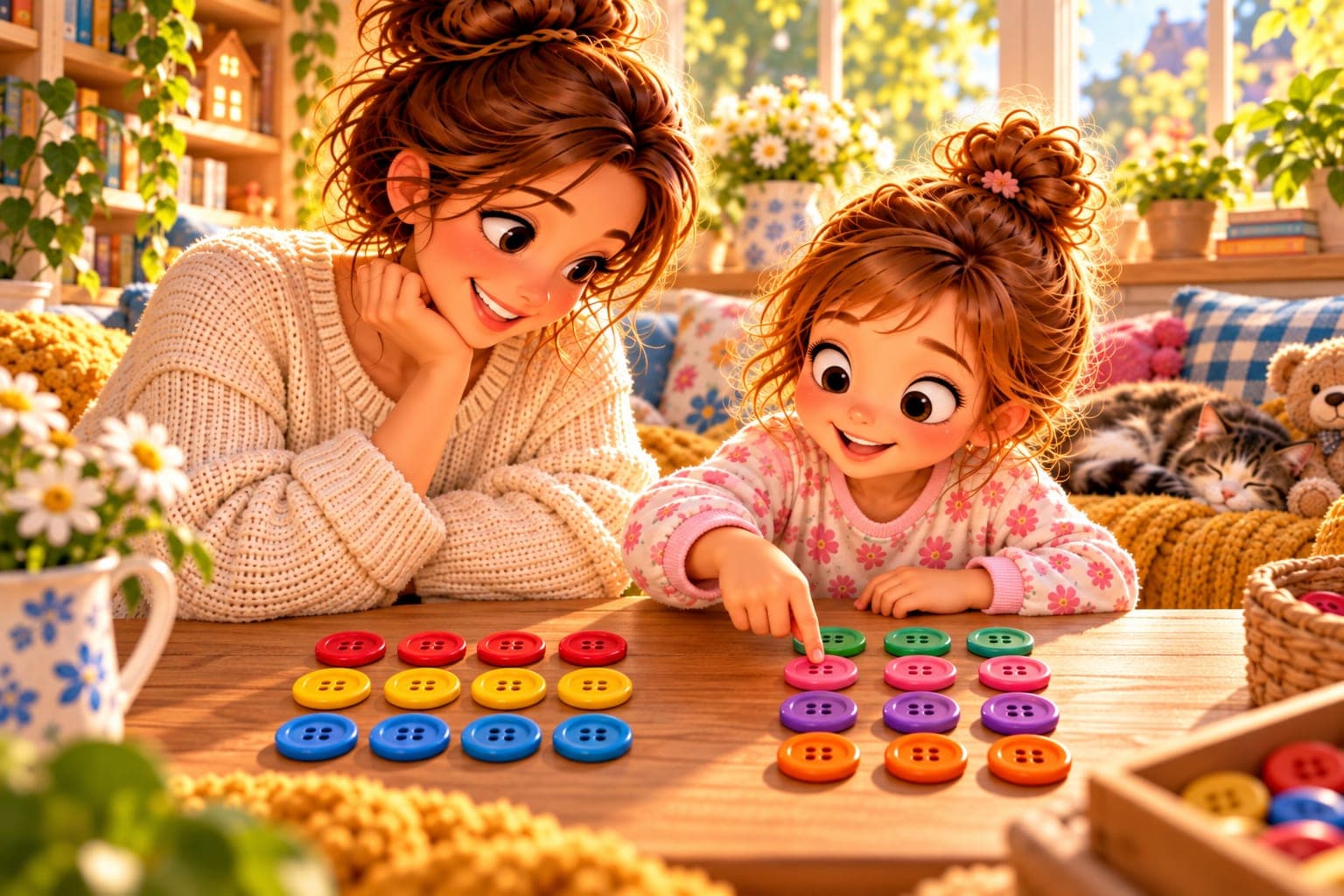
Another useful model is a rectangular array. Arrange 3 rows of 4 buttons. Then turn the array: now there are 4 rows of 3 buttons, but there are still 12 altogether. This naturally shows the commutative property of multiplication: 3 × 4 and 4 × 3 have the same answer.
This matters more than memorising answers quickly. Early-years school maths is not only about carrying out multiplication and division, but also about understanding operations, the relationships between them and developing personal calculation strategies.
You can start with questions such as:
- “How many socks are there altogether if we have 4 pairs?”
- “There are 2 strawberries on each of 5 plates. How many strawberries are there?”
- “We have 3 boxes with 6 crayons in each. How can we count them all without adding one at a time?”
When a child can draw, build or explain a multiplication problem, the “×” symbol stops feeling abstract.
What order should you teach multiplication tables in?
It is usually easiest to teach the tables in an order that lets a child spot patterns quickly before moving to facts that need more connections. A practical sequence is ×2, ×5, ×10, then ×3 and ×4, and finally ×6, ×7, ×8 and ×9.
1. Start with ×2, ×5 and ×10
With ×2, your child is simply doubling a number. If they know 8 + 8, they can easily reach 2 × 8 = 16.
With ×10, the pattern is very clear: 6 × 10 = 60 and 9 × 10 = 90. Multiplying by 5 can be linked to counting in fives: 5, 10, 15, 20, 25…
For practice, begin with separate worksheets for the first tables: “2 Times Table”, “5 Times Table” and “10 Times Table”.
2. Then move to ×3 and ×4
Multiplying by 3 can be built from ×2: 3 × 6 is 2 × 6 plus one more 6, so 12 + 6 = 18.
For ×4, use double-doubling. If 2 × 7 = 14, then 4 × 7 is twice as much, which is 28.
3. Finish with ×6, ×7, ×8 and ×9
Here your child should build on facts they already know. For example:
- 6 × 7 = 5 × 7 + 7 = 35 + 7 = 42;
- 7 × 8 = 7 × 7 + 7 = 49 + 7 = 56;
- 8 × 6 = double 4 × 6 = 24 × 2 = 48;
- 9 × 6 = 10 × 6 − 6 = 60 − 6 = 54.
For the harder tables, separate practice materials can help. You can use an 8 times table worksheet and a 9 times table worksheet.
What tricks can help a child remember multiplication facts?
A trick is useful when it helps a child understand a relationship rather than replacing understanding. The best ones let your child work out a new fact from one they already know.
Commutativity. If your child knows 4 × 7 = 28, they do not need to learn 7 × 4 as a completely new fact. The answer is the same.
Multiplying by 9 as “times 10 minus one group.” Instead of trying to recall 9 × 7, calculate 10 × 7 − 7 = 70 − 7 = 63.
Using fingers for ×9. Your child holds up ten fingers. For 9 × 4, they bend the fourth finger. There are 3 fingers to the left and 6 to the right, so the answer is 36. This method works for 9 multiplied by numbers from 1 to 10.
Square facts as anchor points. It helps to know 6 × 6 = 36, 7 × 7 = 49 and 8 × 8 = 64. Then 7 × 8 can be worked out as 7 × 7 + 7.
Half of ×10 for ×5. If your child knows 8 × 10 = 80, they can see 8 × 5 as half of 80, which is 40.
These strategies fit an approach in which a child talks about how they calculated and compares different routes to an answer instead of repeating one memorised procedure.
How can you practise multiplication tables for 10 minutes a day?
Ten minutes is enough for a short, regular session if the practice follows a simple structure. It is not a race. Doing fewer questions accurately is better than doing many under pressure.
A simple session can look like this:
- 2 minutes – review. Two easy facts and one from yesterday.
- 3 minutes – a new table or strategy. Build groups with blocks, draw them, or work from a table your child already knows.
- 3 minutes – worksheet or game. Use a short worksheet for one table, such as ×7 only, or play bingo, memory or a dice game.
- 2 minutes – check. Three facts in a random order and one question: “How did you work that out?”
4-week plan
Week | Goal | What to do for 10 minutes a day |
|---|---|---|
1 | Understanding multiplication, ×2, ×5, ×10 | Build equal groups, count in 2s, 5s and 10s, practise commutativity, and do a short worksheet every other day. |
2 | ×3 and ×4 | Build ×3 from ×2 and use doubling for ×4. Mix new facts with the ones from week 1. |
3 | ×6 and ×7 | Use ×5 and familiar square facts. Write down 3–5 facts that are still difficult. |
4 | ×8 and ×9 plus review | Use doubling, “×10 minus one group” and the finger method for ×9. Mix all the tables instead of reciting them in order. |
If your child needs more time, stretch the plan to four full weeks or longer. There is no need to “finish” a table just because the calendar says so.
You can choose ready-made resources in the printable worksheetssection. For daily practice, you can also use the math worksheet generator: choose multiplication or division by one number, such as ×7 only, and print a fresh worksheet with answers each day.

How can you turn multiplication practice into a game?
A good game creates lots of short calculations and does not punish a child for one mistake. That way, your child gets repetition without feeling as though they are taking a test.
Try these five simple games:
- Answer bingo. Fill a 3 × 3 grid with nine answers. The parent calls out multiplication facts and the child covers the matching answers.
- Memory matching. One card shows the multiplication fact and another shows the answer. Find matching pairs such as “7 × 8” and “56”.
- Two dice. Roll the dice and multiply the numbers shown. For tables above 6, add separate number cards from 7–10.
- Shop game. One pencil costs 4 coins. How much do 6 pencils cost? Change the price and the number of items.
- Error detective. The parent deliberately says, “8 × 7 = 54.” The child has to spot the error and show a correct way to calculate it.
After the game, ask your child to name one fact that used to feel difficult but now feels easier. The next day, you can prepare a fresh worksheet in the math worksheet generator, choosing only the table that still needs practice.

How can you check progress without stress?
Focus first on whether your child understands the calculation and can find the answer. Expect instant recall only later. At the beginning, do not use a timer.
Once or twice a week, choose 10 multiplication facts in a random order. Mark each one as one of three levels:
- A – I know it straight away;
- B – I can work it out using my own method;
- C – I need help.
Progress does not only mean getting more “A” answers. If a fact moves from “C” to “B,” your child has learned a strategy and taken an important step.
Also ask: “How do you know?”, “Could you work it out another way?”, and “Which fact you already know helps you?”. These questions show whether your child understands relationships between numbers.
Only when most facts are correct does it make sense to check fluency occasionally. The goal is not a speed record, but being able to use multiplication facts comfortably in later maths.
What mistakes make learning multiplication tables harder?
The problem is often not too little practice, but the way practice is organised.
- Starting with rote recitation of whole tables. A child may be able to recite “6, 12, 18…” and still not know what 6 × 7 equals.
- Only asking facts in order. Mix the questions so the answer does not depend on the previous one.
- Introducing a timer too early. Pressure can increase mistakes and make a child less willing to try.
- Correcting without asking about the method. Instead of immediately giving the answer, ask: “Which fact can we use to work this out?”
- Practising everything at once. If your child only confuses 6 × 7, 7 × 8 and 8 × 9, focus on those examples.
- Comparing with other children. Compare your child’s result today with their own result from a week ago.
When should you ask a teacher or specialist for help?
Talk to your child’s teacher first if, despite regular practice, your child still does not understand what multiplication means after several weeks or cannot use simple strategies. The teacher can help check whether the difficulty is with multiplication facts themselves or with earlier number skills.
It may be worth seeking broader support if your child also has clear difficulties counting forwards and backwards, comparing numbers, doing simple addition and subtraction, or understanding which number is larger. In that case, ask the teacher or school support team about appropriate next steps.
Do not diagnose a child based on learning multiplication facts more slowly. Needing extra repetition for ×7 or ×8 does not by itself indicate a learning disorder. Look at the wider picture of the child’s maths skills.
You can find more resources for parents in the Labugen guide.
Sources
- Minister Edukacji, „Rozporządzenie z dnia 11 marca 2026 r. w sprawie podstawy programowej wychowania przedszkolnego oraz podstawy programowej kształcenia ogólnego dla szkoły podstawowej”, 2026: https://dziennikustaw.gov.pl/D2026000037801.pdf
- Zintegrowana Platforma Edukacyjna, „Szkoła podstawowa I–III – podstawa programowa – edukacja wczesnoszkolna”, dostęp 2026: https://zpe.gov.pl/podstawa-programowa/edukacja-wczesnoszkolna
- Instytut Badań Edukacyjnych – Państwowy Instytut Badawczy, „Rozmowy o liczeniu”, 2026: https://www.ibe.edu.pl/pl/zmiany-w-szkolach-aktualnosci/3951-rozmowy-o-liczeniu