

In short: how can you teach a 5-year-old English through movement?
- Choose 4–5 commands that are easy to show with the body.
- At first, say the command and do the movement with your child.
- After a few repetitions, say only the command and give your child time to respond.
- When one command is easy, combine two: “Stand up and clap your hands”.
- Then add “in”, “on”, “under” and short phrases with objects.
- After a few games, swap roles so your child gives the commands to you.
Earlier stages are covered in English for a 3-year-old and English for a 4-year-old. Here we move on from individual words to understanding spoken commands through movement.
What is the “listen and do” TPR method?
TPR, or Total Physical Response, is an approach in which a child hears a command in an additional language and responds physically. They do not have to speak straight away. First, they connect the sound of the phrase with an action: they hear “Stand up” and stand, or “Touch your nose” and touch their nose.
James J. Asher developed the TPR approach. The British Council describes it as a method built around instructions, demonstration and a learner's physical response. With a 5-year-old, the practical rule is simple: translate less and show more.
Movement verbs, body parts, directions and prepositions are especially easy to practise this way. All you need is a bit of floor space, a ball, a box or a cushion.
Which English commands should you teach a 5-year-old?
Start with commands that have one clear action. Do not introduce all of them in one day. Pick 4–5 and use them in a short game for several days.
English command | What it means in action | Movement or gesture | Simple game |
|---|---|---|---|
Stand up | get to your feet | stand up from the floor or a chair | “start–stop” |
Sit down | move into a sitting position | sit down | quick position changes |
Jump | jump once | one jump | jump towards a cushion |
Turn around | turn your body around | turn on the spot | “Simon Says” |
Clap your hands | clap your hands together | clapping | clap to a rhythm |
Stamp your feet | stamp your feet | stamping | imitate animals |
Touch your nose | touch your nose | finger to nose | body-parts game |
Touch your head | touch your head | hand on head | body-parts game |
Close your eyes | close your eyes | eyes closed | object guessing |
Open your eyes | open your eyes | eyes open | object guessing |
Give me the ball | hand the ball to me | pass the ball | passing objects |
Put the ball in the box | place the ball inside the box | put the ball into the box | tidy-up game |
Put the toy on the chair | place the toy on top of the chair | put the toy down | practise the preposition “on” |
Put the car under the table | move the car beneath the table | slide the car under | practise “under” |
Find something red | look for a red object | search for a colour | colour race |
Go to the door | walk to the door | move across the room | mini command course |
Walk like a cat | move the way a cat might | quiet tiptoe walk | animal imitation |
Freeze | stop moving and stay still | freeze in place | dance-and-freeze game |
Then change one element at a time: switch “red” to “blue”, or “ball” to “car”. This helps your child understand the structure rather than memorising one fixed phrase.

How do you start without turning the game into a quiz?
Begin by doing the command together. Say “Jump” and jump with your child. Repeat it two or three times. Then say “Jump” and wait. If your child jumps, the method is working.
If your child does not respond, do not ask, “What does jump mean?”. Just model the jump again. The goal is to understand the command in context, not to provide a translation into the home language.
A soft toy can help too. The teddy can “not understand”, while your child shows it what to do. That way, your child does not feel tested.
Which command games take only 5–10 minutes?
Games with a clear rule and quick movement work best. Five minutes is enough to repeat several phrases without dragging the activity out.
“Simon Says”
The parent says, “Simon says: touch your nose”, and the child does the action. If the command comes without “Simon says”, the child stays still. At first, do not eliminate your child for a mistake—laugh and keep playing.
Command obstacle course
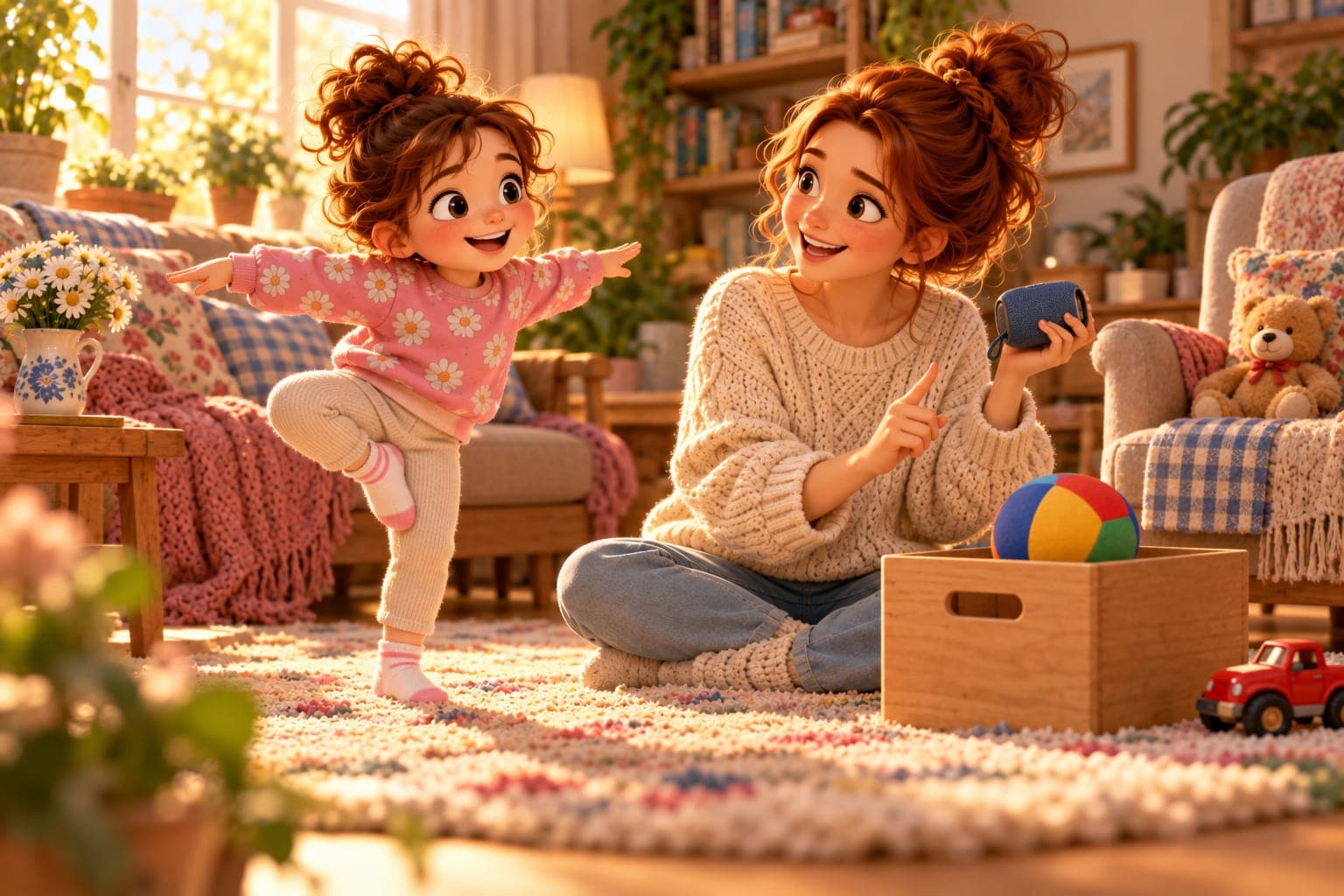
Set out a cushion, box and chair. Guide your child: “Go to the chair”, “Jump”, “Put the ball in the box”, “Turn around”. Once the route is familiar, change the order.
“Freeze” with music
Play music. When you stop it, say “Freeze”. Then add commands such as “Clap your hands”, “Turn around” and “Touch your head”. Your child can respond without having to speak in a full sentence.
Treasure hunt
Hide a few objects. Give clues such as “Look under the chair”, “Go to the door” and “Find something red”. At first, you can point to the place. Gradually, remove the gesture.
If you want a calmer activity after all that movement, use printable activity cards or a simple dot-to-dot ornament activity for a 5-year-old. While your child works, reuse familiar commands such as “Take a pencil”, “Start here” and “Stop”.

How can you increase the difficulty gradually?
Practise one command first, then two in sequence, and only later add prepositions and objects. That is easier than adding many new words at once.
Stage 1: one command
- “Jump.”
- “Sit down.”
- “Clap your hands.”
Stage 2: two commands
- “Stand up and jump.”
- “Touch your nose and sit down.”
- “Clap your hands and turn around.”
Stage 3: an object
- “Give me the ball.”
- “Take the teddy.”
- “Find the car.”
Stage 4: in, on, under
- “Put the ball in the box.”
- “Put the teddy on the chair.”
- “Put the car under the table.”
You do not need to translate “in”, “on” and “under” separately. Show the difference using one object. Your child will quickly see that changing the word changes the object's position.
When should you swap roles and let your child give the commands?
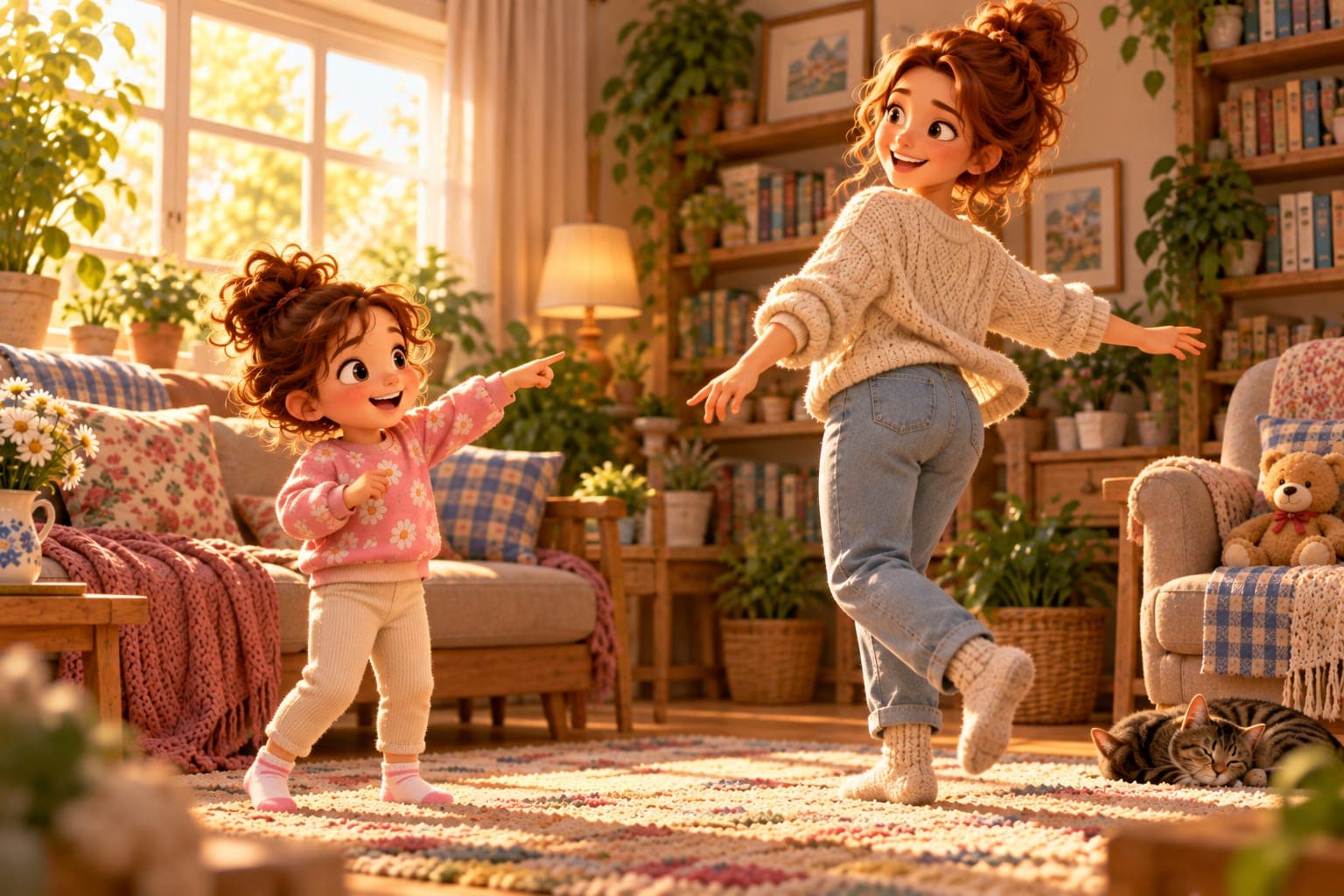
When your child understands several phrases without your gesture, let them lead. The commands do not need to be complete or perfect. If your child says “Mum, jump” or “Ball in box”, accept it and do the action.
You can model a fuller version without direct correction. Your child says “Ball box”, and you reply, “Put the ball in the box? OK!” and do it.
What if your child answers in their home language?
Accept the answer and model the English version naturally, without requiring repetition. If you ask “Where is the ball?” and your child answers in the home language while pointing under the table, you can say, “Yes, under the table” and continue playing.
If your child understands the command, do not turn the moment into a test of the correct spoken answer. Build comprehension and confidence first.
You can also use Labugen educational games for occasional variety, but movement and real objects are still especially useful for practising spatial commands.
What mistakes should you avoid when teaching English to a 5-year-old?
The most common mistake is adding too many commands at once. Another is translating constantly and repeatedly asking whether your child remembers the meaning.
- Do not correct every spoken attempt immediately.
- Do not require your child to repeat every phrase.
- Do not raise the difficulty just because your child responded correctly once.
- Do not turn “Simon Says” into a scored test.
- Do not keep the game going when your child is clearly tired.
- Do not mix five new topics into one session.
Should you worry if your child is not speaking English yet?
You do not need to expect immediate speaking. In TPR, a child may spend some time mainly listening and responding physically. The British Council also describes a “silent period”, when a learner may absorb the language without pressure to produce it.
If your child understands simple commands, joins the game and happily returns to familiar phrases, that is already valuable language learning. You can invite speech through role reversal, but there is no need to force it.
If you are concerned about your child's overall speech and language development in their home language too—for example, difficulty understanding everyday instructions or very limited communication—discuss it with an early-years teacher, speech-language professional or another appropriate specialist. This article is not a speech-development assessment.
How can you plan a simple week of English games?
You do not need a separate lesson every day. A short game using the same set of phrases is enough.
Day | Game | What you practise |
|---|---|---|
Monday | “Simon Says” | stand up, sit down, jump |
Tuesday | “Freeze” | freeze, clap, turn around |
Wednesday | colour hunt | find something red/blue |
Thursday | box and toys | in, on, under |
Friday | obstacle course | two commands in sequence |
weekend | your child leads | giving commands independently |
If your child wants to repeat the same game, let them. You can find other low-pressure activities in the parents' guide.
Sources
- James J. Asher, „The Total Physical Response Approach to Second Language Learning”, The Modern Language Journal, 1969: https://onlinelibrary.wiley.com/doi/10.1111/j.1540-4781.1969.tb04552.x
- Richard Frost, British Council TeachingEnglish, „Total physical response – TPR”, 2004: https://www.teachingenglish.org.uk/professional-development/teachers/teaching-knowledge-database/t-w/tpr