

In short: how do you start with 20 English words?
If your family is just starting English at home, choose words your child can immediately see, point to or touch.
- Split the 20 words across 4 weeks, 5 at a time.
- Say each word when its meaning is right there in the situation.
- Pair the word with a gesture, movement or object hunt.
- Check understanding through action, not by asking “What is this in English?”.
- If your child answers in their home language, accept the answer and calmly model the English word.
If you are starting from zero, first see English for a 3-year-old — how to start without table lessons. That guide covers first contact with English. Here we focus on one practical set of 20 words.
Which 20 English words should you teach a 4-year-old?
Start with words that connect easily to an object, picture, movement or everyday situation. Below are five small groups of four words.
The pronunciation in brackets is only a guide for the parent. It does not replace listening to a recording, and English pronunciation varies by accent.
Group | Word | Pronunciation | When to use it | Gesture or game |
|---|---|---|---|---|
colours | red | /red/ | with a red crayon, cup or block | touch something red |
colours | blue | /bluː/ | with blue clothes or toys | find three blue things |
colours | yellow | /ˈjel.oʊ/ | with a banana, toy car or sun in a picture | point to the yellow crayon |
colours | green | /ɡriːn/ | with grass, leaves or a block | put the green things together |
animals | dog | /dɒɡ/ | when you see a dog | make a dog sound and point to the dog |
animals | cat | /kæt/ | with a cat, soft toy or picture | move your hands like paws |
animals | bird | /bɜːd/ | with a bird outside the window or on a walk | make wings with your arms |
animals | fish | /fɪʃ/ | with a book, bath toy or picture of a fish | move your hand as if it were swimming |
food | apple | /ˈæp.əl/ | at snack time or while shopping | put the apple with the fruit |
food | banana | /bəˈnɑː.nə/ | while peeling a banana | pretend the banana is a phone |
food | milk | /mɪlk/ | at breakfast or another meal | point to the cup or carton |
food | water | /ˈwɔː.tər/ | while pouring water | make a drinking gesture |
clothes | shoes | /ʃuːz/ | before leaving home | find your own shoes |
clothes | coat | /kəʊt/ | while putting on a coat or jacket | stretch out your arms to get dressed |
clothes | hat | /hæt/ | with a hat or during dress-up play | put your hand on your head |
clothes | socks | /sɒks/ | while getting dressed or folding laundry | match socks into pairs |
home and body | hand | /hænd/ | while washing hands, drawing or waving | wave your hand |
home and body | nose | /nəʊz/ | while washing your face or looking in a mirror | touch your nose |
home and body | door | /dɔːr/ | when leaving a room | open and close the door |
home and body | bed | /bed/ | while making the bed or at bedtime | put the teddy to bed |
Do not recite the whole list every day. One natural “red” while your child is holding a red crayon gives the word a clear context.
For colours and animals, you can also use printable colouring pages. Your child can choose a crayon when they hear the English colour word or point to animals they already know.
How can you weave English words into a 4-year-old's day?
The easiest way is to attach words to routines that already happen every day. In the morning you get “socks” and “shoes”. At breakfast, “milk”, “water” or “apple”. On a walk, “dog”, “bird”, “red” and “green”. In the evening, “bed”.
Keep it short. Instead of long sentences, use one word or a simple prompt: “Red?”, “Where is the dog?”, “Show me your hand”, “Shoes on”. The situation and gesture carry much of the meaning.
A paper activity can help too. With a car dot-to-dot for a 4-year-old you can add “car”, “red car” or “blue car”. The activity does not need to be an English lesson to create a natural chance to use a familiar word.

What does a 4-week plan of 5 words look like?
The plan helps the adult stay organised; it is not an exam deadline. If your child needs more time, stay with the same five words for longer.
Week | 5 words | Best situations |
|---|---|---|
1 | red, blue, dog, cat, apple | crayons, walks, snack time |
2 | yellow, green, bird, fish, banana | drawing, walks, books, mealtimes |
3 | milk, water, shoes, coat, hat | breakfast, going out, getting dressed |
4 | socks, hand, nose, door, bed | laundry, bathroom, home, evening |
Do not drop earlier words when a new week starts. If “red” already works, keep using it naturally. The new five simply get more attention.
A small note with five words on the fridge can help. It is a prompt for the adult, not a reading task for the child.
How can you combine the words into first phrases?
After four weeks, you can start joining familiar words into very short phrases. Do not introduce a whole new list at once—use what your child already understands and add only one simple element.
Start with combinations that fit a real situation: “red apple” with a red apple, “blue hat” with a blue hat, “my shoes” while getting dressed, “big dog” on a walk or “wash hands” at the sink. Say the phrase while your child can see the object or do the action, so the meaning stays clear without translation.
After week 4, choose one or two phrases like these each day. Do not make a separate exercise. At breakfast you might say “red apple”, before leaving “my shoes”, and in the bathroom “wash hands”. If your child answers with one word, such as “shoes”, accept it and expand: “Yes, my shoes”. This models a longer phrase without demanding repetition.
When your 4-year-old starts combining words independently, do not correct every form. If they say “blue hat” in the right situation, respond with a natural complete phrase and keep the interaction moving. The important step is that English words are beginning to connect with each other and with real meaning.
Which games with these words take only 3–5 minutes?
A short game is enough if the words also reappear in daily routines.
Colour “I spy”. Say: “I spy something red” or simply “Find red”. Your child looks for a matching object.
“Where is…?” Put out three toys or pictures. Ask “Where is the cat?” or “Where is the fish?”. Your child only needs to point.
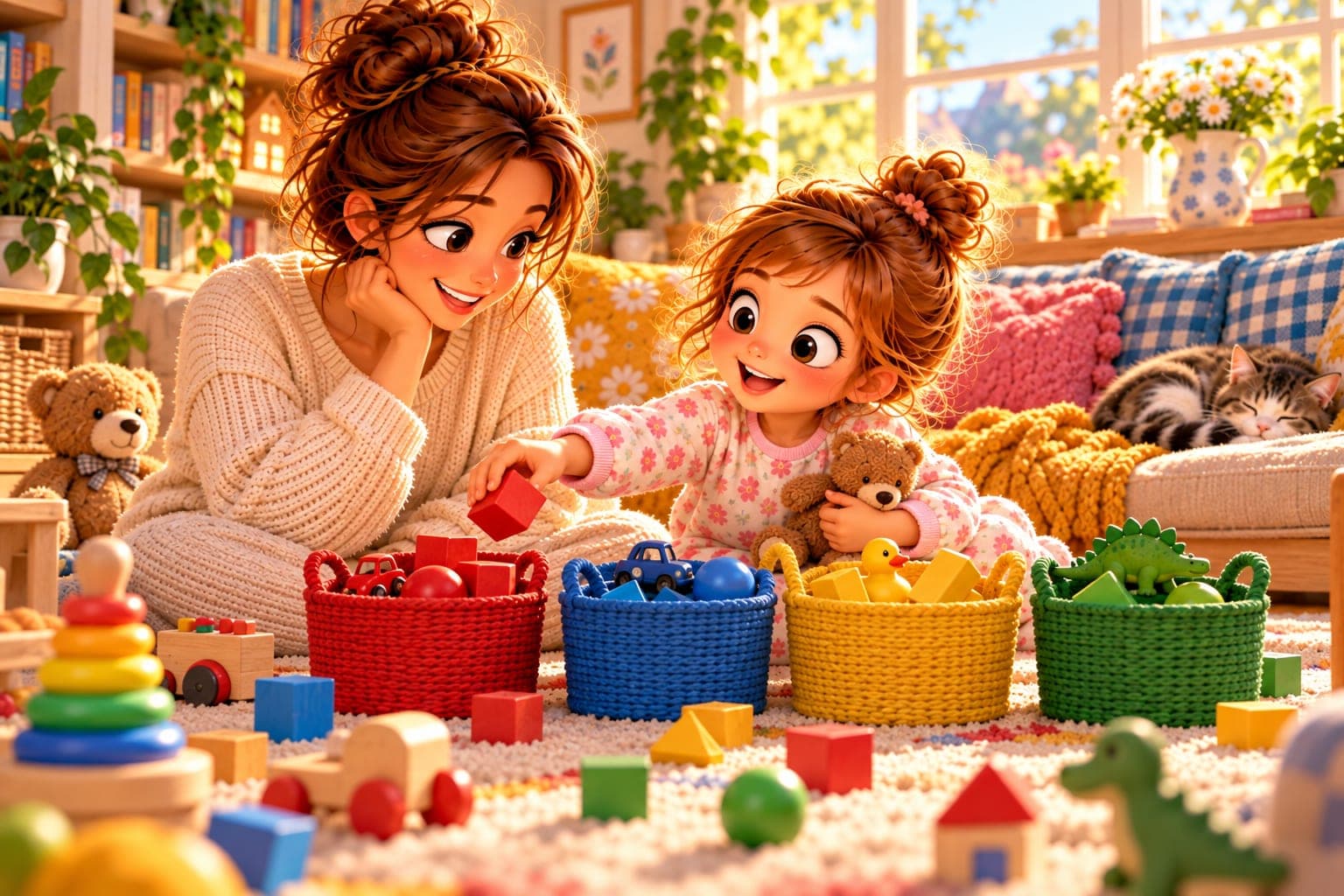
Sorting. Say: “Red here, blue here”. You can also sort clothes: “socks”, “hat”, “coat”.
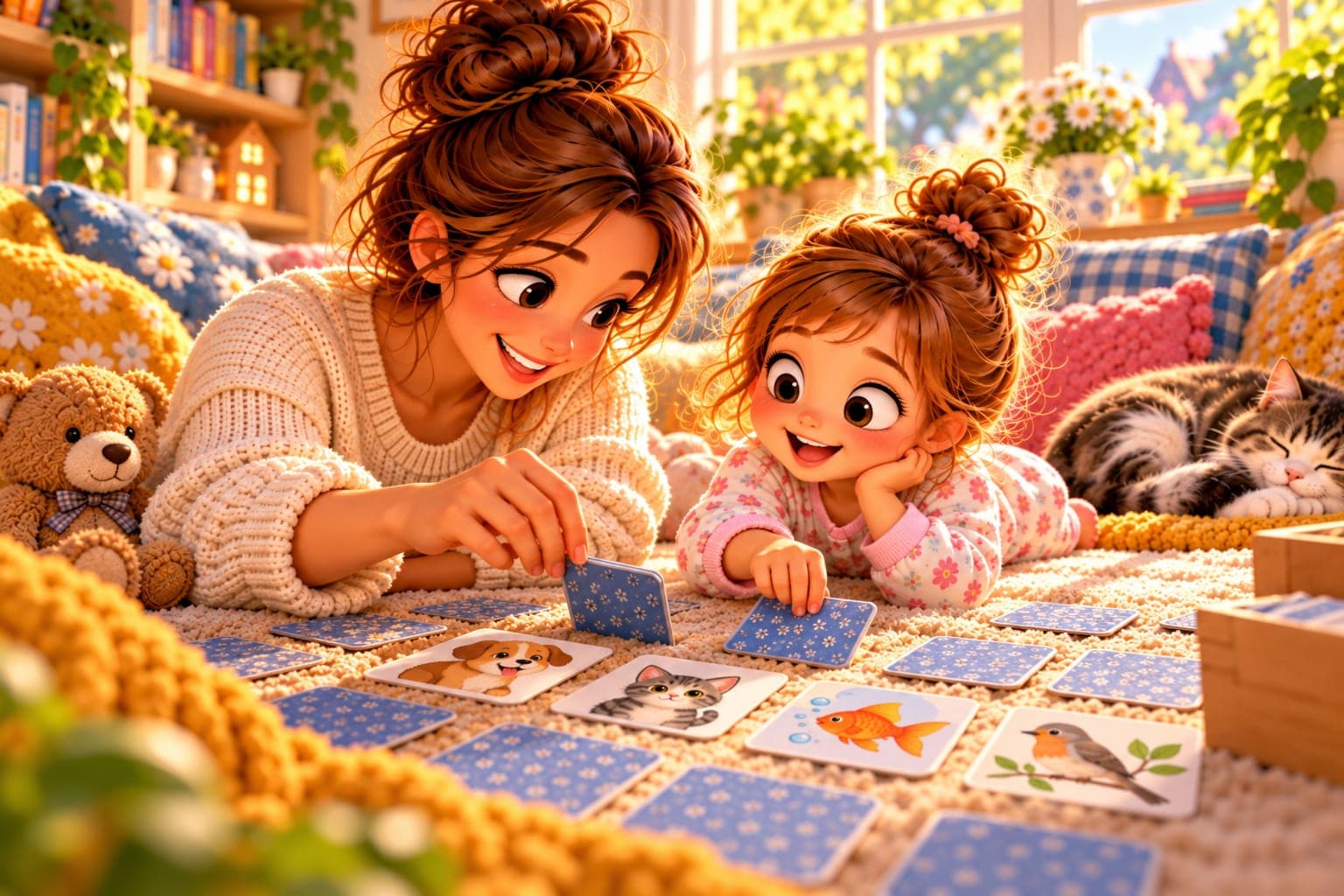
Picture matching game. As each card is turned over, the adult names the picture in English. There is no need to make the child repeat it.
“Bring me…” Say “Bring me the shoes” or “Bring me the hat”. Your child shows understanding through action.
For variety, you can sometimes use Labugen educational games or printable activity cards. The adult still adds the English words—do not assume the resource itself is designed as an English-language course.

How can you check progress without quizzing?
Check through your child's response. If you say “Where is the dog?” and they point to the dog, you can see that they understand the word.
You can also notice whether your child:
- chooses the right colour,
- brings the requested object,
- touches the correct body part,
- sorts pictures according to the prompt,
- responds without needing a translation into the home language.
Do not expect every word your child understands to appear immediately in speech. Understanding often develops before independent spoken use.
What if your child answers in their home language?
Accept the answer and model the English word without stopping the game. If you ask “Where is the dog?” and your child answers in the home language while pointing to it, say “Yes, dog” and continue.
If your child mixes languages, do not treat it as a mistake or bad habit. ASHA notes that children who use more than one language may mix words across languages. Regular, meaningful opportunities to communicate matter more than perfect separation from the first day.
How can you help with pronunciation without constant correction?
The best approach is modelling: simply repeat the word naturally and correctly. If your child says “fis”, answer “Yes, fish” and point to the fish.
A written pronunciation guide is only a starting point. If you are unsure how a word sounds, listen to it in a reliable learner's dictionary. Do not make your child repeat a word over and over just to chase a perfect accent.
What mistakes should you avoid when teaching English to a 4-year-old?
The word list is there to help the adult, not to turn play into a test.
- Do not introduce all 20 words at once. Stick to a small group of five.
- Do not fire off quiz questions. Instead of “What is this in English?” use “Where is the cat?”.
- Do not require an English answer every time.
- Do not correct every sound. Model the natural word and keep going.
- Do not compare your child's pace with other children.
If you need neutral pictures of colours, animals and everyday objects, you can use worksheet generators as a backdrop for play. They are not a promise of a ready-made English course.
When should you discuss speech and language development with a specialist?
Exposure to English itself is not a cause for concern. ASHA states that using more than one language does not cause or worsen speech or language disorders.
If you are concerned about your child's communication in their home language as well—for example, they struggle to express needs or understand simple messages—talk to a paediatrician or speech-language professional. Any assessment should consider all the languages your child uses.
Sources
- American Speech-Language-Hearing Association, „Learning More Than One Language”, dostęp 2026: https://www.asha.org/public/speech/development/learning-more-than-one-language/
- British Council, „Support for parents”, LearnEnglish Kids, dostęp 2026: https://learnenglishkids.britishcouncil.org/support-for-parents