
In short: what maths skills should children practise regularly in early primary school?
- addition and subtraction up to 100 — almost every day, with just a few examples;
- tens and ones — 2–3 times a week, especially if your child confuses how two-digit numbers are written;
- multiplication and division — 2–3 times a week, first with real objects and then increasingly from memory;
- word problems — twice a week, including simple two-step problems;
- clocks, measurement and money — 1–2 times a week and through everyday situations;
- 10–15 minutes a day is enough for the whole routine.
You can find a full set of materials in the early primary mathssection. If your child is moving on from simpler calculations, the previous step may also help: early primary maths — how to choose the right level.
Which maths skills are worth reviewing most often in early primary school?
Keep returning to seven areas: calculations up to 100, place value, multiplication and division, word problems, time, measurement and money. Short reviews reveal understanding better than one long worksheet each week.
1. Addition and subtraction up to 100
Practise calculations both without and with crossing a multiple of ten. Example without crossing: 43 + 25 = 68. Example with crossing: 47 + 8 = 55. Subtraction: 72 − 18 = 54.
Common difficulty: the child counts one by one or loses track of the tens when crossing 50, 60 or 70.
5-minute practice: give three questions each from addition up to 100 and subtraction up to 100. Ask your child to explain how they reached the answer. For crossing a ten, you can also use an addition up to 100 with regrouping worksheet.
2. Tens and ones
Your child should understand that 64 is 6 tens and 4 ones, not just recognise the number visually. Example: “Which number has 7 tens and 3 ones?” — 73.
Common difficulty: reversing 46 and 64 or finding it hard to split 58 into 50 and 8.
5-minute practice: say numbers from 20 to 99 and ask your child to name the tens and ones. Then reverse the task: “5 tens and 9 ones” — the answer is 59.
3. Multiplication and division — meaning first, memory later
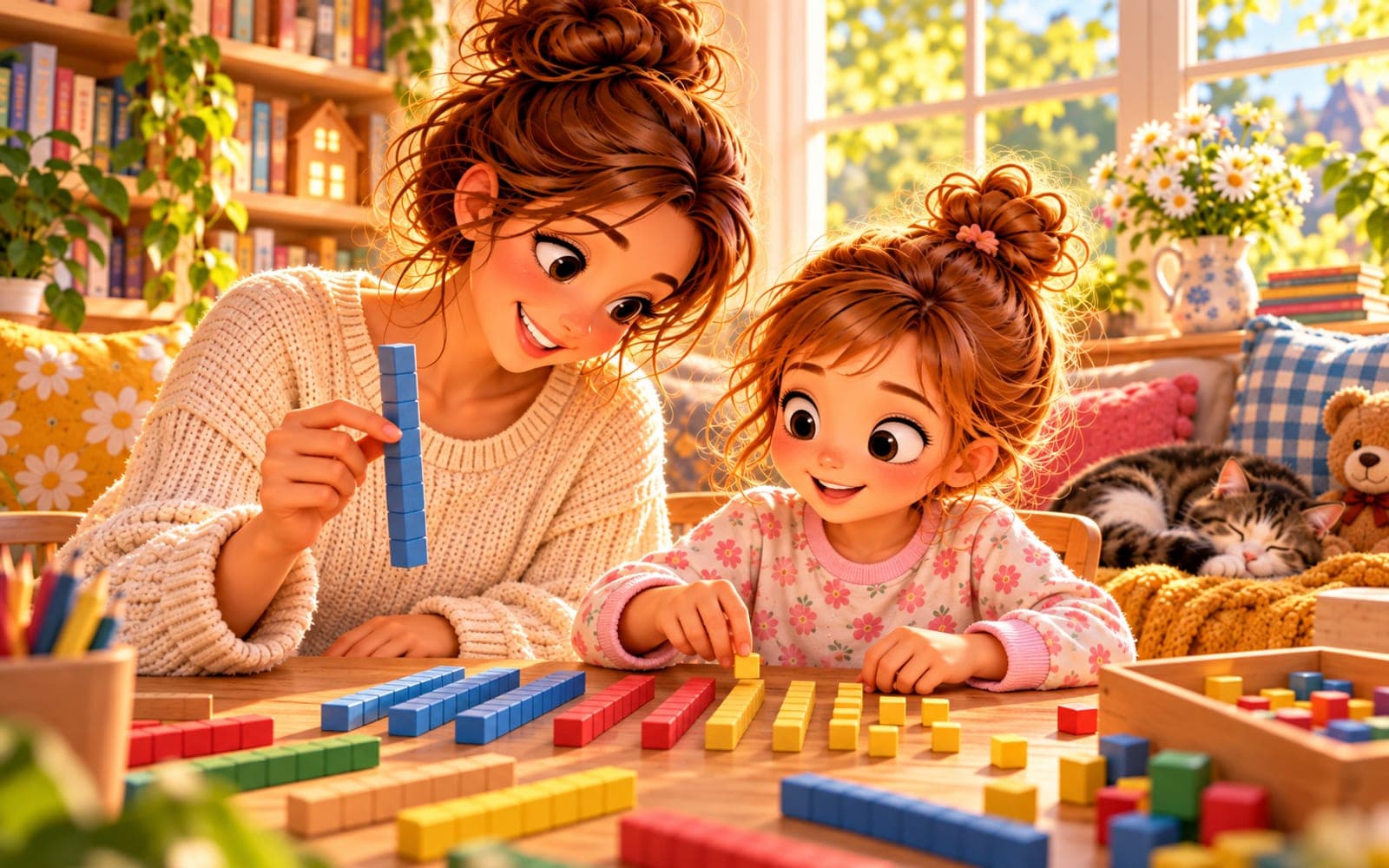
Multiplication should grow out of equal groups. Example: 4 plates with 3 blocks on each gives 4 × 3 = 12. Division can be shown as sharing: 12 blocks shared equally among 3 people gives 12 ÷ 3 = 4.
Common difficulty: the child remembers an answer but cannot show what the calculation means.
5-minute practice: make 3 groups of 4 blocks, then show 15 ÷ 5 = 3 as five equal groups. Use multiplication tables, division and the guide how to teach a child times tables.
4. Word problems, including two-step problems
In early primary school, practise not only choosing an operation but also deciding the order of two steps. Example: “Emma had 24 stickers. She got 8 more and then gave away 5. How many does she have now?” First 24 + 8 = 32, then 32 − 5 = 27. Answer: 27 stickers.
Common difficulty: the child picks every number from the problem and performs a random operation.
5-minute practice: read one activity from early primary word problems. Ask your child to say what changes in the first step before writing the calculation.
5. Clocks: half hours and quarter hours
Your child should become comfortable recognising whole hours, half hours and quarter hours. Example: from 14:15 to 14:45, 30 minutes pass. From 16:30 to 17:00, 30 minutes also pass.
Common difficulty: confusing half past four with 5:30 or treating a quarter of an hour as 25 minutes.
5-minute practice: draw three clock faces showing 7:30, 10:15 and 18:45. Your child reads the times and says how many minutes remain until the next full hour. You can use the clocks — half hours and quarter hourssection.
6. Units of measurement: centimetres, kilograms and litres
These are best practised with real objects. Example: if a crayon is 14 cm long and a pencil is 19 cm long, the pencil is longer by 5 cm. If a bottle contains 1 litre of water and we use half a litre, half a litreremains.
Common difficulty: the child calculates correctly but chooses the wrong unit, for example giving the length of a table in kilograms.
5-minute practice: measure three objects with a ruler, read the mass on a food package and identify the capacity of a bottle. Review materials are available in the units of measurementsection.
7. Money
Money connects arithmetic with everyday life. Example: a notebook costs 6 coins and a pen costs 4 coins. Together that is 10 coins. If you pay 20 coins, the change is 10 coins.
Common difficulty: the child adds the price to the amount paid instead of finding the difference.
5-minute practice: make a pretend shop with three prices. Your child chooses two products, calculates the total and the change from 20 coins.
How often should each skill be practised?
Not every skill needs a daily worksheet. What matters is returning to it regularly and noticing whether your child needs fewer prompts over time.
Skill | How often | Sign of progress |
|---|---|---|
addition and subtraction up to 100 | 4–5 times a week | your child calculates more efficiently and can explain the method |
tens and ones | 2–3 times a week | correctly splits and writes two-digit numbers |
multiplication and division | 2–3 times a week | understands equal groups and recalls more facts from memory |
word problems | twice a week | chooses an operation and can explain the order of steps |
clocks | 1–2 times a week | correctly reads half hours and quarter hours |
units of measurement | 1–2 times a week | chooses an appropriate unit for the situation |
money | 1–2 times a week | calculates a shopping total and simple change |
The EEF recommends combining purposeful maths activities with mathematics that appears in everyday routines, such as telling time, shopping and measuring.
How can you build a 10–15 minute daily weekly rhythm?
The simplest approach is to give each day one main focus and add 3–4 short calculations every day.
Day | 10–15 minute plan |
|---|---|
Monday | addition and subtraction up to 100 + tens and ones |
Tuesday | multiplication with objects + one word problem |
Wednesday | subtraction crossing a ten + clocks |
Thursday | division into equal groups + measurement |
Friday | mixed calculations + money |
weekend | no compulsory worksheet: clocks, shopping, cooking, measuring |
For quick review, you can use the math worksheet generator. Change the number range and type of operation so the worksheet matches what your child is currently practising at school.
How can home practice connect with classroom learning?
First check the child’s notebook or information from the teacher. Home review should reinforce the method currently being taught.
If the class is splitting 47 into 40 and 7, use similar examples at home. If multiplication is being taught as equal groups, do not jump straight to memorising the whole table. The EEF recommends building on what a child already knows and using objects and representations.
School curricula usually describe mathematics across a broader early primary stage, rather than setting a separate rigid checklist for one year. The order and pace can therefore differ between schools.
What mistakes should you avoid during review?
- Sessions that are too long. After 10–15 minutes, it is often better to stop than turn review into an hour-long test.
- Practising only one type of question for the whole week. Children also need to recognise which operation fits a situation.
- Learning multiplication facts without understanding. Start with groups and sharing, then build faster recall.
- Giving the answer after the first hesitation. Ask your child to show their thinking or model the calculation with objects.
- Trying to get ahead of the curriculum at all costs. It is better to secure current material than introduce new topics without foundations.
When should you talk to the teacher?
Talk to the teacher when a difficulty persists despite short practice and affects several basic areas at once, such as tens and ones, addition up to 20 or simple word problems.
Ask how your child manages in class, which calculation strategies are being taught and what should be practised first.
Sources
- Minister Edukacji, Rozporządzenie z dnia 11 marca 2026 r. w sprawie podstawy programowej wychowania przedszkolnego oraz podstawy programowej kształcenia ogólnego dla szkoły podstawowej, Dz.U. 2026 poz. 378.
- Education Endowment Foundation, Improving Mathematics in the Early Years and Key Stage 1, 2020.
- Education Endowment Foundation, Integrating maths into everyday routines, materials accompanying the report “Improving Mathematics in the Early Years and Key Stage 1”.