
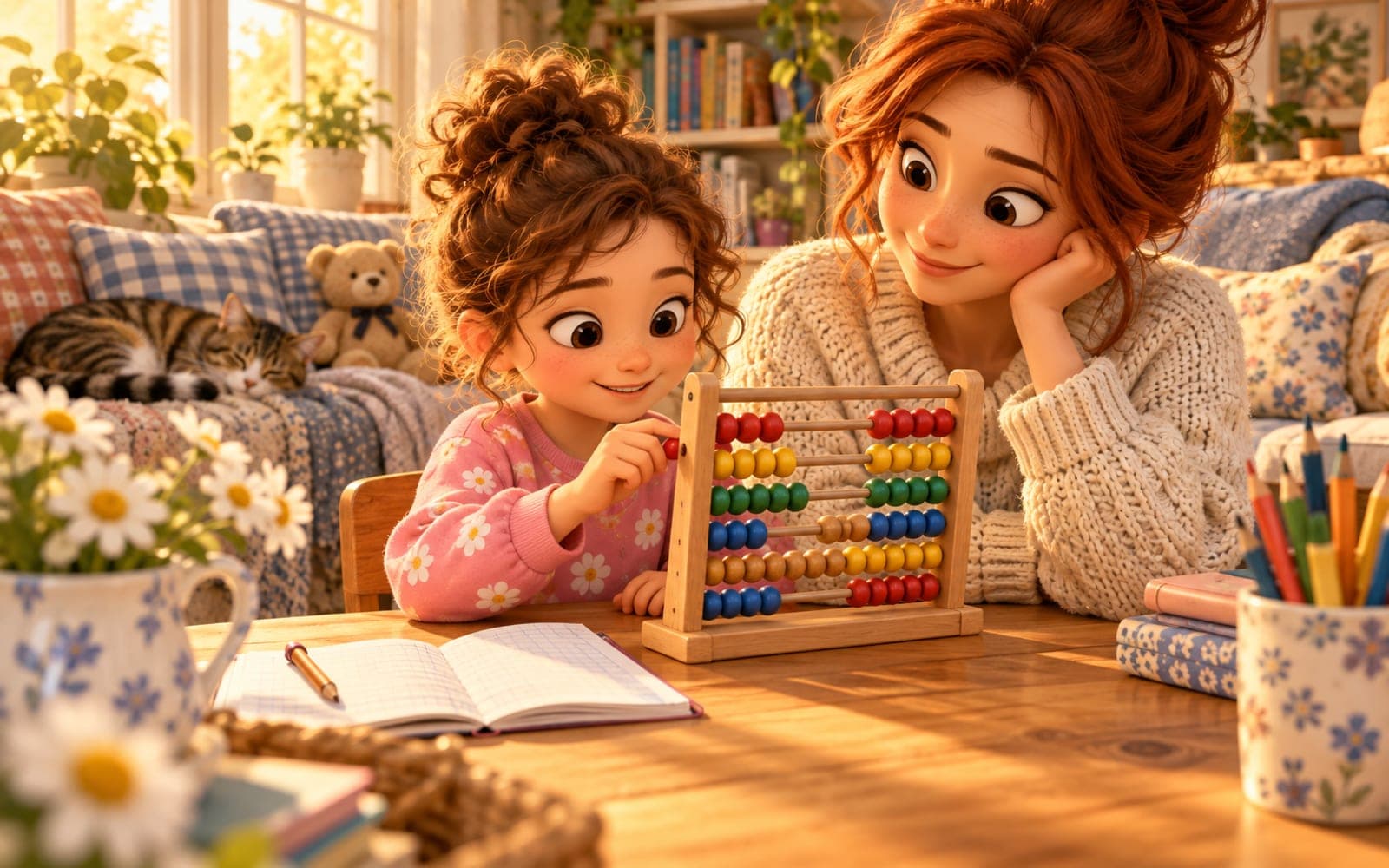
How do you choose the right level of maths activities in early primary school?
First check what your child already understands, and only then choose the number range or type of calculation. Do not start from a textbook page number or from what classmates are doing.
- Start with counting real objects and simple calculations up to 10.
- Raise the level only when your child can explain what they are doing.
- Introduce one new difficulty at a time: a larger number range, crossing 10, or a word problem.
- If your child starts guessing, loses track of the operation sign or counts everything again from the beginning, lower the difficulty.
- Practise briefly and regularly instead of doing many similar examples in one evening.
You can choose materials from the early primary mathssection and create your own sets in the math worksheet generator. The generator can create PDFs with addition and subtraction up to 10, 20 and 100, including an answer key.
What progression works well in early primary maths?
The safest approach is to move from concrete objects toward increasingly abstract notation. The progression below is not an official school curriculum sequence. It is a practical order that makes it easier to see exactly where a difficulty begins.
Level | Example task | How to tell your child is ready to move on |
|---|---|---|
Counting with objects | Put down 7 blocks. Add 2. How many altogether? 7 + 2 = 9 | Your child counts correctly, understands “add” and “take away,” and can show the answer with objects. |
Addition and subtraction up to 10 | 6 + 3 = 9, 10 − 4 = 6 | Your child solves most similar calculations independently without guessing. |
Making 10 | How many more from 7 to 10? 3, because 7 + 3 = 10 | Your child quickly identifies the missing part for several different numbers. |
Up to 20 without crossing 10 | 12 + 5 = 17, 18 − 6 = 12 | Your child understands tens and ones and does not need to count everything from 1. |
Up to 20 crossing 10 | 8 + 5 = 13, because 8 + 2 + 3; 14 − 6 = 8 | Your child can split a number and bridge through 10 instead of counting chaotically. |
Simple word problems | Emma has 8 crayons and gets 4 more. How many does she have? 8 + 4 = 12 | Your child can say what they need to find, choose an operation and check whether the answer makes sense. |
Comparing numbers | Which number is greater: 14 or 17? 17 | Your child orders numbers correctly and understands “more,” “less” and “how many more” in simple examples. |
Money amounts up to 20 | A pencil costs 6 coins and a notebook 8 coins. Together they cost 14 coins | Your child adds prices and understands that the result is the total amount to pay. |
Whole hours | The clock shows 7:00. In 2 hours it will be 9:00 | Your child reads whole hours and makes simple shifts in time. |
For practice, choose separate sets for addition up to 10, addition up to 20, subtraction up to 20 and comparing numbers. When your child is ready to bridge through ten, a crossing-10 addition worksheet up to 20can also help.
How can you check your child’s level in 5 minutes?
Do a short, untimed check at the table without grades. Say, “I want to see where it will be best to start.” Give five tasks, one from each successive level, and allow fingers or blocks.
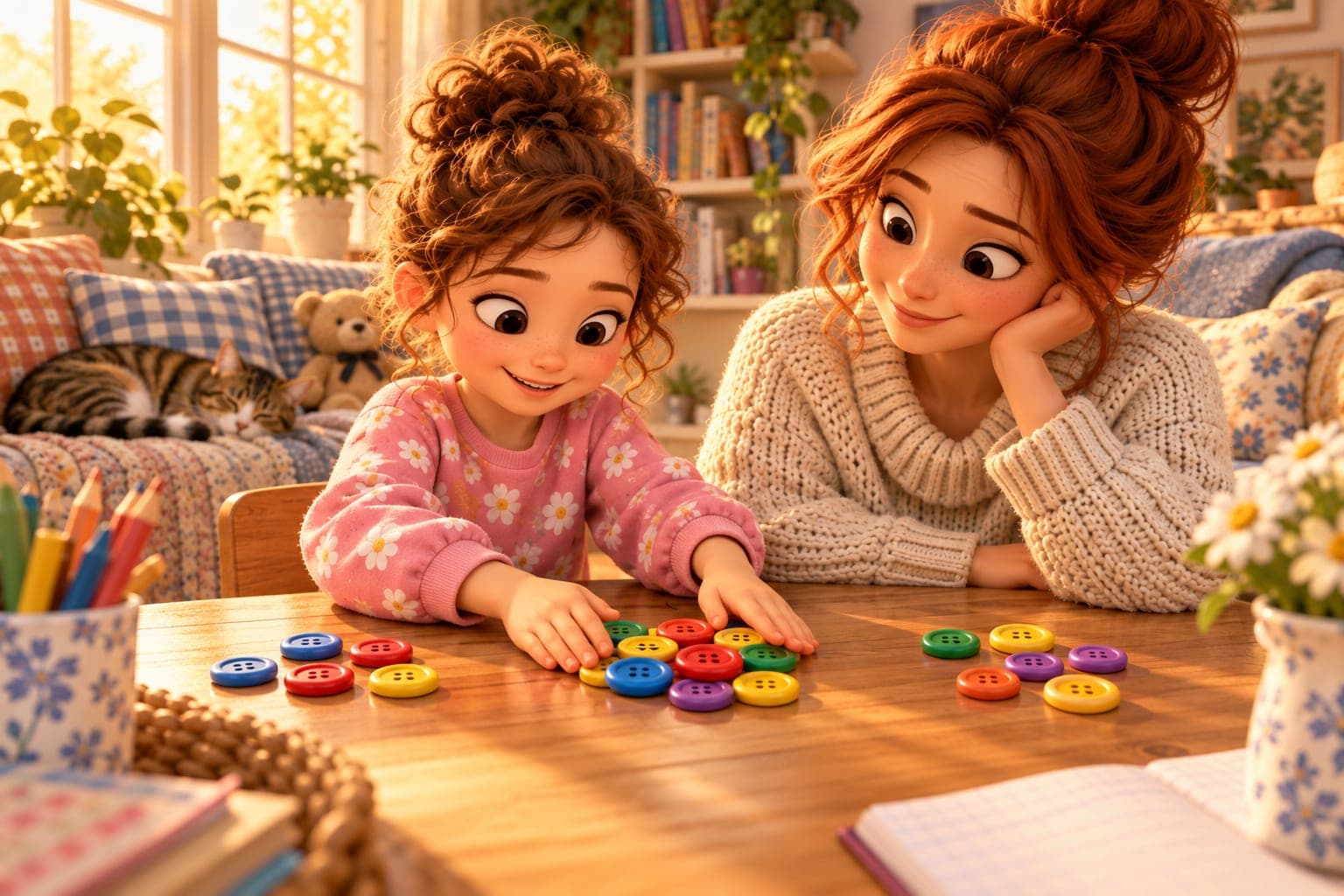
- Show 6 buttons and add 3. How many altogether? 6 + 3 = 9.
- Calculate 9 − 4 = 5.
- Complete: 7 + __ = 10. Answer: 3.
- Calculate 13 + 4 = 17.
- Calculate 8 + 5 = 13. A good explanation is: add 2 to 8 to make 10, leaving 3, so 10 + 3 = 13.
If the first three examples are easy and the fourth takes some thought, start with calculations up to 20 without crossing 10. If the fourth is comfortable but your child starts guessing on the fifth, practise making 10 before doing many more crossing-10 examples.
Do not draw conclusions from one mistake. What matters more is whether your child understands the method. If they can correct the answer after you ask, “How could you check it?”, the skill may be closer to secure than the first answer suggests.
When should you step back one level?
Step back when the difficulty blocks understanding, not only after many unsuccessful worksheets. Warning signs include a run of the same type of error, guessing the operation sign, recounting every quantity from the beginning, or being unable to answer “why?”.
For example, with 8 + 6 your child counts on one from 8, loses track after crossing ten and often loses the answer. Instead of repeating more crossing-10 calculations, return to making 10: 8 + 2 = 10, then split 6 into 2 and 4. Stepping back is not a punishment. It rebuilds the calculation strategy.
Is counting on fingers or using an abacus okay?
Yes. Fingers, an abacus, blocks and drawings can help a child see quantity and understand the operation. The Education Endowment Foundation recommends purposeful use of manipulatives and representations, connected to pictures, symbols and mathematical notation.
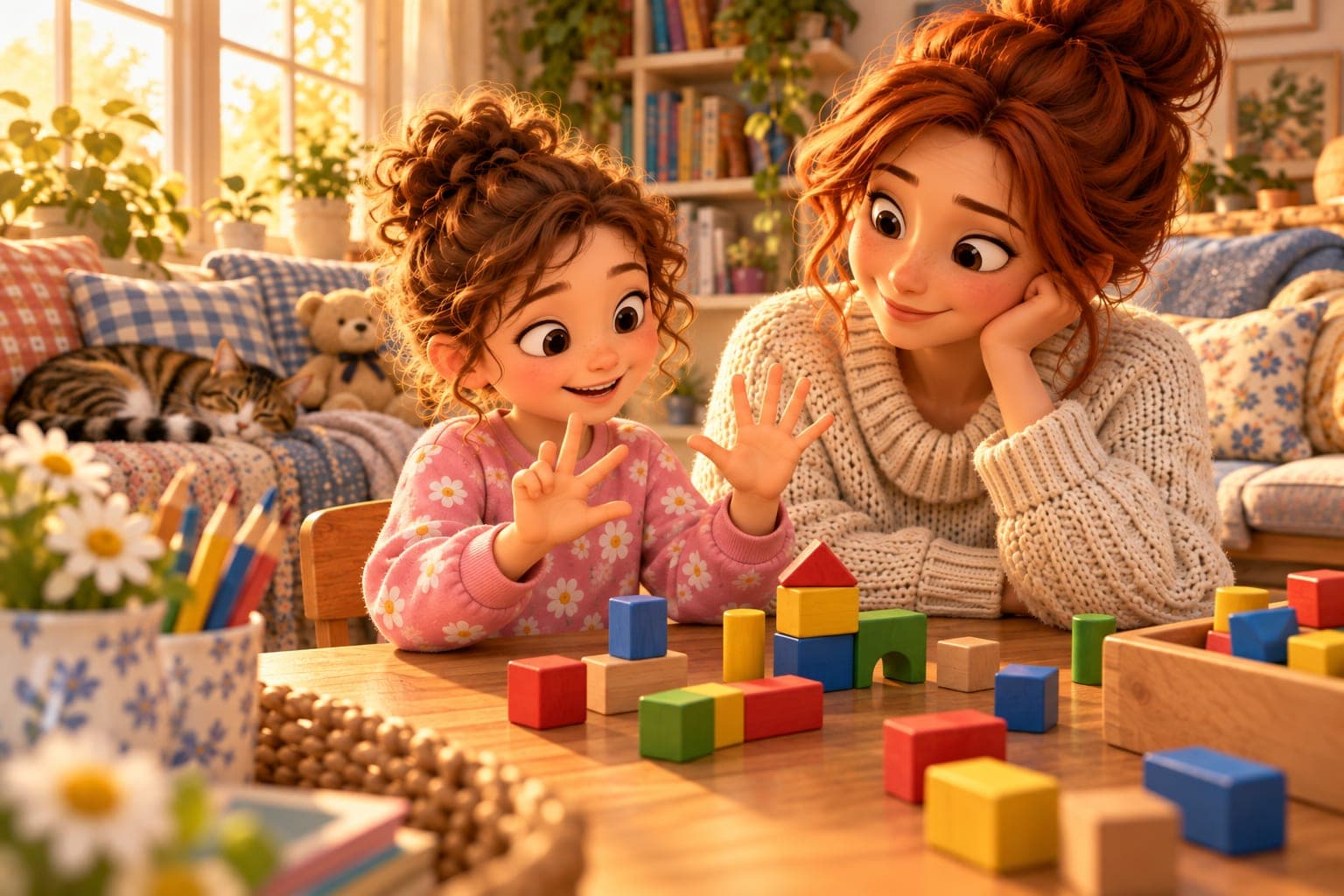
Do not remove support simply because your child “should be doing it mentally by now.” Instead ask, “Show me how you worked it out.” Then encourage a shorter route. With 6 + 3 your child may first use fingers and later recognise 9 without counting every finger.
To develop number sense, you can also use the game Labugen Shoal, where children work with quantities through play.
How many maths problems should a child do each day?
For home review, a short session is usually better than a long worksheet that must be “finished.” Start with about 10 minutes and 6–10 well-chosen examples. If your child is still working calmly, add a short game or one practical task.
Do not increase both the number of problems and the difficulty at the same time. When entering a new stage, a few examples are enough. For money, play shop and use money-counting activities. For time, move on to whole hours on a clock.
What might a 4-week plan look like?
The plan should respond to your child’s results rather than work like a rigid calendar.
Week | Main goal | Example practice |
|---|---|---|
1 | Check the foundations | Counting with objects, addition and subtraction up to 10, making 10. |
2 | Up to 20 without crossing 10 | 3–4 short sessions, for example 12 + 4, 17 − 5, comparing numbers. |
3 | Crossing 10 | Split the second addend: 9 + 4 = 9 + 1 + 3 = 13; subtract by bridging through 10. |
4 | Apply the skills | Simple word problems, money amounts up to 20, whole hours and mixed review. |
If week 2 is still difficult, do not move mechanically to week 3. Repeat the same range in another form: blocks, a number line, a game or a shorter worksheet.
How can you practise word problems without guessing the operation?
Your child should first understand the situation and only then choose the operation sign. Ask them to retell the problem in their own words, identify the information and say what needs to be found.
Example: “Maya has 9 stickers. She gets 5 more. How many does she have now?” Your child can set out 9 blocks and add 5. Then split 5 into 1 and 4: 9 + 1 = 10, 10 + 4 = 14, so the answer is: Maya has 14 stickers.
For an older sibling or as a next step in later years, you may also find the guide how to read and understand word problemsuseful.
What mistakes should you avoid when choosing the level?
- Skipping foundations. Crossing 10 without understanding how to make 10 often turns into counting one by one.
- Comparing with other children. Compare your child with their own earlier work.
- Practising only for speed. Accuracy and method come first; fluency comes later.
- Removing concrete supports too early. Fingers and an abacus can be a bridge toward symbols.
- Doing only columns of calculations. Mix written calculations with word problems, money, clocks and comparisons.
When should you talk to the teacher?
Talk to the teacher when difficulties continue despite stepping back a level and practising calmly, or when you are unsure whether home practice matches what is being taught in class. Give a concrete example: “7 + 2 is secure, but with 8 + 5 my child always starts counting from 1.”
School maths expectations are usually described across a broader early-primary stage rather than as a simple home checklist for one school year. They include developing understanding of numbers and operations, interpreting mathematical situations and using personal strategies. Classroom pacing can therefore vary, and the teacher can tell you what is currently being practised.
If the teacher also sees persistent, significant difficulties, ask what additional support is available through the school. The aim is to adapt the way your child learns, not to make a diagnosis at home.
Sources
- Minister Edukacji, Rozporządzenie z 11 marca 2026 r. w sprawie podstawy programowej wychowania przedszkolnego oraz kształcenia ogólnego dla szkoły podstawowej, Dz.U. 2026 poz. 378, 2026.
- Ministerstwo Edukacji Narodowej, Nowe podstawy programowe wychowania przedszkolnego i kształcenia ogólnego dla szkoły podstawowej — rozporządzenia podpisane, 2026.
- Education Endowment Foundation, Use manipulatives and representations to develop understanding, material from the guide “Improving Mathematics in the Early Years and Key Stage 1”.