

In short: how can you prepare a child for harder calculations?
As primary maths becomes more advanced, children need increasing fluency as well as an understanding of why a method works, not just the final answer. At home, practise briefly and focus on one goal at a time.
- Split numbers into tens and ones, for example 47 = 40 + 7.
- Practise addition and subtraction up to 100 when crossing a multiple of ten.
- Show three-digit numbers as hundreds, tens and ones.
- Introduce missing-number problems, such as 38 + □ = 64, and check the answer with the inverse operation.
- Ask your child to estimate before calculating exactly.
- Connect calculations with money, length and time.
For short review sessions, use the math worksheet generator, and find ready-made resources in printable worksheets.
What changes as primary maths becomes more advanced?
Children increasingly need to calculate fluently, explain their method and check their own answers. Memorised answers are not enough if a learner does not understand place value or cannot break a calculation into simpler steps.
In primary education, mathematics develops calculation alongside reasoning, problem solving and using maths in everyday situations.
For a parent, this means one important change: instead of asking only “What did you get?”, ask “How did you work it out?” more often. When your child can show the method, it is easier to see whether an error comes from inattention or from misunderstanding the number.
Times tables have their own learning progression and are not the main topic of this article. If that is what you need, see learning times tables in primary school. Here we focus on calculations that prepare children for larger numbers and more independent problem solving.
How can you practise addition up to 100 when crossing a ten?
This is easiest when your child splits one number so they can first reach the next multiple of ten. That reduces the number of steps they need to hold mentally.
Example: 48 + 27.
- 48 needs 2 more to reach 50.
- Split 27 into 2 and 25.
- Calculate 48 + 2 = 50.
- Then 50 + 25 = 75.
You can also split both numbers into tens and ones: 48 = 40 + 8 and 27 = 20 + 7. Then 40 + 20 = 60 and 8 + 7 = 15, so 60 + 15 = 75.
Do not insist on one “correct” method when your child is reasoning accurately. One child may prefer bridging to the next ten, while another separates tens and ones.
For practice, print addition up to 100 with regrouping — worksheet 1. A few examples a day are enough at first, but ask your child to write out the method for one of them.
How can you practise subtraction up to 100 when crossing a ten?
With subtraction, it can help to move first to a multiple of ten or split the number being subtracted into parts. Your child should see that the whole calculation does not need to happen in one jump.
Example: 63 − 28.
- First 63 − 3 = 60.
- There are still 25 left to subtract from 28.
- 60 − 20 = 40.
- 40 − 5 = 35.
Another route is 63 − 20 = 43, then 43 − 8 = 35.
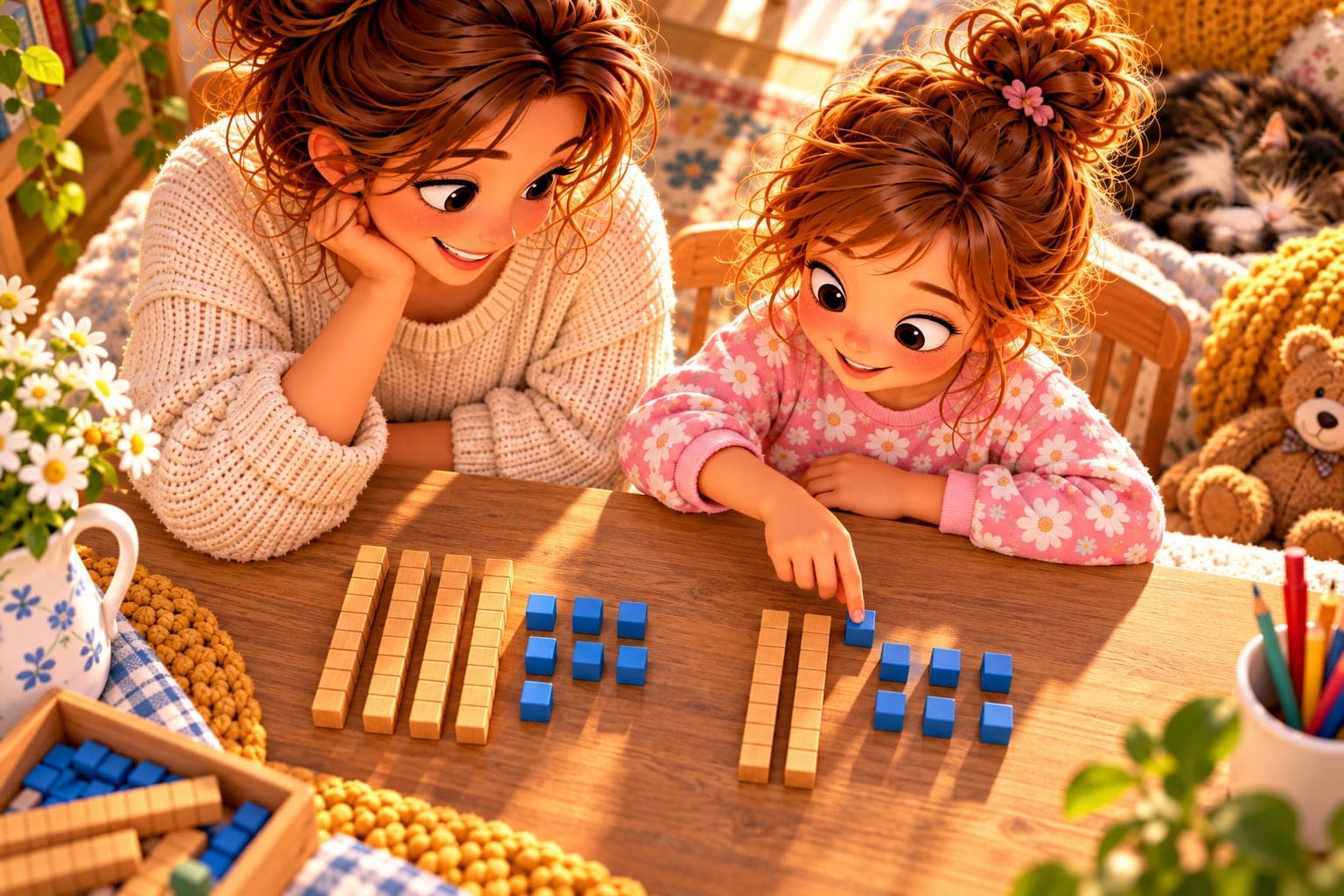
If your child gets lost in the notation, use a number line or base-ten blocks. The goal is not to remove support as quickly as possible. Move from concrete models to written notation only when each step makes sense.
A ready-made resource is subtraction up to 100 with regrouping — worksheet 1.
How can you explain hundreds, tens and ones?
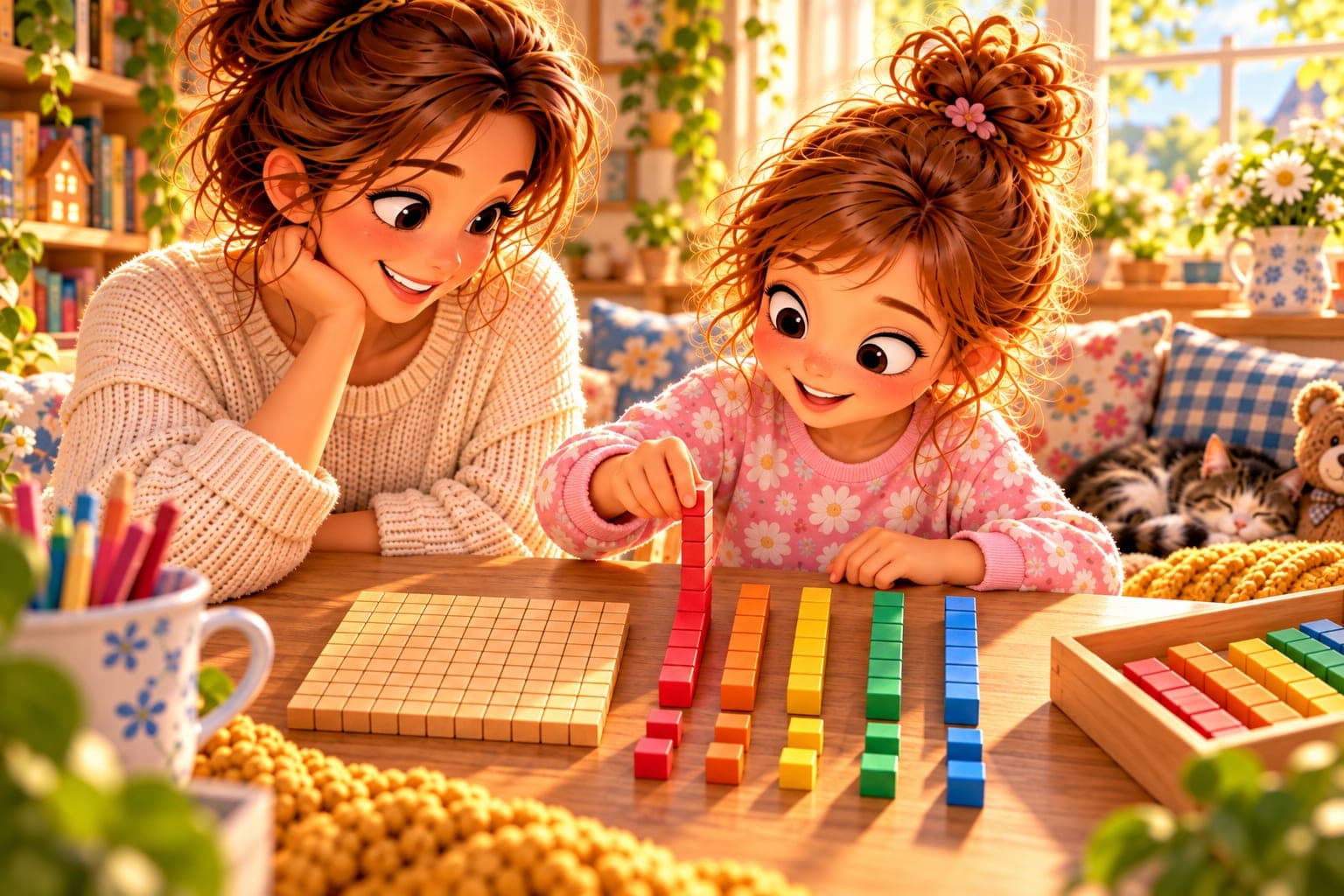
Build the number from three place-value positions. In 364, the digit 3 represents three hundreds, 6 represents six tens, and 4 represents four ones.
You can write:
364 = 300 + 60 + 4
Then change only one digit and ask what changed:
- 364 → 394: 3 tens were added,
- 364 → 304: 6 tens disappeared,
- 364 → 365: 1 one was added.
Another useful activity is building numbers from digit cards. Ask your child to use 2, 5 and 8 to make the largest and smallest three-digit numbers. Then ask why 852 is greater than 825.
This activity helps reduce a common error: reversing digits and treating 407 as if it were 470. A digit’s value depends on its position.
How can you practise missing-number calculations?
Present the box as a missing number that can be found in more than one way. There is no need to introduce letters or formal equation language yet.
Example: 38 + □ = 64.
Your child can:
- count on from 38 to 64,
- use the inverse operation 64 − 38,
- bridge from 38 to 40, then to 60 and finally to 64.
Understanding the relationship between numbers matters more than speed. When children see that addition and subtraction are connected, checking answers later becomes easier.
The same applies to □ − 17 = 45. You can ask: “What number gives 45 after subtracting 17?” The inverse operation leads to 45 + 17 = 62.
How can inverse operations be used to check an answer?
Inverse operations provide a simple way to check calculations. After addition, subtract one addend; after subtraction, add the difference to the number that was subtracted.
Example:
47 + 36 = 83
Check:
83 − 36 = 47
Or:
92 − 58 = 34
Check:
34 + 58 = 92
Do not require a check after every example. One or two on a short worksheet is enough. The aim is to build the habit: “I can verify my answer.”
This is especially useful for children who understand the maths but lose marks through occasional notation mistakes.
How can you teach estimation?
Estimation means predicting roughly what result to expect before calculating exactly. It helps children spot an answer that clearly cannot be right.
With 49 + 32 you can think: 49 is close to 50 and 32 is close to 30, so the answer should be near 80. The exact answer is 81.
With 76 − 28 you can expect an answer close to 50. If your child writes 14 or 104, they should be able to notice that something is wrong.
At home, you do not need to teach formal rounding rules for every example. Simply ask: “Will the answer be closer to 20, 50 or 100?”
How can you practise money, length and time without an extra lesson?
The best practical calculations appear during an ordinary day. Your child can see why addition and subtraction are useful.
Money: while shopping, ask whether 20 coins are enough for two items costing 7 coins and 5 coins. Then work out the change.
Length: measure a table top and a book. Ask how many centimetres longer the table top is. You can also estimate the length before measuring.
Time: if you need to leave at 17:40 and getting ready takes 25 minutes, ask what time you should start. For simpler examples, use an analogue clock face.
These activities are brief and do not feel like another homework session. You can choose extra materials from the worksheet generators or alternate them with a short round of educational games.

What are the most common mistakes at this stage of primary maths?
Most problems are not about a lack of mathematical ability but about one step in a calculation going wrong. That is why it is useful to watch the method, not only the answer.
- Confusing tens and ones. A child calculates 46 + 20 as if it were 46 + 2. Return to 46 = 40 + 6.
- Reversing digits. 36 appears instead of 63. Ask your child to read the number aloud and point out the tens.
- Losing part of a split number. In 63 − 28, the child subtracts 20 but forgets the 8. Write 28 = 20 + 8.
- Calculating without checking whether the answer makes sense. An answer of 125 for 67 − 32 should raise a red flag. Estimating first helps.
- Jumping to harder worksheets. If crossing a ten is not secure, larger numbers will only create more errors.
How can you practise maths through the week without tears?
A short, predictable routine usually works better than one long session before a test. Set aside 10–15 minutes and stop before your child becomes tired.
Day | Goal | Example activity |
|---|---|---|
Monday | addition up to 100 | 5 calculations using bridging to a ten |
Tuesday | subtraction up to 100 | 5 calculations split into two steps |
Wednesday | hundreds, tens and ones | split 6 three-digit numbers |
Thursday | missing numbers and checking | 4 missing-number problems + 2 inverse-operation checks |
Friday | estimation | estimate first, then calculate 6 answers |
Saturday | money or length | one problem while shopping or measuring |
Sunday | time | 3 questions about start and finish times |
If you miss a day, do not double the amount the next day. Simply return to the plan.
You can also let your child choose the order of two short tasks. That small choice often reduces resistance. After a correct solution, do not immediately ask ten more questions. Finishing on a success makes it easier to return the next day.
When should you talk to the teacher?
Talk to the teacher when the same difficulty continues despite calm practice and your child cannot explain a basic relationship between numbers. It is also useful to ask which methods are being taught in class so home practice reinforces rather than contradicts them.
Reasons for a conversation can include repeatedly confusing tens and ones, persistent digit reversals, major difficulty crossing a ten, or not understanding a simple missing-number problem even after working with concrete objects.
The goal is not to diagnose your child at home. A teacher sees their work across many classroom situations and can explain what is already secure and what needs more support. If difficulties are clear and persistent, you can agree on appropriate next steps together.
Sources
- Ministerstwo Edukacji, Podstawa programowa kształcenia ogólnego dla szkoły podstawowej, annex to the regulation of 28 June 2024: https://eli.gov.pl/api/acts/DU/2024/996/text.html
- Ministerstwo Edukacji Narodowej, Nowe podstawy programowe wychowania przedszkolnego i kształcenia ogólnego dla szkoły podstawowej – rozporządzenia podpisane, 2026: https://www.gov.pl/web/edukacja/nowe-podstawy-programowe-wychowania-przedszkolnego-i-ksztalcenia-ogolnego-dla-szkoly-podstawowej-wraz-ze-zmianami-w-ramowych-planach-nauczania-dla-publicznych-szkol-podstawowych--rozporzadzenia-podpisane
- Instytut Badań Edukacyjnych – PIB, Matematyczne zadania badawcze w podręcznikach edukacji wczesnoszkolnej, 2026: https://ibe.edu.pl/pl/aktualnosci/3780-matematyczne-zadania-badawcze-w-podrecznikach-edukacji-wczesnoszkolnej