
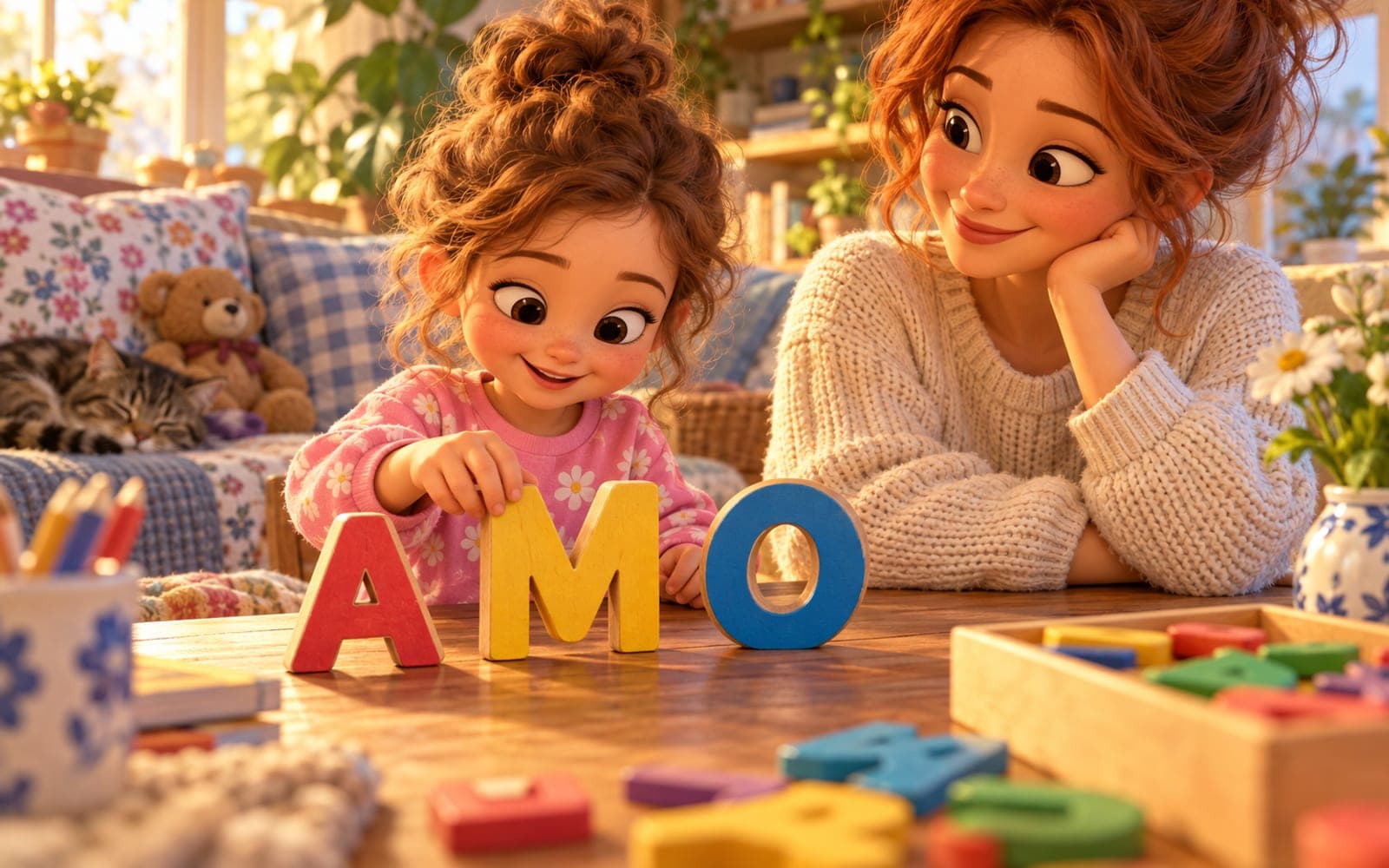
How can you practise the alphabet with a child, in brief?
- Start with the letter sound, meaning the sound used in a word, and add the letter name later.
- Introduce common vowel sounds and consonants that are easy to hear and blend into simple words.
- Do not work from A to Z in order. Choose letters that quickly let your child build simple sound combinations and short words.
- Combine listening, looking and hand movement: your child hears a sound, sees the letter, points to it, builds it and traces it.
- One activity should last 5–10 minutes. Short, regular practice is more useful than a long “lesson.”
- Introduce less regular English spellings and digraphs only after your child understands the basic relationship between sounds and letters.
If you want to combine letter learning with hand practice straight away, use printable worksheets or alphabet and letter coloring pages.
What is the difference between a letter name and a letter sound, and which comes first?
For early reading, the letter sound, meaning the sound we hear and say in a word, is more useful than the letter name. A letter is the written symbol used to represent sound. The name is something else again: B is called “bee”, M is “em”, and S is “ess”.
A child blending B and A needs to hear /b/ + /a/. If they use the names “bee” + “ay”, the result is much harder to blend into a word. In early reading practice, keep it simple: “This is B; its common sound is /b/, as in bat.”
With consonants, avoid adding an extra “uh” sound. Instead of saying “buh”, “duh” or “tuh”, try to say the sounds /b/, /d/ and /t/ as cleanly and briefly as you can. This makes later blending into words easier.
Letter names still matter. They are useful for spelling aloud, talking about written words and learning alphabetical order. But they do not have to be the first tool for reading. Phonics teaching focuses on making systematic links between speech sounds and their written forms.

What order should you introduce letters in?
You do not have to teach the alphabet in alphabetical order. For children aged 4–7, it is more practical to choose an order that quickly reveals the connection between a sound, a letter and a simple word.
Good early choices include:
- common short vowel sounds, for example a, i, o;
- consonants that are easy to hear and can be prolonged without adding a vowel, for example m, s, f, l, n;
- then selected short consonant sounds, for example t, p, c, b, d.
There is no single compulsory list for every child. Adjust the order to the sounds your child can say confidently and to familiar words. Letters from the child’s name often build interest, but they do not need to determine the whole sequence.
Once your child knows a few letters, start combining them immediately into simple words, for example am, Sam, sat, mat. This shows why recognising letters matters. Reciting “A, B, C…” practises alphabetical order, but it does not replace learning to read.
How should you introduce common English spelling patterns?
English uses 26 letters, but one letter can represent more than one sound, and the same sound can be spelled in different ways. Introduce these patterns gradually once your child is secure with several basic letter-sound links.
You can work with pairs or small groups:
- a – a_e, i – i_e: compare short and long vowel patterns in familiar words, such as “cap/cape” and “kit/kite”;
- c – k: compare two common spellings for /k/, such as “cat” and “kit”;
- c – /k/, c – /s/, g – /g/, g – /dʒ/: show that one letter can have different common sounds, as in “cat/cent” and “go/gem”;
- ee – ea: show that the same sound can have different spellings, as in “see” and “sea”.
Do not introduce all of these patterns in one day. One new pattern in a short activity is enough, followed by review of patterns your child already knows.
For hand-movement practice, you can use ready-made resources such as lowercase w, f, h and l tracing sheets.
When should you introduce digraphs such as sh, ch, th, ph, ng, wh and ck?
Introduce digraphs when your child already understands that letters represent sounds and can blend simple sounds into words. Explain it without jargon: “Sometimes two letters work together to spell one sound.”
Use words your child already knows:
- sh – ship,
- ch – chip,
- th – thin,
- ph – phone,
- ng – ring,
- wh – when,
- ck – duck.
Do not ask your child to memorise the whole list first. Choose one digraph, find it on the page, listen to words that contain it, and mark the two letters together, for example by circling both. This shows that the spelling uses two letters that work as one sound unit in that word.
At this stage, it is also useful to compare what you hear with what you see in print. Early-reading activities often practise distinguishing speech sounds from letters and noticing common digraphs.
Should you teach uppercase and lowercase letters at the same time?
First make sure your child can confidently recognise a few letters, then pair the uppercase and lowercase forms as two versions of the same letter. Your child should know that A and a look different but represent the same letter.
Uppercase print letters can be easier to build with sticks and trace with large movements. Lowercase letters are essential too, because they dominate ordinary text. Do not stay with uppercase letters alone for too long.
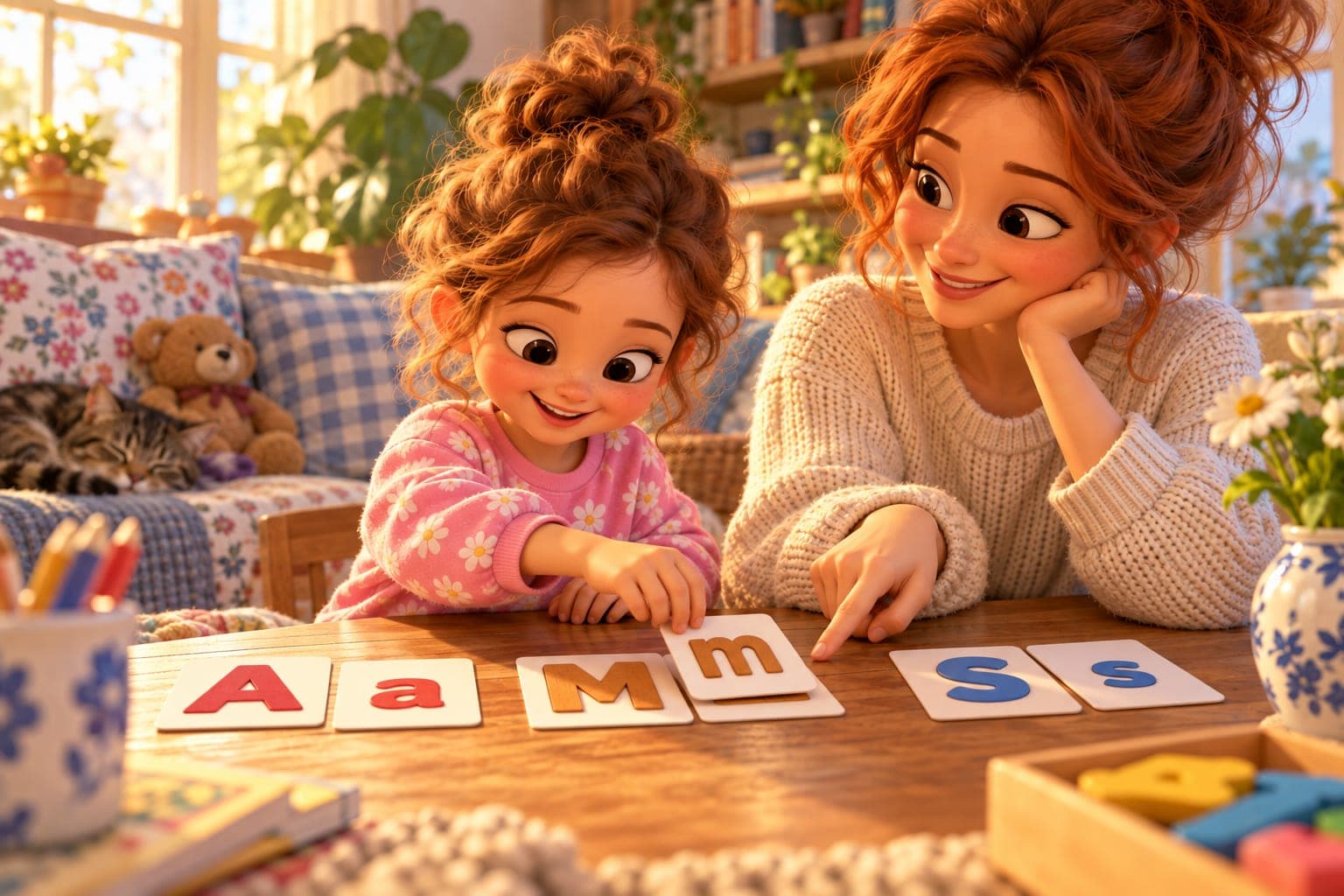
A simple game is “find the pair”: prepare cards with A–a, M–m and S–s, and ask your child to match them. Add more visually similar letters only later.
To practise direction and shape, you can use uppercase C, G, J and Z tracing sheets and uppercase W, F, H and L finish-the-letter sheets.
How can you practise a letter through listening, looking and hand movement?
The best short activities combine three routes at once: your child hears the sound, sees the letter and makes a movement connected with its shape. You do not need special equipment.
Example for the letter M:
- Listening – 2 minutes. Say three words: “moon”, “cat”, “milk”. Your child raises a hand when they hear /m/ at the beginning.
- Looking – 2 minutes. Show M and m on cards. Look for those letters in a book or on packaging.
- Movement – 2 minutes. Your child traces M with a finger in the air, on the table or in a tray of grain.
- Blending – 2 minutes. Combine M with A and T. Try to read “mat” and “am”.
- Review – 1 minute. Show the letter again and ask: “What sound can this letter make here?”
If your child wants to write, offer a few large letters to copy. Do not expect a 4-year-old to produce a long row of even letters. The goal is to connect sound, symbol and movement, not to practise calligraphy.

What alphabet games take 5–10 minutes?
Choose activities that are easy to stop before your child gets tired.
Sound hunt. Choose /m/. Your child looks around the room for objects whose names begin with /m/. You only need things already in the room.
Letter memory. Make two cards for each of 4–6 familiar letters. When your child finds a pair, they say a common sound for the letter and one word that starts with it.
Build a letter. Make the letter from blocks, string, buttons or craft sticks. Then your child moves a finger along its shape.
Uppercase–lowercase sort. Prepare several pairs such as A–a, M–m and L–l. Your child matches the pairs and says a common sound.
Find it in print. Use a page from an old newspaper, leaflet or printout. Spend two minutes circling letters your child already knows. For similar activities, you can choose printable resources.

What might a 4-week alphabet learning plan look like?
Keep the plan flexible. If your child needs more time, repeat a week instead of adding more letters.
Week | Goal | Example letters and activities | Time |
|---|---|---|---|
1 | Hear and recognise the first short vowel sounds | a, i, o; listen for the sound at the beginning or middle of familiar words, trace with large movements | 5–10 min a day |
2 | Combine vowels with easy consonants | m, s, t; words such as sat, mat, Sam; letter memory | 5–10 min a day |
3 | Expand the set and blend letters into short words | e, u, f, n, p; find letters in a book, build words with cards | 5–10 min a day |
4 | Reinforce uppercase and lowercase forms and make first spelling comparisons | A–a, M–m, S–s; review, matching pairs, one selected English digraph or spelling pattern if your child is ready | 5–10 min a day |
After four weeks, do not check “how much of the alphabet is left.” Instead, see whether your child can hear a familiar sound, point to a letter that commonly represents it and recognise that letter in a new place. That is a stronger foundation for the next steps.
What mistakes should you avoid when teaching the alphabet?
Teaching the whole alphabet at once. Reciting 26 letters is not the same as understanding the sounds letters can represent.
Adding an “uh” sound to consonants. “Buh”, “duh” and “tuh” make blending harder. For early reading, say /b/, /d/ and /t/ as briefly and cleanly as possible.
Teaching only letter names. “Bee” is the correct name of B, but when blending a word your child needs its sound /b/.
Introducing too many visually similar letters at once. If your child confuses b, d and p, or m and n, separate them during teaching and return to familiar examples.
Practising only at a table. Sound awareness can be practised on a walk, in the bath or during play. Talking about the first sound in a word and noticing rhymes are useful ways to build phonological awareness.
Correcting every mistake as if it were a test. Give the correct model and try again. For a child aged 4–7, regular practice and feeling safe while learning matter more.
When should difficulties with letters be discussed with a speech and language professional or another specialist?
Consider speech and language support when the difficulty is not only with letters but also with clearly hearing or producing speech sounds. A consultation can help if your child consistently substitutes or omits sounds in speech, struggles to repeat simple syllables, or finds it very hard to identify the first sound in a familiar word.
In the early years, not knowing the whole alphabet is not a reason for a diagnosis. Children develop at different rates. Pay more attention to speech, understanding instructions, interest in books and progress after calm practice.
If a school-age child still cannot reliably connect familiar letters with their common sounds after regular teaching, talk to the teacher. If needed, the school can suggest an appropriate specialist assessment or support route.
Sources
- Instytut Badań Edukacyjnych, „Metoda foniczna”, the current guide to educational practices: https://przewodnik.ibe.edu.pl/metoda-foniczna
- Instytut Badań Edukacyjnych, „Jak wspierać rozwój językowy i komunikację dziecka – przewodnik dla rodziców dzieci w wieku przedszkolnym”, 2025: https://ibe.edu.pl/files/BIBLIOTEKA/Szkola-dostepna/jak-wspierac-rozwoj-jezykowy-i-komunikacje-dziecka-przewodnik.pdf
- Ministerstwo Edukacji Narodowej, „Podstawa programowa – materiały dla nauczycieli przedszkoli i szkół podstawowych”, updated 2024: https://www.gov.pl/web/edukacja/podstawa-programowa-materialy-dla-nauczycieli
- Ośrodek Rozwoju Edukacji, resources for early primary education on letters, speech sounds and reading, 2015: https://zasobyip2.ore.edu.pl/pl/publications/list/1146/5/title-asc