
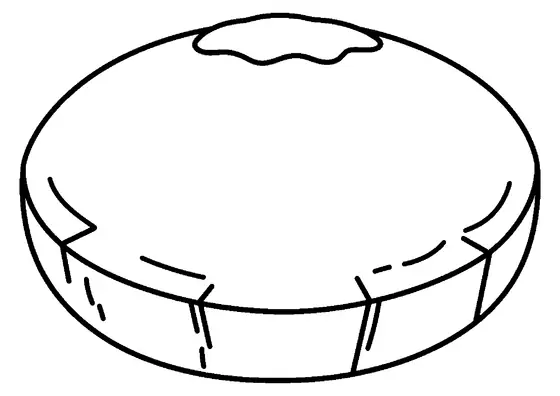
Asteroid with a Giant Crater
A compact planetary body orbits in space, featuring a single dominant impact basin alongside wide open plains.

A4 format (portrait), black outlines on a white background · for home and classroom use
All coloring pages: Planet and Solar System Coloring Pages
Similar coloring pages: Planet and Solar System Coloring Pages

What else can you print? Free, no account needed
Custom Name Coloring Pages
Enter your child's name to generate a custom coloring page featuring large outline letters to color and decorate.
Open generator →Connect the Dots Generator
Eight connect-the-dots pictures across three difficulty levels. Features faint outline guides for younger children and dots only for older kids.
Open generator →Printables
Worksheets, tracing lines, mazes and dot-to-dots in A4.
Browse printables →
A Round Asteroid with a Dominant Crater
This object displays a small, rounded asteroid drifting through space. The celestial body is marked by one massive impact crater that dominates its face, surrounded by expansive, smooth open plains extending across the rest of its surface.
The Dynamics of Asteroid Craters
Impact craters on small space rocks are created when smaller debris collides with them at incredible speeds of thousands of miles per hour. Because small asteroids have very weak gravitational forces, much of the debris thrown up by an impact escapes into space instead of settling back down. Over billions of years, a single major collision can reshape an entire small world without destroying it.
Natural Colors of a Cratered Asteroid
- Main Surface Plains: Pale ash gray, dusty charcoal, or muted brownish stone
- Giant Crater Basin: Dark shadow gray or deep charcoal black
- Interior Rim Wall: Light slate gray or pale silver gray