
How do you choose educational activities for a 6-year-old?
Short activities work best when they combine thinking with movement and give your child a chance to try independently. A six-year-old preparing for school does not need home lessons. They need opportunities to listen for sounds, count, plan, draw, wait for a turn, and cope with not always winning.
In short:
- one activity can last 5–15 minutes;
- alternate table activities with movement;
- finish before your child is clearly tired;
- offer a choice between two activities;
- make an activity harder only when the easier version feels comfortable.
At this age, language, early mathematics, movement, thinking skills, social skills, and independence can all be supported through everyday play without turning the home into a classroom.
If you want ready-made practice, also see school-readiness activities for ages 5–6: adding with objects, letters and early reading, plus space and time concepts.
How can you practice speech sounds and early reading skills?
Use listening, comparing words, and playing with speech sounds. At this stage, hearing the sound matters more than copying letters.
1. Last-sound word chain
You only need a few familiar words; time: 5–8 minutes. The first person says “cat”; the next finds a word beginning with the final sound /t/, such as “table.” This builds listening analysis and quick word retrieval. Easier: use only objects in the room. Harder: choose a category such as animals or food.
2. First-sound detective
Materials: household objects; time: 5–10 minutes. Say a sound, such as /m/, and ask your child to find things whose names begin with it. This practices identifying the first sound and builds vocabulary. Easier: show three objects to choose from. Harder: also look for words with the sound in the middle.
3. Syllable steps
Materials: a clear patch of floor; time: 5 minutes. Your child says a word and takes one step for each syllable: “el-e-phant” is three steps. This practices breaking words into parts and coordination. Easier: use short two-syllable words. Harder: your child invents a word with a set number of syllables.
How can you practice counting and addition to 10?
Use real objects such as blocks, spoons, buttons, or dice. Your child can then see what the calculation means.
4. Shop up to 10 coins
Materials: a few toys, price tags from 1–5 coins, and play coins; time: 10–15 minutes. Any two items then fit within 10 coins. Your child buys two things and works out the total. This practices addition within 10 and number sense. Easier: buy one item. Harder: ask how many coins are left from 10.
5. Make ten
Materials: 10 blocks in two colors; time: 5–8 minutes. Build pairs of numbers that make 10, such as 6 and 4. This practices number bonds to 10. Easier: keep all the blocks visible. Harder: show only one part and ask for the missing number.
6. Two-dice race
Materials: two dice, counters, and a drawn track; time: 10 minutes. Your child rolls both dice, adds the dots, and moves the counter by that amount. Standard dice can total 12; to stay within 10, cover the six face on both dice so only 1–5 remain. This practices counting, addition, and following rules. Easier: use one die. Harder: before moving, ask for two different ways to make the same total.
7. Number Shoal
Materials: computer or tablet; time: 5–10 minutes. In the Number Shoal game, your child counts the creatures and chooses the matching group. This builds number sense and quick quantity recognition. Easier: play together and count aloud. Harder: your child gives the answer before pointing.
For a short table activity, you can also use the math worksheet generator to make addition-to-10 practice in a PDF with an answer key.
How can you prepare the hand for writing?
Writing readiness is not only about forming letters. Smooth movement, pressure control, hand-eye coordination, and moving the hand in a chosen direction all matter.
8. Figure eights without lifting the hand
Materials: paper and a thick pencil or crayon; time: 5 minutes. Your child draws large horizontal figure eights in one continuous movement. This practices flow and hand control. Easier: draw a model to trace with a finger. Harder: gradually make the figure eights smaller. You can also use the figure-eight practice sheet for ages 5–6.
9. Connect 15 dots
Materials: a worksheet and pencil; time: 5–10 minutes. Your child connects the numbers in order while trying to guide the line precisely. This practices grip, movement control, and number order. Easier: trace from point to point with a finger first. Harder: after connecting the dots, your child adds a background. A ready-made example is the 15-dot turtle for ages 5–6.
10. Path through a narrow tunnel
Materials: paper and pencil or a printable sheet; time: 5–10 minutes. The goal is to draw a line through the middle of a path without touching the edges. This practices precision and movement planning. Easier: draw a wide path. Harder: choose two medium mazes for ages 5–6.
How can you develop logic and planning?
Logic activities work best when your child can try, back up, and revise an idea without time pressure.
11. Picture sudoku
Materials: a printable and pencil; time: 10–15 minutes. Your child fills the spaces so pictures do not repeat in a row or column. This practices reasoning and working memory. Easier: solve the first row together. Harder: ask your child to explain each choice. Try easy 6×6 picture sudoku.
12. Pipe puzzle without a timer
Materials: computer or tablet; time: 10 minutes. In Labugen Pipeworks , your child turns pipe pieces to create a connection. This practices predicting consequences and planning. Easier: identify the start and end together. Harder: before moving, your child explains which two pieces they want to connect.
13. Build from instructions
Materials: blocks; time: 10 minutes. The adult describes a structure without showing a model, for example: “two red blocks at the bottom, blue in the middle.” This practices understanding instructions and spatial imagination. Easier: use three blocks. Harder: your child gives instructions for the adult.
14. Which one does not belong — and why?
Materials: four household objects; time: 5–8 minutes. Put out, for example, a spoon, fork, cup, and sock. Your child chooses the item that does not belong and explains the rule. This practices categorizing and reasoning. Easier: choose an obvious set. Harder: allow more than one sensible answer.
How can you practice movement and coordination?
Movement helps a six-year-old release tension and practice following instructions in sequence.
15. Movement dictation
Materials: open space; time: 5–8 minutes. Say: “two steps forward, turn left, jump, touch the floor.” Your child follows the sequence. This practices memory, spatial awareness, and coordination. Easier: give one instruction at a time. Harder: give four or five movements at once.
16. Cushion course
Materials: cushions, paper tape, a chair; time: 10–15 minutes. Your child follows a marked route, goes around obstacles, and stops on a signal. This practices balance and body control. Easier: make a simple route. Harder: add carrying a light object without dropping it.
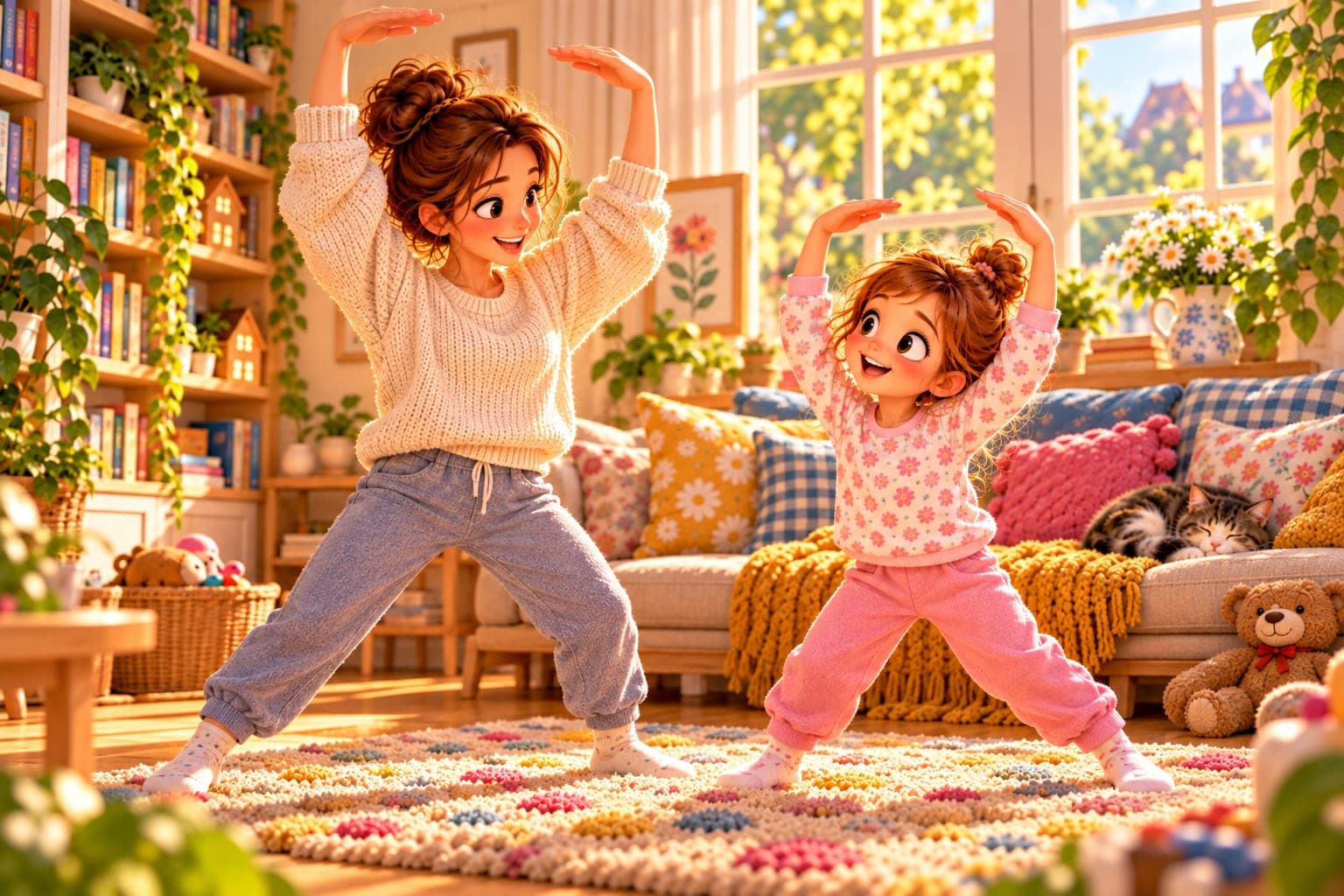
17. Mirror
Materials: none; time: 5 minutes. Stand facing each other. One person makes slow movements and the other copies them. This practices coordination, attention, and pace control. Easier: move only the arms. Harder: after one minute, switch roles without stopping.
Which family games teach rules, turn-taking, and handling losing?
Choose games where the result is not controlled entirely by the adult and the rules are short and clear.
18. Family memory game
Materials: pairs of cards with simple pictures; time: 10–15 minutes. Each player turns over two cards and waits for their turn. This practices memory, self-control, and following rules. Easier: use 6 pairs. Harder: add more pairs or use matching pairs such as “numeral–number of dots.”
19. Race to the finish
Materials: a die, counters, and a paper track with 20 spaces; time: 10–15 minutes. Players move their counters according to the die. This practices turn-taking, counting, and accepting the result of a game. Easier: no special spaces. Harder: add two “move back 2” spaces and two “move forward 2” spaces.
20. Family riddle tournament
Materials: small slips of paper and a pencil; time: 10–15 minutes. Each person takes a turn drawing or asking a riddle while the others try to answer. This practices listening, patience, and accepting that someone else may answer first. Easier: the adult gives two possible answers. Harder: your child makes up a riddle in a chosen category.
How can you quickly compare all 20 activities?
No. | Activity | Area | Time |
|---|---|---|---|
1 | Last-sound word chain | speech sounds | 5–8 min |
2 | First-sound detective | speech sounds | 5–10 min |
3 | Syllable steps | speech sounds + movement | 5 min |
4 | Shop up to 10 coins | addition | 10–15 min |
5 | Make ten | numbers | 5–8 min |
6 | Two-dice race | addition | 10 min |
7 | Number Shoal | number sense | 5–10 min |
8 | Figure eights without lifting the hand | hand skills | 5 min |
9 | Connect 15 dots | hand skills + numbers | 5–10 min |
10 | Path through a narrow tunnel | hand skills + planning | 5–10 min |
11 | Picture sudoku | logic | 10–15 min |
12 | Pipe puzzle without a timer | logic | 10 min |
13 | Build from instructions | planning | 10 min |
14 | Which one does not belong — and why? | logic | 5–8 min |
15 | Movement dictation | coordination | 5–8 min |
16 | Cushion course | movement | 10–15 min |
17 | Mirror | coordination | 5 min |
18 | Family memory game | rules | 10–15 min |
19 | Race to the finish | rules + counting | 10–15 min |
20 | Family riddle tournament | rules + language | 10–15 min |
How can you make a simple weekly plan?
You do not need several activities every day. One short table activity and one movement activity on selected days are more than enough.
Day | Activity 1 | Activity 2 |
|---|---|---|
Monday | first-sound detective | cushion course |
Tuesday | shop up to 10 coins | mirror |
Wednesday | picture sudoku | movement dictation |
Thursday | figure eights or dot-to-dot | build from instructions |
Friday | Number Shoal or Pipeworks | family memory game |
weekend | race to the finish | family riddle tournament |
What is the adult’s role in play with a 6-year-old?
The adult’s main job is to set up simple conditions, remind the rules, and avoid taking away the child’s chance to think independently. Instead of giving the answer quickly, ask: “What could you check?” or “Which way do you want to try?”
In family games, you do not need to let your child win every time. After a loss, calmly name the feeling, remind them of the rule, and offer another round. This way, play builds not only counting or memory but also how to take part in a shared activity.
How are activities for a 6-year-old different from activities for a 4-year-old?
A six-year-old can usually focus longer, understand rules more easily, and follow tasks with several steps. That is why activities can include addition to 10, simple strategies, more precise drawing, and games where someone loses. A four-year-old needs shorter rules, more movement, and simpler choices. If you have a younger child, also see educational activities for 4-year-olds.
What mistakes should you avoid during educational play?
- Do not turn every activity into a test or keep asking “do you know this?”.
- Do not correct every mistake immediately; give your child time to self-correct.
- Do not make an activity harder just because it looks too easy to an adult.
- Do not drag the activity out when your child loses focus.
- Do not base all school readiness on worksheets and screens.
When should you talk to a professional?
One difficulty does not mean there is a developmental problem. However, it is worth talking with your child’s early-years or school teacher, a speech-language professional, pediatrician, or another appropriate child-development professional if difficulties are clear, persist in everyday situations, and affect several areas such as understanding simple directions, speech, coordination, peer interaction, or independence.
A good starting point is observing your child during ordinary play and talking with their teacher. A professional looks at development more broadly than one task completed at home.
Sources
- Minister Edukacji, Rozporządzenie z 11 marca 2026 r. w sprawie podstawy programowej wychowania przedszkolnego oraz podstawy programowej kształcenia ogólnego dla szkoły podstawowej, Dz.U. 2026 poz. 378, 2026.
- Ministerstwo Edukacji Narodowej, Nowe podstawy programowe wychowania przedszkolnego i kształcenia ogólnego dla szkoły podstawowej – rozporządzenia podpisane, 2026.