
What can you do with children for Halloween, in brief?
- Choose 3–4 short activities: movement, counting or letters, a maze and coloring.
- Prepare paper, crayons, scissors for an adult, and 10 paper pumpkins or leaves.
- For children aged 4–6, use large elements, counting to 10 and simple instructions.
- For children aged 7–10, add logic tasks, word activities and a harder maze.
- If you do not celebrate Halloween, replace ghosts with leaves, pumpkins and woodland animals.
How can you plan Halloween activities for kids without making them scary?
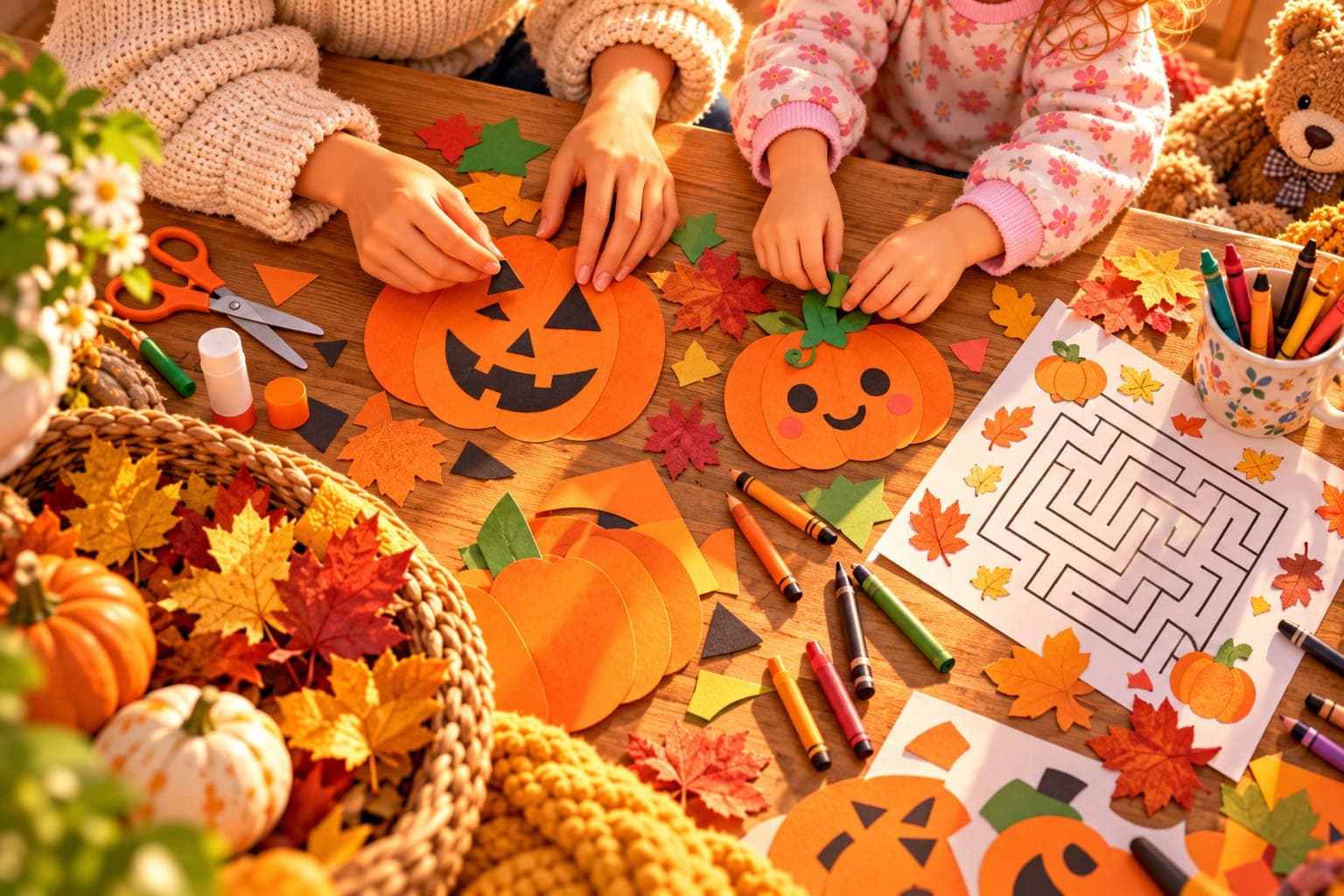
The simplest approach is to use Halloween as a theme for calm play rather than a test of bravery. At home or in a group setting, pumpkins, autumn leaves, black cats and bats are enough. A bat can simply be presented as an interesting nocturnal animal. There is no need for monsters, blood or frightening masks.
Not every family celebrates Halloween. That is why each activity can have two versions. The Halloween version uses pumpkins, cats and friendly ghosts. The autumn version uses pumpkins, leaves, chestnuts and animals active in autumn. The learning goal stays the same.
Start by preparing one work area and only a few materials. Children focus more easily when they do not have to choose from a dozen worksheets. You can use Halloween coloring pages, or, if you prefer a neutral theme, choose educational coloring pages.
What educational Halloween activities work well for ages 4–6?
For children aged 4–6, activities that last 5–10 minutes and use concrete things they can count, point to or color usually work best. The goal is not to finish a whole worksheet but to complete one clear task.
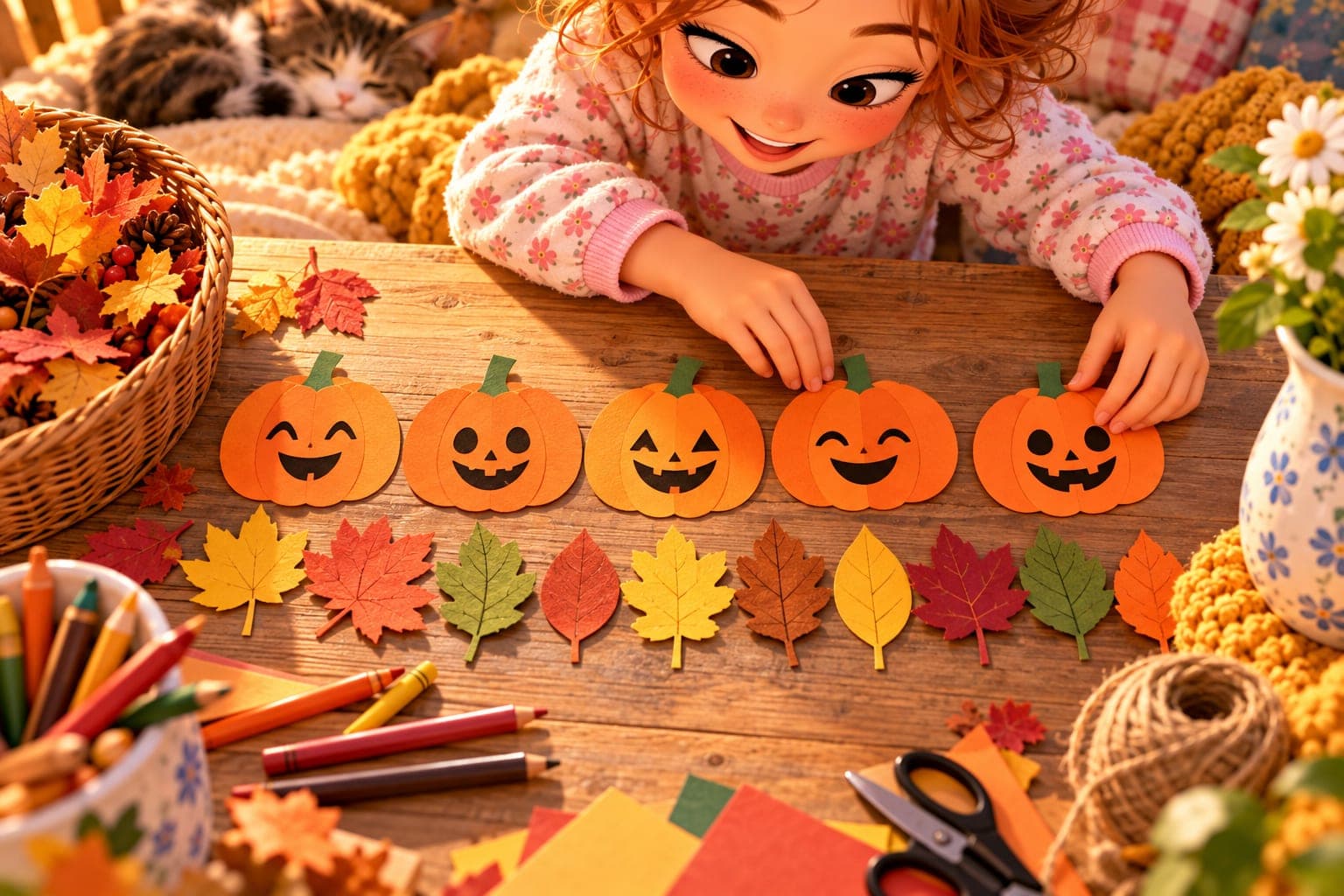
1. Count pumpkins or leaves – 7 minutes.
Materials: 10 paper circles, small pumpkins or leaves. Put down 3 items and ask your child to add enough to make 5. Then change the number. A younger child counts to 5; an older child to 10.
2. First-letter hunt – 8 minutes.
Materials: paper and a crayon. Write large letters P, C, L and B. Say the words “pumpkin,” “cat,” “leaf” and “bat.” The child points to the letter each word starts with. If you are using an autumn theme instead, choose “pumpkin,” “chestnut,” “leaf” and “branch.”
3. Autumn pattern – 5 minutes.
Materials: pictures of a pumpkin and a leaf, or two kinds of blocks. Make a pattern: pumpkin–leaf–pumpkin–leaf. The child says what comes next. Then try: pumpkin–pumpkin–leaf.
4. Color by instruction – 10 minutes.
Materials: a coloring page and crayons. Say, “Color two pumpkins orange and one leaf yellow.” This combines following instructions, counting and hand control.
What Halloween activities should you choose for ages 7–10?
Children aged 7–10 can work for 10–15 minutes on one activity if it has a clear goal and is not too easy. A good mix includes maths, language, logic and route planning.
1. Pumpkin maths – 10 minutes.
Materials: paper and a pencil. Write: “There were 12 pumpkins in a basket. Four were taken for decorations. How many are left?” Then ask the child to make a similar problem using leaves or chestnuts.
2. Pumpkin acrostic – 10 minutes.
Materials: paper. Choose the word “PUMPKIN” or “AUTUMN.” The child finds one word for each letter. You can set a category, such as things at home or plants.
3. Maze – 10–15 minutes.
Materials: a printout and pencil. The child first follows the route with their eyes and only then draws the line. For a 7-year-old, you can choose a large maze with the solution, and for children aged 7–8, two difficult mazes.
4. Logical sequence – 10 minutes.
Materials: 6 small cards. Draw these stages: seed, sprout, plant, flower, small pumpkin, ripe pumpkin. The child puts them in order and explains the choice.
How can you plan 45 minutes of activities step by step?
Alternate a table activity with movement, and leave a calm activity until the end. This structure works well both at home and with a group.
Time | Activity | Materials | Ages 4–6 | Ages 7–10 |
|---|---|---|---|---|
8 min | counting | paper pumpkins or leaves | counting to 5–10 | word problems |
7 min | movement | 4 sheets of paper on the floor | jump to the named picture | a sequence of 3–4 instructions |
10 min | letters and words | paper, crayon | first letter | pumpkin acrostic |
10 min | maze or logic | printout | simple route | harder maze |
10 min | coloring | coloring page, crayons | large areas | details and instructions |
If you want more options, browse the printable worksheets. In a school-age group, you can prepare two difficulty levels and let children choose a worksheet without comparing scores.
How can you make an autumn version instead of Halloween?
The autumn version can use exactly the same plan and practise the same skills. Only the theme changes. Replace a ghost with a cloud, a spiderweb with a pattern of branches, and a Halloween decoration with a basket of pumpkins and leaves.
For example, “count 8 ghosts” becomes “count 8 leaves.” A maze can guide a squirrel to an acorn, and a letter activity can use the words “forest,” “leaf,” “pumpkin” and “owl.” This lets a teacher use one plan with a group whose families have different traditions, without judging anyone’s beliefs.
What can you prepare if you do not have a printer?
You can still create a complete set of activities with about 10 minutes of preparation. On four sheets of paper, draw one large pumpkin, leaf, cat and bat. The sheets can be used for counting, making patterns and movement games. For an older child, draw a simple 4 × 4 grid and place symbols in the squares to be completed according to a rule.
You can draw a maze by hand: make a wide path from a pumpkin to a basket, add two dead ends, and let the child trace the route with a finger first. For a letter activity, write 6–8 words and ask the child to circle the ones that start with the same sound. You can also use worksheet generators, when you want to quickly prepare another activity at a different level.
For a group version, prepare one set of symbols for each pair of children. One child gives an instruction, the other follows it, then they switch roles. This turns the same material into more than one activity.
What mistakes should you avoid during these activities?
The most common mistake is preparing too many attractions. A child does not need to do everything for the session to be successful.
- Do not scare children for fun. If a child does not want a mask, a dark room or a ghost story, choose a gentler theme.
- Do not stretch an activity by force. If a 5-year-old loses interest after 7 minutes, change the activity.
- Do not give everyone the same level. A 4-year-old and a 9-year-old need different instructions.
- Do not judge how neat the coloring looks. It is better to ask what the child drew and why they chose that color.
- Do not base the whole activity on sweets. Paper symbols, movement and puzzles are enough.
How can you end the session so a child can wind down?
Finish with a calm activity for 5–10 minutes. Coloring, completing a simple maze or talking about which activity was most interesting can all work well. There is no need to add another reward.
You can also ask the child to choose one piece of work to keep. This naturally closes the session and gives them a sense of ownership. If you used several materials, save the rest for another day rather than finishing everything in one evening.
Sources
- Ministerstwo Edukacji Narodowej, „Nowe podstawy programowe wychowania przedszkolnego i kształcenia ogólnego dla szkoły podstawowej”, 2026: https://www.gov.pl/web/edukacja/nowe-podstawy-programowe-wychowania-przedszkolnego-i-ksztalcenia-ogolnego-dla-szkoly-podstawowej-wraz-ze-zmianami-w-ramowych-planach-nauczania-dla-publicznych-szkol-podstawowych--rozporzadzenia-podpisane
- UNICEF Parenting, „5 fun ideas for learning through play”, dostęp 2026: https://www.unicef.org/parenting/child-care/5-fun-ideas-for-learning-through-play