
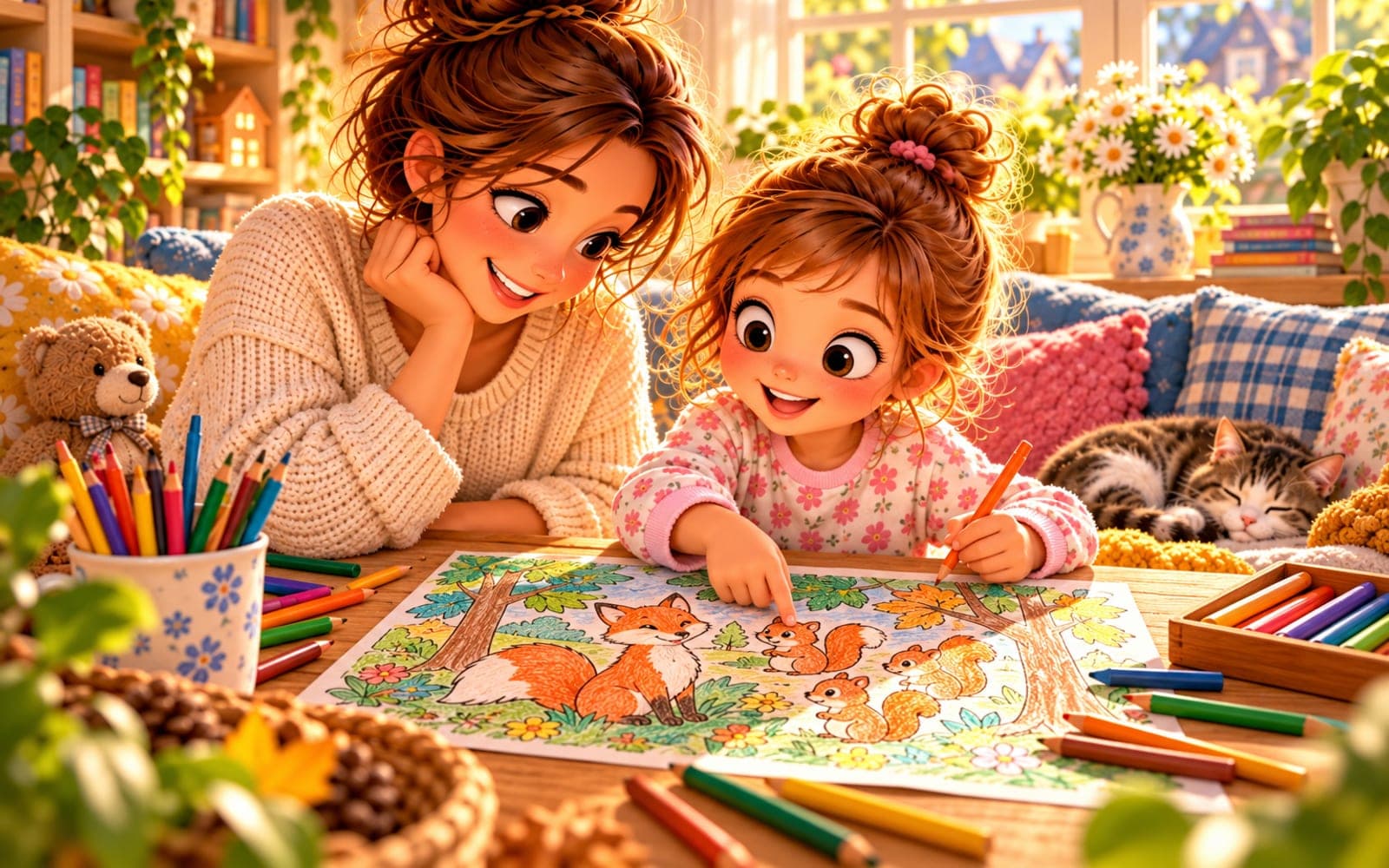
In short: how can you combine coloring with learning?
- Choose one goal for each coloring page: counting, colors, shapes, vocabulary, or storytelling.
- Ask short questions instead of turning the activity into a test.
- For color-by-code activities, use colored dots rather than numbers or letters.
- Plan short 10–15 minute sessions and stop sooner if your child loses interest.
- Every few days, offer a coloring page with no task at all — just for fun.
For a five-year-old, learning through coloring works best when it is part of conversation and play. You do not need to turn the page into a school worksheet. If you want ready-made materials, start with educational coloring pages.
If you want to extend the activity beyond coloring, also try activities for 5-year-olds: counting to 10, comparing, shapes, beginning sounds and syllables.
What can a 5-year-old learn while coloring?
Coloring can open the door to vocabulary, counting, observation, storytelling, and following simple directions. The aim is not to “cover material,” but to help your child notice patterns and talk about what they see during an ordinary activity.
At this age, the most useful learning usually grows out of play, conversation, and hands-on experience. A coloring page can support that kind of practice as long as it does not replace free play or real-world exploration.
For a 5-year-old, this is not the stage for formal handwriting drills or arithmetic on every page. If your child is four, a better starting point may be how to increase the detail level in coloring pages for 4-year-olds.
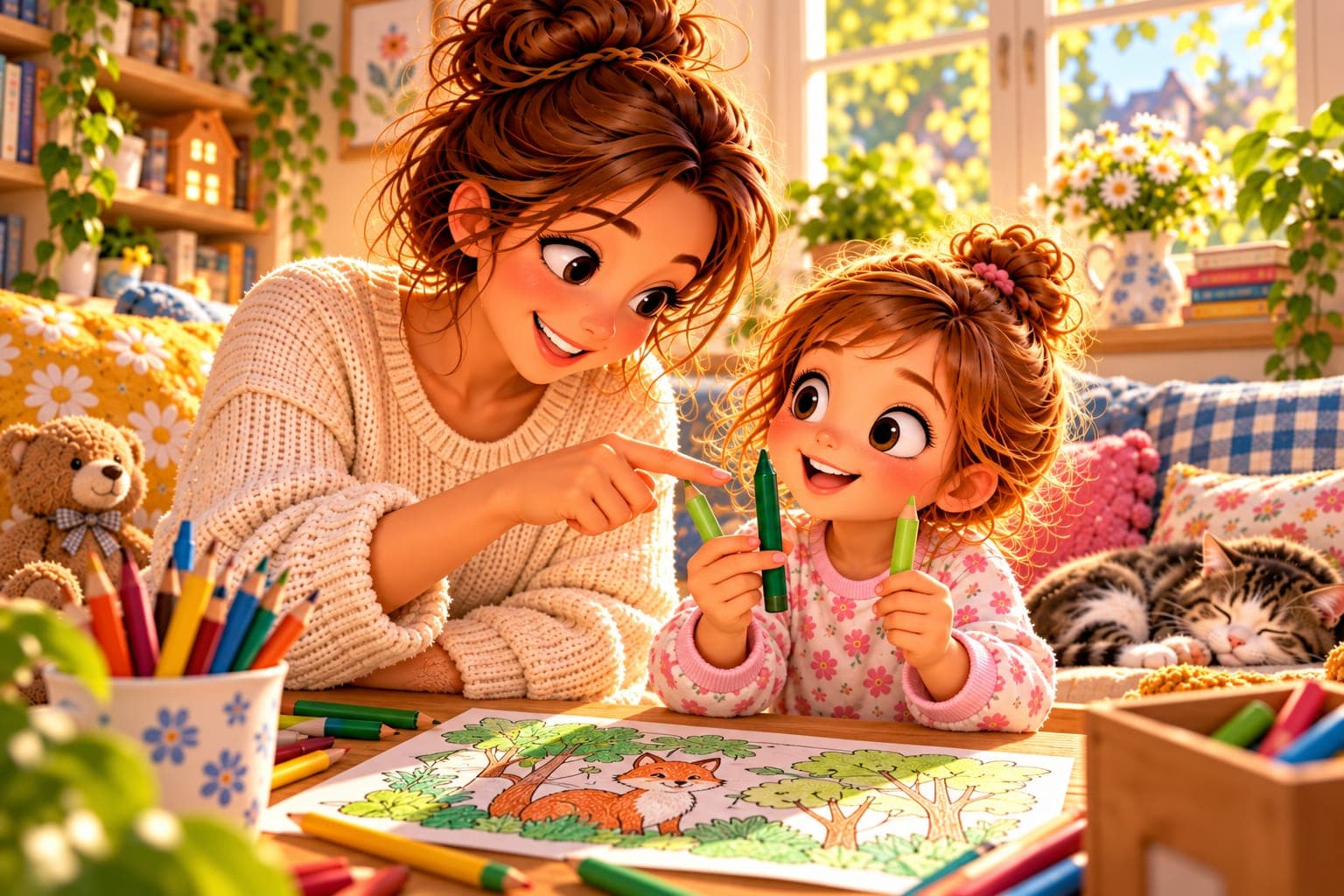
What are the best “coloring + learning” ideas?
Here are nine simple approaches. Pick just one for each page and treat the question as an invitation to talk.
1. Colors and shade names
Instead of asking only “what color is this?”, compare similar shades: light and dark green, sky blue and navy, yellow and gold. Your child does not need to know every name — they can simply describe the difference.
Parent prompt: “Which blue looks more like the sky, and which one looks more like water at night?”
2. Counting objects
Choose a picture with several repeated objects and count them before or after coloring. Animals, leaves, fruit, and flowers work well. You can also find ready-made materials in numbers and counting, but here the goal is counting objects, not learning how to write numerals.
Parent prompt: “How many squirrels can you see? Let’s count them together.”
3. Spotting shapes
Look for circles, triangles, rectangles, and other simple shapes hidden in the picture. A circle might be a car wheel, the sun, or the center of a flower.
Parent prompt: “What in this picture is shaped like a circle?”
4. Color code without numbers or letters
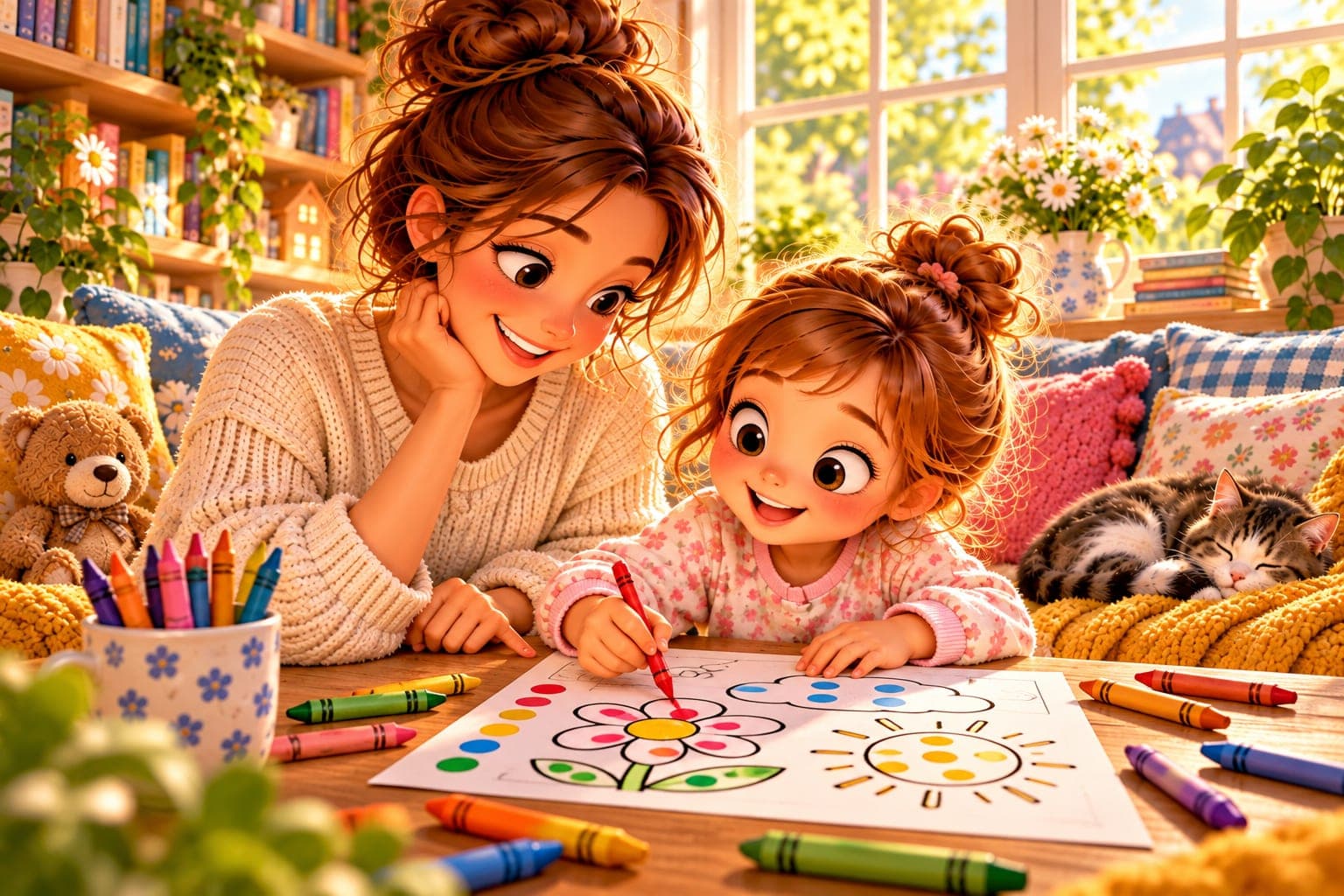
Make a key using colored dots only. A red dot means red, a green dot means green, and a blue dot means blue. Add small matching dots next to the parts you want your child to color.
Parent prompt: “What color does this dot tell you to use, and where can you find another one just like it?”
5. Telling a story
A coloring page can be the beginning of a short story. Ask what happened before, what is happening now, and what might happen next.
Parent prompt: “Where is this fox going, and what might it find behind the tree?”
These conversations work especially well with woodland animal coloring pages.
6. Seasons and nature
With seasonal pictures, talk about things your child has noticed on walks. In an autumn scene, you might look for leaves, mushrooms, chestnuts, or clothes that suit cooler weather.
Parent prompt: “How can you tell it is autumn in this picture?”
You can use autumn coloring pages and compare them with what your child can see outside.
7. The first sound in a picture word
Point to one familiar object or animal and say its name slowly. Ask your child to listen for the first sound, without showing the written letter.
Parent prompt: “Owl. O-o-owl. What sound do you hear at the beginning?”
This is a listening activity, not a handwriting lesson. If your child does not want to pull words apart into sounds, go back to simply talking about the picture.
8. Recognizing their own name
In the personalized name coloring page generator you can make a page with your child’s name. At this stage, it is enough for your child to recognize the whole name as a familiar word shape. There is no need to copy it or write it from memory.
Parent prompt: “Which name on the page is yours? How can you tell?”
9. Observation and dot-to-dot
A simple dot-to-dot can add variety to coloring. On the owl dot-to-dot for ages 5–6 page, your child connects the dots in order from 1 to 12. If they do not yet recognize every numeral, point to the next dot and count aloud together — this is number sequencing, not arithmetic.
Parent prompt: “What picture do you think will appear when you connect all the dots?”
How do you match the goal, the coloring page, and the parent prompt?
One page does not need to practice everything at once. This table helps you choose one focus quickly.
Goal | Which coloring page? | What can the parent say? |
|---|---|---|
color names | flowers, clothes, landscapes | “Which shade is lighter?” |
counting | animals, fruit, leaves | “How many can you see?” |
shapes | vehicles, houses, toys | “Where is the circle hiding?” |
following directions | a simple picture with a few areas | “Color the areas marked with a green dot.” |
storytelling | a scene with a character and a background | “What happened just before this?” |
nature | forest, garden, seasons | “Which of these have we seen on a walk?” |
first sound | a picture of one familiar object | “What sound do you hear at the start of the word?” |
name recognition | a personalized coloring page | “Where is your name?” |
How can you plan a week in 10–15 minute sessions?
A short plan can keep things varied, but it should never feel like a requirement. If your child does not want to color that day, simply skip the session.
Day | 10–15 minutes of coloring |
|---|---|
Monday | animals + counting objects |
Tuesday | any picture + colors and shades |
Wednesday | an autumn or woodland scene + a short story |
Thursday | a simple code using colored dots |
Friday | a name coloring page + recognizing their own name |
Saturday | dot-to-dot or shape spotting |
Sunday | free coloring with no task |
Ten or fifteen minutes is a practical planning suggestion, not a developmental rule. You can stop after five minutes or stay with the page longer if your child wants to continue.
When does coloring become too “educational”?
There is too much teaching when your child is more focused on getting the answer right than enjoying the drawing. If they keep asking “is this right?”, are afraid to choose their own color, or put the crayons down as soon as they hear a task, go back to free coloring.
A good sign is spontaneous conversation: your child starts counting, naming colors, or inventing a story on their own. You do not need to correct every mistake. If the cat ends up with purple fur, there is no need to change it to the “correct” color.
You can also offer a choice: “Do you want a little challenge today, or just coloring?” That keeps the activity enjoyable and gives your child a sense of control.

What mistakes should you avoid with educational coloring pages?
- Too many goals at once. Counting, sounds, shapes, and directions on one page can quickly become tiring.
- Codes based on a numeral or letter. For a five-year-old, colored dots and picture symbols are enough. Dot-to-dot with numbers is the exception — it is a separate, intentional way to practice counting in sequence.
- Correcting artistic choices. A green sun can be part of the fun.
- Quizzing. A question should start a conversation, not test performance.
- Comparing with other children. Match the difficulty to your own child’s interests and current skills.
- Giving up free drawing. Coloring pages are an extra, not the only kind of art activity.
When should you talk to a teacher or specialist?
One difficulty on a coloring page is not enough to draw conclusions about a child’s development. But if similar difficulties regularly appear during play, conversation, and everyday routines — for example, your child clearly struggles to understand simple directions or communicate needs — start by talking with their early-years teacher.
The teacher can describe how your child manages in different group situations and whether it would be useful to speak with an education, speech-language, or child-development professional. An article or coloring page cannot replace an individual assessment.
Sources
- Minister Edukacji, Rozporządzenie z 11 marca 2026 r. w sprawie podstawy programowej wychowania przedszkolnego oraz podstawy programowej kształcenia ogólnego dla szkoły podstawowej, Dz.U. 2026 poz. 378, 2026.
- Ministerstwo Edukacji Narodowej, Nowe podstawy programowe wychowania przedszkolnego i kształcenia ogólnego dla szkoły podstawowej — rozporządzenia podpisane, 2026.