
Rocket on a Dusty Plain
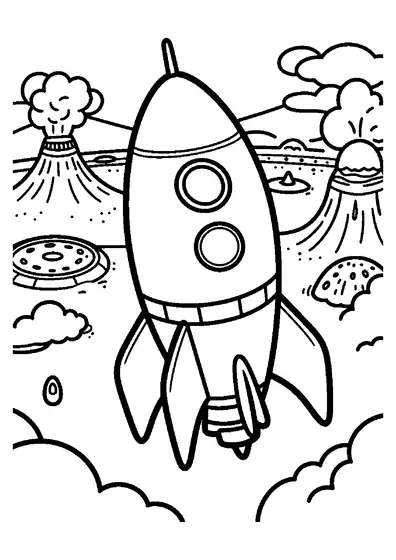
A compact research rocket rests on a quiet extraterrestrial surface alongside communication gear crates and a radio antenna.

A4 format (portrait), black outlines on a white background · for home and classroom use
All coloring pages: Space and Rocket Coloring Pages
Similar coloring pages: Space and Rocket Coloring Pages




What else can you print? Free, no account needed
Custom Name Coloring Pages
Enter your child's name to generate a custom coloring page featuring large outline letters to color and decorate.
Open generator →Connect the Dots Generator
Eight connect-the-dots pictures across three difficulty levels. Features faint outline guides for younger children and dots only for older kids.
Open generator →Printables
Worksheets, tracing lines, mazes and dot-to-dots in A4.
Browse printables →
Research Spacecraft on an Alien Surface
A scientific exploration rocket sits anchored on a flat, dusty plain surrounded by rolling cratered hills. Near the base of the landing vessel, supply crates and a tall antenna stand assembled to support surface research operations. Landers of this design allow planetary scientists to measure soil composition, monitor local atmospheric pressure, and transmit data back home.
Scientific Missions on Distant Worlds
Robotic landers and research rockets are sent to remote planets to collect environmental data without risking human lives. Because extraterrestrial surfaces lack protective atmospheres, dust storms can sweep across plains and coat scientific instruments in fine particles. High-gain antennas play a vital role on these missions by bouncing radio signals across millions of miles to orbital satellites.
Real Colors of Planetary Equipment
- Research rocket outer body: matte white, bright orange, or metallic gray
- Equipment crates: olive green, dark gray, or industrial yellow
- Radio antenna: silver, black, or metallic aluminum
- Alien soil and dusty plain: dull brown, dark tan, or reddish gray
- Cratered hills: slate gray, dark charcoal, or muted ochre