
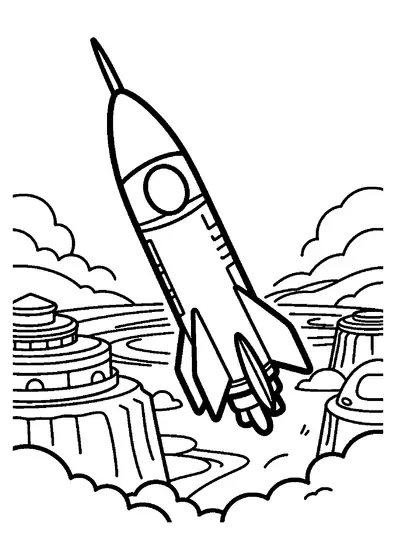
Rocket Among Ice Hills
A tall exploration rocket sits beside a specialized heating module in a landscape of smooth icy hills.

A4 format (portrait), black outlines on a white background · for home and classroom use
All coloring pages: Space and Rocket Coloring Pages
Similar coloring pages: Space and Rocket Coloring Pages



What else can you print? Free, no account needed
Custom Name Coloring Pages
Enter your child's name to generate a custom coloring page featuring large outline letters to color and decorate.
Open generator →Connect the Dots Generator
Eight connect-the-dots pictures across three difficulty levels. Features faint outline guides for younger children and dots only for older kids.
Open generator →Printables
Worksheets, tracing lines, mazes and dot-to-dots in A4.
Browse printables →
Polar Base Among Ice Formations
A tall space exploration rocket stands grounded on a frozen plain flanked by rolling, smooth ice formations. Positioned beside the craft is an external heating module designed to protect onboard systems from freezing temperatures in extreme cold environments.
Extremes of Frozen Worlds in the Solar System
Many moons in our outer solar system, such as Jupiter's Europa and Saturn's Enceladus, are completely covered by global ice shells tens of miles thick. Below these frozen crusts, scientists believe deep liquid water oceans exist, warmed by tidal forces and thermal vents deep beneath the ice.
Colors of Icy Environments and Space Hardware
- Exploration rocket: Clean white casing with high-visibility orange or yellow trim
- Heating module: Dark carbon gray, insulated gold thermal wrapping, or bright red
- Smooth ice hills: Pale cyan, light sky blue, brilliant white, and soft turquoise highlights
- Terrain shadows: Deep navy blue or slate gray