
Rocket by the Lunar Antenna
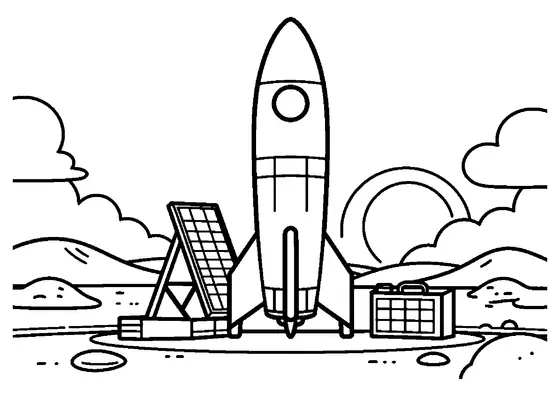
A classic rocket stands beside a massive communications dish on a cratered lunar landscape under the view of a distant planet.

A4 format (landscape), black outlines on a white background · for home and classroom use
All coloring pages: Space and Rocket Coloring Pages
Similar coloring pages: Space and Rocket Coloring Pages



What else can you print? Free, no account needed
Custom Name Coloring Pages
Enter your child's name to generate a custom coloring page featuring large outline letters to color and decorate.
Open generator →Connect the Dots Generator
Eight connect-the-dots pictures across three difficulty levels. Features faint outline guides for younger children and dots only for older kids.
Open generator →Printables
Worksheets, tracing lines, mazes and dot-to-dots in A4.
Browse printables →
Communication Base on the Lunar Surface
A classic rocket rests on a cratered moon plain beside a giant satellite dish antenna. In the distance, a large planet hangs above the horizon, overseeing the surface communications site.
Moon Communications and Deep Space Signals
Parabolic dish antennas on the Moon send and receive radio signals across vast interstellar distances. Without an atmosphere to distort electromagnetic waves, lunar dishes achieve exceptionally clear transmissions with Earth and orbiting probes. Craters created by meteoroid impacts often serve as natural structural basins for building giant radio telescopes.
Colors of the Lunar Environment and Equipment
- Rocket exterior: Bright white with black thermal control bands
- Dish antenna: Matte white or aluminum gray with dark steel supports
- Moon surface and craters: Varied shades of charcoal, ash gray, and pale stone
- Planet in the sky: Deep azure blue with swirling white cloud belts