
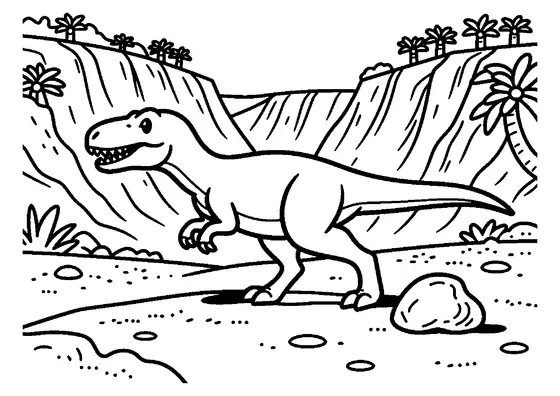
T. Rex in a Sandy Canyon
A large Tyrannosaurus rex navigates a sandy canyon filled with large boulders, a fallen tree branch, and layered rock formations.

A4 format (portrait), black outlines on a white background · for home and classroom use
All coloring pages: Predatory Dinosaur Coloring Pages
Similar coloring pages: Predatory Dinosaur Coloring Pages


What else can you print? Free, no account needed
Custom Name Coloring Pages
Enter your child's name to generate a custom coloring page featuring large outline letters to color and decorate.
Open generator →Connect the Dots Generator
Eight connect-the-dots pictures across three difficulty levels. Features faint outline guides for younger children and dots only for older kids.
Open generator →Printables
Worksheets, tracing lines, mazes and dot-to-dots in A4.
Browse printables →
A Tyrannosaurus Rex in a Rocky Desert Canyon
A powerful Tyrannosaurus rex stands inside a sandy canyon surrounded by steep, layered rock walls. Near the dinosaur lies a large boulder alongside a broken branch on the canyon floor.
Fossil Discoveries of Tyrannosaurus Rex in Ancient Environments
Fossilized remains of Tyrannosaurus rex have been discovered in North American rock strata that formed ancient river basins and floodplains. Over millions of years, water erosion carved these rock layers into deep canyons, exposing prehistoric fossils buried beneath sandstone and mudstone.
Reconstructed Colors of Tyrannosaurus Rex and Canyon Landscapes
- T. rex pebbled skin: Earthy olive green, dark brown, or muted gray-green
- Sandy canyon floor: Pale tan, desert yellow, or warm beige
- Layered rock formations: Terracotta orange, rust red, and striped tan strata
- Weathered boulder: Medium slate gray, granite brown, or stone beige
- Fallen tree branch: Dark bark brown or weathered gray wood