
Parasaurolophus Beside a Nest on a Sandy Point
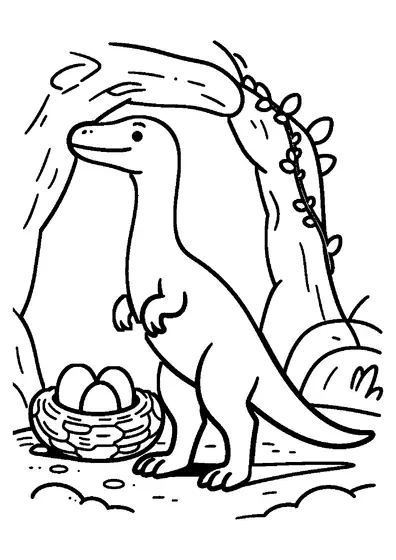
Beside a sandy point on a quiet lake, a crested Parasaurolophus watches over a nest of prehistoric eggs.

A4 format (portrait), black outlines on a white background · for home and classroom use
All coloring pages: Dinosaur Coloring Pages
Similar coloring pages: Dinosaur Coloring Pages




What else can you print? Free, no account needed
Custom Name Coloring Pages
Enter your child's name to generate a custom coloring page featuring large outline letters to color and decorate.
Open generator →Connect the Dots Generator
Eight connect-the-dots pictures across three difficulty levels. Features faint outline guides for younger children and dots only for older kids.
Open generator →Printables
Worksheets, tracing lines, mazes and dot-to-dots in A4.
Browse printables →
Parasaurolophus beside its lakeside nest
The dinosaur stands near a nest on the sandy shore, with the lake forming the scene’s calm natural setting. Its long head crest makes Parasaurolophus easy to recognize, while the eggs introduce the nesting behavior shared by all known dinosaur groups. The surroundings include only the sandy point and nearby water described for this page.
What dinosaur nests reveal
Fossil nests can show how eggs were arranged and whether dinosaurs returned to the same nesting areas. Eggshell fragments also help researchers study shell structure and identify differences among groups. However, a nest found near a skeleton does not automatically prove which individual laid or guarded the eggs.
Natural colors of Parasaurolophus and the nest
- Parasaurolophus skin: the original color is unknown and could have included camouflage or display patterns
- Head crest: no confirmed color survives; it may have contrasted with the rest of the head
- Eyes: brown, amber, or very dark tones are plausible but not proven
- Eggs: dinosaur eggshell could be pale, speckled, or colored, depending on the species
- Sand and lake water: sand commonly ranges from cream to tan, while water reflects blue, green, or gray