
Deinonychus Among Horsetails and Ferns
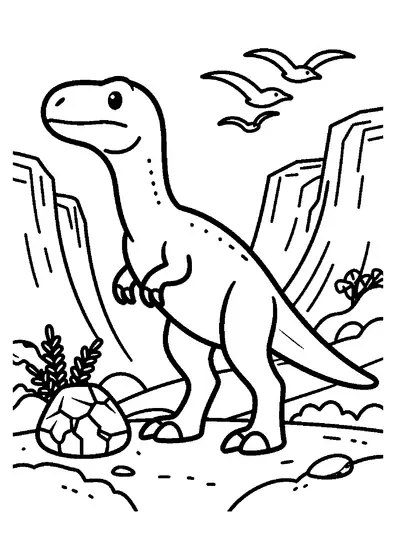
A swift Deinonychus appears in a prehistoric setting of horsetails and ferns.

A4 format (portrait), black outlines on a white background · for home and classroom use
All coloring pages: Dinosaur Coloring Pages
Similar coloring pages: Dinosaur Coloring Pages




What else can you print? Free, no account needed
Custom Name Coloring Pages
Enter your child's name to generate a custom coloring page featuring large outline letters to color and decorate.
Open generator →Connect the Dots Generator
Eight connect-the-dots pictures across three difficulty levels. Features faint outline guides for younger children and dots only for older kids.
Open generator →Printables
Worksheets, tracing lines, mazes and dot-to-dots in A4.
Browse printables →
Deinonychus among prehistoric plants
Deinonychus was a lightly built predatory dinosaur with a long tail, grasping hands, and a large curved claw on each foot. The scene places this agile hunter among horsetails and ferns, plants whose ancient relatives grew long before flowering plants became widespread. Its raised sickle claw highlights the feature for which dromaeosaurs are especially well known.
Surprising facts about Deinonychus
Scientists think Deinonychus was an active animal that relied on balance and quick movement while pursuing or restraining prey. Fossil evidence from related dinosaurs shows that members of its wider family had feathers, so Deinonychus is commonly reconstructed with feathering rather than bare, scaly skin. Horsetails spread through underground stems and still grow in damp places today.
Realistic colors for Deinonychus and its surroundings
- Deinonychus feathers: the exact colors are unknown, but natural browns, rusty reds, black, and cream are plausible choices
- Face and lower legs: muted tan, brown, or gray, as seen on many living ground birds
- Sickle claws: dark brown, charcoal, or nearly black keratin
- Fern fronds: fresh green, deep green, or yellow-green
- Horsetail stems: green with darker joints and brownish tips