
Camarasaurus at the Edge of a Prehistoric Wetland
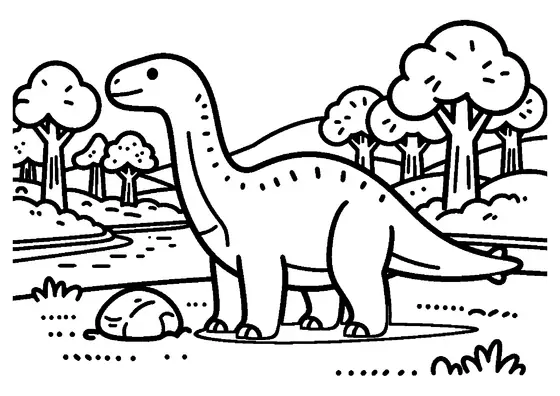
A sturdy Camarasaurus pauses beside a prehistoric wetland in this dinosaur scene.

A4 format (landscape), black outlines on a white background · for home and classroom use
All coloring pages: Dinosaur Coloring Pages
Similar coloring pages: Dinosaur Coloring Pages



What else can you print? Free, no account needed
Custom Name Coloring Pages
Enter your child's name to generate a custom coloring page featuring large outline letters to color and decorate.
Open generator →Connect the Dots Generator
Eight connect-the-dots pictures across three difficulty levels. Features faint outline guides for younger children and dots only for older kids.
Open generator →Printables
Worksheets, tracing lines, mazes and dot-to-dots in A4.
Browse printables →
Camarasaurus at the wetland’s edge
Camarasaurus was a large plant-eating sauropod with a robust body, a comparatively short neck for its group, and a compact, box-shaped head. The dinosaur is shown at the edge of a prehistoric wetland, an environment where water and land meet. Its strong proportions differ from the especially slender bodies and extremely long tails of some other sauropods.
Camarasaurus facts worth knowing
Its name refers to hollow spaces within its vertebrae, which helped make the enormous skeleton lighter without removing the strength needed to support the neck. Camarasaurus had broad, spoon-shaped teeth suited to biting vegetation. Wetlands can preserve footprints, bones, and plant material when sediment covers them before they decay or are scattered.
Likely colors of Camarasaurus and the wetland
- Camarasaurus skin: the true color is unknown; olive, brown, tan, or muted gray are reasonable natural shades
- Back and flanks: darker mottling or bands could provide camouflage, although no exact pattern is known
- Belly and throat: a paler beige or gray, following patterns found in many large animals
- Wetland water: greenish brown, muddy blue, or reflective gray
- Damp ground: dark brown, clay red, gray, or ocher