
Rocket over Crater Sea
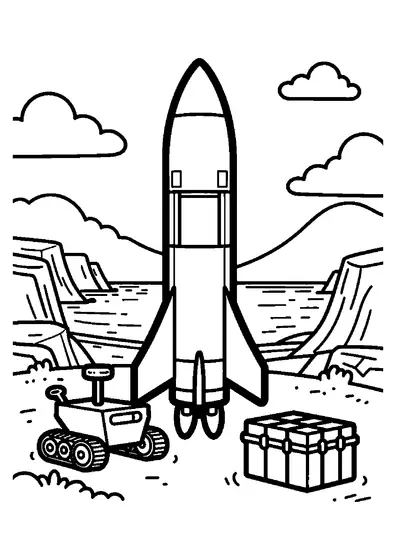
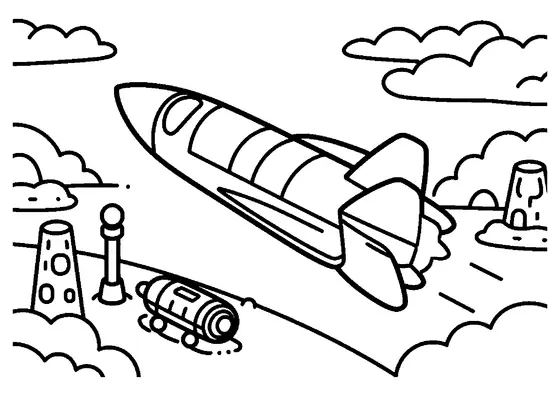
A heavy rocket hovers low over the shoreline of a liquid sea enclosed within a massive planetary crater bounded by rocky hills.

A4 format (landscape), black outlines on a white background · for home and classroom use
All coloring pages: Space and Rocket Coloring Pages
Similar coloring pages: Space and Rocket Coloring Pages

What else can you print? Free, no account needed
Custom Name Coloring Pages
Enter your child's name to generate a custom coloring page featuring large outline letters to color and decorate.
Open generator →Connect the Dots Generator
Eight connect-the-dots pictures across three difficulty levels. Features faint outline guides for younger children and dots only for older kids.
Open generator →Printables
Worksheets, tracing lines, mazes and dot-to-dots in A4.
Browse printables →
Planetary Survey Over a Crater Reservoir
This scene depicts a survey rocket traveling across a coastal landscape nestled inside a wide impact crater. The rocket hovers near a rocky shoreline where ocean waves crash against stone outcrops and surrounding hills.
Impact Craters and Alien Basins
Impact craters form when giant meteorites or asteroids strike planetary surfaces at high speeds, creating bowl-shaped depressions surrounded by raised rims. On geologically active worlds or moons, low-lying crater basins can occasionally fill with liquid methane, water, or brine to create isolated crater lakes. Observing crater shores helps scientists study geological history and sediment layers.
Authentic Colors of Planetary Landscapes
- Rocket outer shell: glossy white or dark metallic slate
- Ocean waves: deep turquoise, navy blue, or dark gray liquid
- Coastal rocks: dark charcoal, rusty red, or weathered brown
- Crater hills: muted gray-brown with dark shadow slopes
- Rocket thruster nozzles: burnt bronze or matte dark gray