
Rocket Over an Ice Canyon
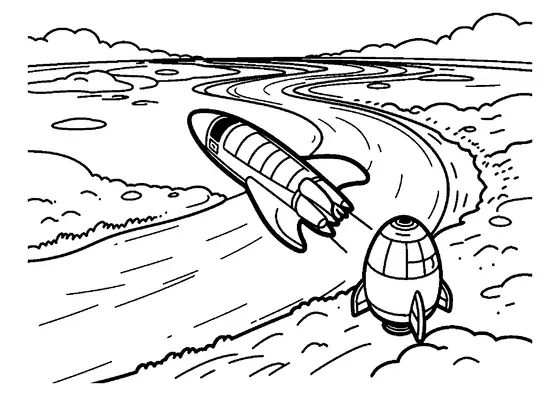
A specialized research spacecraft travels above a deep canyon with icy walls accompanied by a detached escape pod.

A4 format (landscape), black outlines on a white background · for home and classroom use
All coloring pages: Space and Rocket Coloring Pages
Similar coloring pages: Space and Rocket Coloring Pages




What else can you print? Free, no account needed
Custom Name Coloring Pages
Enter your child's name to generate a custom coloring page featuring large outline letters to color and decorate.
Open generator →Connect the Dots Generator
Eight connect-the-dots pictures across three difficulty levels. Features faint outline guides for younger children and dots only for older kids.
Open generator →Printables
Worksheets, tracing lines, mazes and dot-to-dots in A4.
Browse printables →
Atmospheric Flight Above Icy Terrain
Research spacecraft survey remote planetary geology from high altitude to map glacial terrain. Steep canyon walls carved by ancient glaciers expose deep layers of compressed ice and rock. Secondary escape pods travel alongside main research ships to provide emergency recovery options during hazardous planetary surveys.
Glacial Canyons and Planetary Exploration
Ice canyons exist on cold planetary bodies like Mars and icy moons such as Europa. Glacial ice in deep chasms often contains trapped atmospheric gases that reveal the geological history of a planet. Atmospheric survey probes utilize thermal sensors to scan canyon depths while maintaining altitude.
Color Guide for Glacial Flying Missions
- Research rocket hull: titanium silver or bright white
- Rocket propulsion glow: fiery orange or electric blue
- Escape pod body: white with high-visibility red accents
- Canyon ice walls: pale turquoise, crisp white, and shadowed gray