
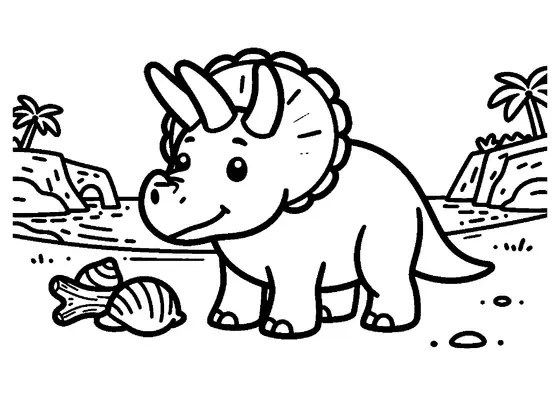
Triceratops on a Rocky Jurassic Plateau
A plant-eating Triceratops stands in a rocky Jurassic landscape with its three horns and broad frill on display.

A4 format (portrait), black outlines on a white background · for home and classroom use
All coloring pages: Dinosaur Coloring Pages
Similar coloring pages: Dinosaur Coloring Pages
What else can you print? Free, no account needed
Custom Name Coloring Pages
Enter your child's name to generate a custom coloring page featuring large outline letters to color and decorate.
Open generator →Connect the Dots Generator
Eight connect-the-dots pictures across three difficulty levels. Features faint outline guides for younger children and dots only for older kids.
Open generator →Printables
Worksheets, tracing lines, mazes and dot-to-dots in A4.
Browse printables →
Triceratops on the rocky plateau
This scene features a Triceratops standing on a rocky plateau. Its large head carries two long brow horns, a shorter nose horn, and a wide bony frill. Triceratops walked on four sturdy legs and used its beak to crop vegetation. The open, stony setting places the dinosaur within a rugged prehistoric landscape.
Surprising facts about Triceratops
Triceratops lived near the end of the age of non-avian dinosaurs and shared its environment with Tyrannosaurus rex. Its jaws held closely packed teeth that formed efficient cutting surfaces for processing tough plants. Scientists continue to study whether its frill was used mainly for display, recognition, defense, or a combination of purposes.
Realistic colors for Triceratops
- Skin: its exact color is unknown, but muted brown, olive, rust, or sandy tones are plausible
- Frill: no confirmed color survives, so it may match the body or carry contrasting natural markings
- Horn coverings: likely cream, tan, brown, or dark gray, like keratin structures in living animals
- Eyes: brown, amber, or another subdued shade is a believable choice
- Plateau rocks: commonly gray, brown, reddish, or sandy beige