
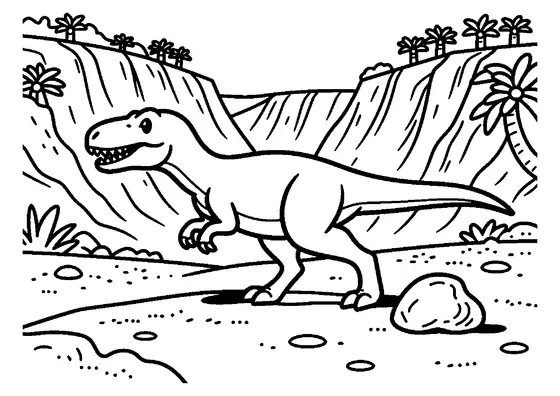
Baryonyx Searching for Fish in a Rocky Shallow
A long-snouted Baryonyx wades through a rocky shallow near the bank of a clear prehistoric lake.

A4 format (landscape), black outlines on a white background · for home and classroom use
All coloring pages: Predatory Dinosaur Coloring Pages
Similar coloring pages: Predatory Dinosaur Coloring Pages


What else can you print? Free, no account needed
Custom Name Coloring Pages
Enter your child's name to generate a custom coloring page featuring large outline letters to color and decorate.
Open generator →Connect the Dots Generator
Eight connect-the-dots pictures across three difficulty levels. Features faint outline guides for younger children and dots only for older kids.
Open generator →Printables
Worksheets, tracing lines, mazes and dot-to-dots in A4.
Browse printables →
Baryonyx Foraging in Shallow Lake Waters
A Baryonyx stands positioned in shallow lake water near a rocky shore as it searches for food. The dinosaur features an elongated crocodile-like snout and a prominent curved hook claw on its front hand.
Specialized Fish-Eating Dinosaur
Baryonyx was a spinosaurid dinosaur discovered in Europe, renowned for its specialized diet composed largely of aquatic life. Its name means heavy claw, referring to the curved claw measuring over twelve inches long on its first finger, which it used to hook fish out of rivers and lakes. Fossilized stomach contents of Baryonyx revealed partially digested fish scales along with bones of a young Iguanodon, proving it was an opportunistic feeder.
Colors of Aquatic Dinosaurs and Shallows
- Baryonyx hide: dark teal, muddy brown, or olive scale tones
- Large hand claw: dark horn brown or glossy black
- Shallow lakebed: smooth river pebbles in shades of beige, gray, and ochre
- Freshwater lake: clear turquoise transitioning to deep blue in deeper spots