
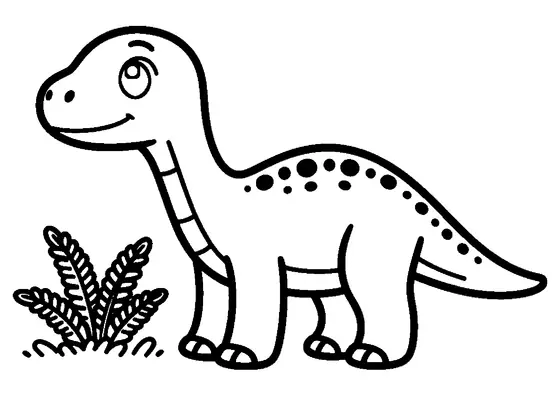
Protoceratops Next to a Fern
A compact Protoceratops stands in profile alongside a large fern leaf.

A4 format (landscape), black outlines on a white background · for home and classroom use
All coloring pages: Herbivorous Dinosaur Coloring Pages
Similar coloring pages: Herbivorous Dinosaur Coloring Pages




What else can you print? Free, no account needed
Custom Name Coloring Pages
Enter your child's name to generate a custom coloring page featuring large outline letters to color and decorate.
Open generator →Connect the Dots Generator
Eight connect-the-dots pictures across three difficulty levels. Features faint outline guides for younger children and dots only for older kids.
Open generator →Printables
Worksheets, tracing lines, mazes and dot-to-dots in A4.
Browse printables →
Protoceratops Standing Beside a Large Fern
A small Protoceratops stands in side view with a distinct beak and a short neck frill. Standing beside the creature, a single large fern leaf decorates the setting.
Real World Discoveries About Protoceratops
Protoceratops inhabited the arid regions of what is now the Gobi Desert during the Late Cretaceous period. Paleontologists have discovered numerous fossilized eggs and nests, proving that these small herbivores cared for their young in social colonies. Their strong beaks allowed them to shear through tough, drought-resistant desert plants.
Natural Colors of Protoceratops and Ferns
- Protoceratops body skin: sandy brown or tan shade blending with desert landscapes
- Short neck frill: dull gray or muted earth color
- Curved beak: dark brown or weathered gray horn tone
- Fern leaf: deep green or forest shade