
Centrosaurus Viewed from the Front
A head-on view reveals the striking facial symmetry and elaborate neck shield of a heavy Late Cretaceous herbivore.

A4 format (portrait), black outlines on a white background · for home and classroom use
All coloring pages: Herbivorous Dinosaur Coloring Pages
Similar coloring pages: Herbivorous Dinosaur Coloring Pages



What else can you print? Free, no account needed
Custom Name Coloring Pages
Enter your child's name to generate a custom coloring page featuring large outline letters to color and decorate.
Open generator →Connect the Dots Generator
Eight connect-the-dots pictures across three difficulty levels. Features faint outline guides for younger children and dots only for older kids.
Open generator →Printables
Worksheets, tracing lines, mazes and dot-to-dots in A4.
Browse printables →
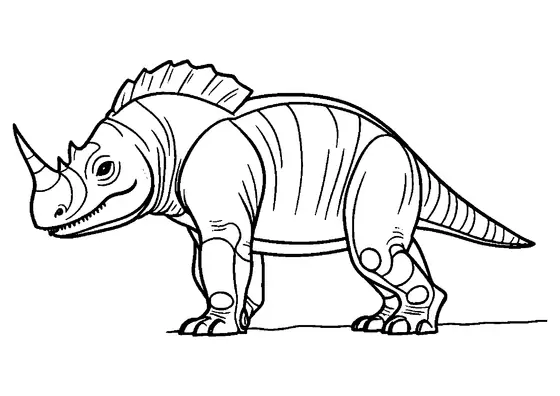
Front View of a Centrosaurus
The illustration captures a Centrosaurus directly from the front perspective. Its central feature is a massive curved nose horn accompanied by a decorative neck frill bordered by small, hook-like bony spikes along the upper rim.
Massive Herds of Canada
Centrosaurus was a medium-sized ceratopsian that roamed North America roughly 76 million years ago. Paleontologists have uncovered vast bone beds containing thousands of individual Centrosaurus skeletons in Alberta, Canada. These massive deposits indicate that large herds perished together during ancient flooding events while crossing swollen prehistoric rivers.
Real World Colors of Centrosaurus
- Centrosaurus body hide: Slate gray, earthy brown, or muted olive skin tones
- Forward curved nose horn: Off-white, weathered ivory, or dark horn tone
- Frill rim spikes: Pale beige, tan, or yellowish bone color
- Eyes and surrounding skin: Dark brown or deep grayish-black