
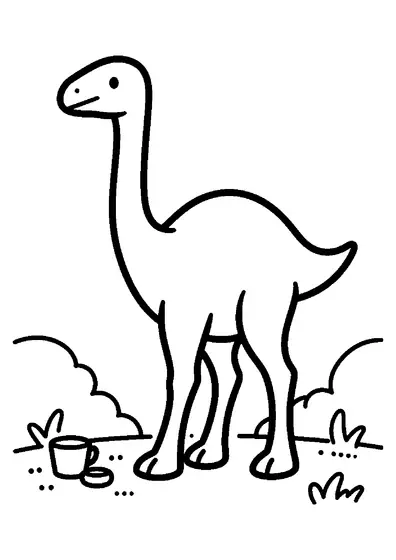
Muttaburrasaurus with a Nose Bump
An Australian Muttaburrasaurus shows off its unusual hollow snout and sturdy posture.

A4 format (landscape), black outlines on a white background · for home and classroom use
All coloring pages: Herbivorous Dinosaur Coloring Pages
Similar coloring pages: Herbivorous Dinosaur Coloring Pages


What else can you print? Free, no account needed
Custom Name Coloring Pages
Enter your child's name to generate a custom coloring page featuring large outline letters to color and decorate.
Open generator →Connect the Dots Generator
Eight connect-the-dots pictures across three difficulty levels. Features faint outline guides for younger children and dots only for older kids.
Open generator →Printables
Worksheets, tracing lines, mazes and dot-to-dots in A4.
Browse printables →
The Anatomy of Muttaburrasaurus
The illustration focuses on Muttaburrasaurus viewed from the side, emphasizing the prominent rounded bump situated on top of its nose. Supported by strong hind legs, this broad-bodied dinosaur also features a firm beak used for gathering plant material.
Function of the Muttaburrasaurus Nose Bump
Muttaburrasaurus is one of the most famous dinosaurs discovered in Australia, named after the town of Muttaburra where its fossils were unearthed. Scientists speculate that the enlarged hollow nasal structure allowed the animal to produce loud booming calls to communicate across long distances or attract mates. Additionally, its powerful jaws contained shearing teeth capable of slicing tough plants like cycads.
Lifelike Colors of Muttaburrasaurus
- Snout bump: bright reddish-brown or vivid orange skin tone for display
- Body hide: dusty olive green or grayish-brown hide
- Hind legs and feet: dark tan or deep slate gray
- Beak: dark charcoal or brownish-black horn shade