
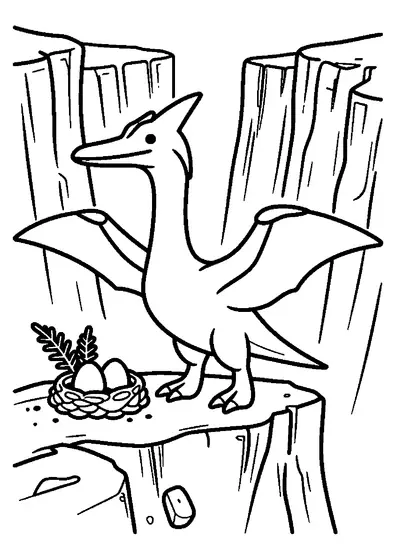
Tapejara Resting on a Fern-Covered Hill
A prehistoric pterosaur with a prominent head crest perched among ancient foliage.

A4 format (portrait), black outlines on a white background · for home and classroom use
All coloring pages: Flying and Sea Reptile Coloring Pages
Similar coloring pages: Flying and Sea Reptile Coloring Pages


What else can you print? Free, no account needed
Custom Name Coloring Pages
Enter your child's name to generate a custom coloring page featuring large outline letters to color and decorate.
Open generator →Connect the Dots Generator
Eight connect-the-dots pictures across three difficulty levels. Features faint outline guides for younger children and dots only for older kids.
Open generator →Printables
Worksheets, tracing lines, mazes and dot-to-dots in A4.
Browse printables →
Pterosaur Tapejara on a Fern Hill
The Tapejara rests atop a rock surrounded by sprawling giant fern leaves on an elevated hill. Its head crest stands out as a defining feature of this flying reptile from the Early Cretaceous period.
Discovering the Tapejara
Tapejara was a genus of pterosaur known for its unusually large head crest, which was likely used for display or species recognition. These flying reptiles inhabited coastal environments near shallow lagoons where lush vegetation thrived. Ancient ferns like the ones growing around its resting spot were very common plant species during the Cretaceous period.
Natural Colors of the Tapejara and Its Habitat
- Tapejara skin: Brown or muted olive green
- Decorative head crest: Bright shades of red, orange, or yellow
- Rock surface: Dark gray or weathered slate
- Fern leaves: Rich deep green