
Euoplocephalus on a Prehistoric Sandy Beach
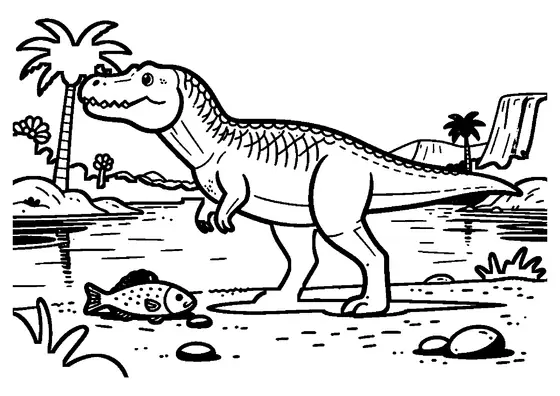
An armored Euoplocephalus stands on a coastal beach beside the open waters of a prehistoric ocean.

A4 format (landscape), black outlines on a white background · for home and classroom use
All coloring pages: Dinosaur Coloring Pages
Similar coloring pages: Dinosaur Coloring Pages

What else can you print? Free, no account needed
Custom Name Coloring Pages
Enter your child's name to generate a custom coloring page featuring large outline letters to color and decorate.
Open generator →Connect the Dots Generator
Eight connect-the-dots pictures across three difficulty levels. Features faint outline guides for younger children and dots only for older kids.
Open generator →Printables
Worksheets, tracing lines, mazes and dot-to-dots in A4.
Browse printables →
Euoplocephalus Along Prehistoric Coastlines
Euoplocephalus was one of the largest armored ankylosaurid dinosaurs of North America. This low-slung herbivore stands on a wide sandy beach adjacent to an ancient ocean. Coastal environments provided rich moisture and lowland vegetation where armored dinosaurs could forage peacefully near the water.
Defense Mechanisms of Armored Dinosaurs
The body of Euoplocephalus was protected by oval bony plates called osteoderms embedded deeply into its tough skin, along with armored eyelids that shielded its eyes. At the end of its stiffened tail was a heavy bone club capable of delivering powerful strikes against incoming predators. Even its skull was fully fusion-plated, leaving virtually no vulnerable spots exposed.
Natural Palette for Coastal Dinosaurs
- Armored back plates: Dark brownish red, earthy gray, or slate blue
- Tail club: Weathered bone white, pale gray, or dark brown
- Beach sand: Light tan, warm beige, or pale golden yellow
- Ocean water: Deep marine blue, turquoise, or sea foam green