
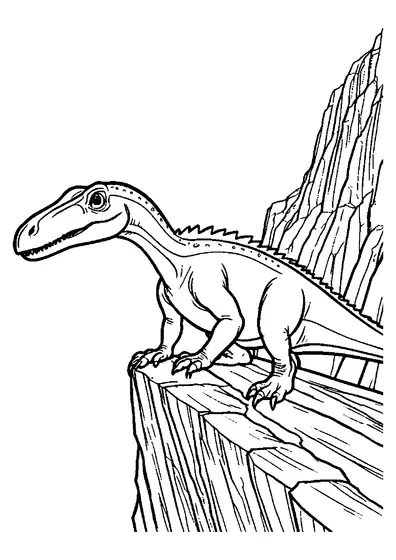
Drepanosaurus with a Gripping Tail
A tree-dwelling Drepanosaurus balances carefully on a thick branch using its specialized tail.

A4 format (portrait), black outlines on a white background · for home and classroom use
All coloring pages: Dinosaur Coloring Pages
Similar coloring pages: Dinosaur Coloring Pages


What else can you print? Free, no account needed
Custom Name Coloring Pages
Enter your child's name to generate a custom coloring page featuring large outline letters to color and decorate.
Open generator →Connect the Dots Generator
Eight connect-the-dots pictures across three difficulty levels. Features faint outline guides for younger children and dots only for older kids.
Open generator →Printables
Worksheets, tracing lines, mazes and dot-to-dots in A4.
Browse printables →
Tree-Dwelling Habits of Drepanosaurus on Wooden Branches
Drepanosaurus was a small, chameleon-like Triassic reptile adapted for an arboreal life among tree branches. It featured a pointed triangular head, strong hooked forelimbs, and a prehensile tail equipped with a claw-like spine at the end. Resting securely on a thick limb, its unique silhouette highlights its specialized limbs designed for climbing rather than walking on flat ground.
Special Adaptations of Prehistoric Climbing Reptiles
Drepanosaurus possessed large, hook-shaped claws on its index fingers that functioned much like modern anteater claws. These strong hooks allowed it to peel back bark or dig into wood crevices in search of insects. Its muscular gripping tail could wrap tightly around woody branches, giving the animal a firm fifth limb for climbing high above the forest floor.
Natural Color Choices for Drepanosaurus and Tree Branches
- Scales on body and neck: Mottled forest green, mossy brown, or leaf-like yellow green
- Triangular head: Light olive, tan, or bark-patterned gray
- Hooked hands and claws: Dark horn brown, charcoal gray, or dull black
- Curled gripping tail: Patterned green and brown stripes for tree canopy camouflage
- Thick branch: Dark oak brown, grayish bark, or weathered timber gray