
Albertosaurus on a Forest Cliff
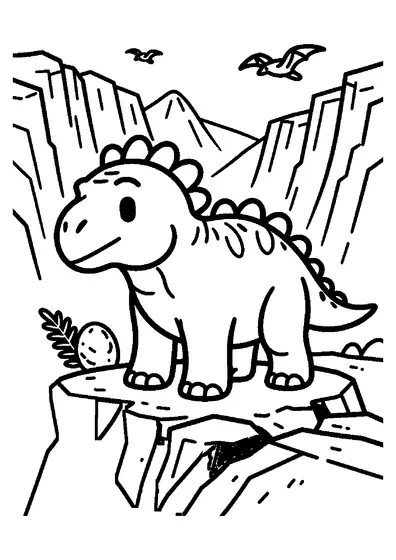
A powerful Albertosaurus stands at the edge of a steep rocky cliff overlooking a vast forest valley below.

A4 format (portrait), black outlines on a white background · for home and classroom use
All coloring pages: Dinosaur Coloring Pages
Similar coloring pages: Dinosaur Coloring Pages


What else can you print? Free, no account needed
Custom Name Coloring Pages
Enter your child's name to generate a custom coloring page featuring large outline letters to color and decorate.
Open generator →Connect the Dots Generator
Eight connect-the-dots pictures across three difficulty levels. Features faint outline guides for younger children and dots only for older kids.
Open generator →Printables
Worksheets, tracing lines, mazes and dot-to-dots in A4.
Browse printables →
Albertosaurus Overlooking a Forest Valley
Albertosaurus was a large apex predator closely related to Tyrannosaurus rex. Positioned high on a cliff edge, this carnivore overlooks a forested valley stretching into the distance, representing its natural hunting territory in prehistoric North America.
Biological Insights into Albertosaurus
Albertosaurus lived in western North America during the Late Cretaceous period, primarily in areas now known as Alberta, Canada. Weighing up to two tons, it had slightly longer legs than T. rex, suggesting it was capable of faster running speeds. Bonebed discoveries reveal that Albertosaurus may have lived and hunted in social groups or packs.
Natural Colors of Albertosaurus and Cliff Scenery
- Albertosaurus body: dark gray, muted olive brown, and yellowish belly skin
- Rocky cliff face: weathered slate, granite gray, and sandstone brown
- Forest valley canopy: deep pine green, moss green, and autumn brown
- Distant mountain air: pale hazy blue and soft light gray