
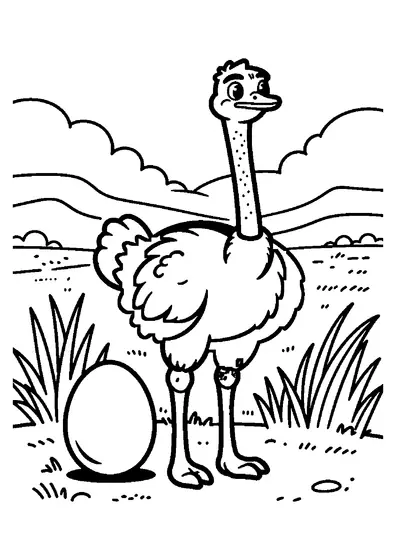
Ostrich on the Karoo Plains
A tall ostrich wanders across the open, dry landscape of the Karoo plains.

A4 format (portrait), black outlines on a white background · for home and classroom use
All coloring pages: African Animal Coloring Pages
Similar coloring pages: African Animal Coloring Pages



What else can you print? Free, no account needed
Custom Name Coloring Pages
Enter your child's name to generate a custom coloring page featuring large outline letters to color and decorate.
Open generator →Connect the Dots Generator
Eight connect-the-dots pictures across three difficulty levels. Features faint outline guides for younger children and dots only for older kids.
Open generator →Printables
Worksheets, tracing lines, mazes and dot-to-dots in A4.
Browse printables →
Ostrich Exploring the Karoo Landscape
The ostrich strides across semiarid Karoo plains surrounded by distant hills, low rocks, and a weathered dry tree trunk. Powerful long legs and dense body feathers help this giant bird adapt to open, dry environments.
How Ostriches Survive on Arid Plains
Ostriches possess long, powerful legs that allow them to cover massive distances across open terrain in search of seeds and plants. Their large eyes give them exceptional vision across flat ground to spot movement from far away. They absorb most of the moisture they need directly from the vegetation they consume.
True Colors of the Ostrich and Its Environment
- Adult male ostrich feathers: deep black with white wing tips
- Ostrich neck and legs: bare pinkish or pale gray skin
- Karoo plain soil: reddish brown or dusty tan
- Dry tree trunk: dark brown or gray
- Distant hills: muted purple or grayish blue