
Red-Necked Ostrich at the Desert's Edge
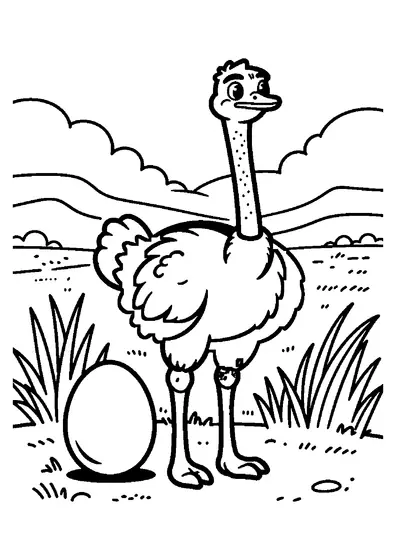
A tall red-necked ostrich stands watch beside a shallow ground nest holding a large egg in a desert environment.

A4 format (portrait), black outlines on a white background · for home and classroom use
All coloring pages: African Animal Coloring Pages
Similar coloring pages: African Animal Coloring Pages


What else can you print? Free, no account needed
Custom Name Coloring Pages
Enter your child's name to generate a custom coloring page featuring large outline letters to color and decorate.
Open generator →Connect the Dots Generator
Eight connect-the-dots pictures across three difficulty levels. Features faint outline guides for younger children and dots only for older kids.
Open generator →Printables
Worksheets, tracing lines, mazes and dot-to-dots in A4.
Browse printables →
Red-Necked Ostrich by a Desert Nest
At the edge of an arid desert landscape, a red-necked ostrich guards a nest built directly on the ground. A single large ostrich egg rests safely in the shallow depression prepared by the parent birds.
Survival Adaptations of Desert Ostriches
The red-necked ostrich is a subspecies of the North African ostrich, known for the bare red skin on its neck and long muscular legs. These massive flightless birds rely on fast running to escape danger, reaching speeds up to forty-five miles per hour across flat terrain. Ostrich eggs are the largest of any living bird species, featuring a thick, tough shell that protects the chick from harsh climate conditions.
Authentic Colors of the Red-Necked Ostrich and Nest
- Male ostrich body feathers: deep black
- Ostrich wing and tail tips: bright white
- Ostrich neck and leg skin: reddish pink
- Ostrich egg shell: smooth ivory white
- Desert ground and nest sand: warm beige and tan