
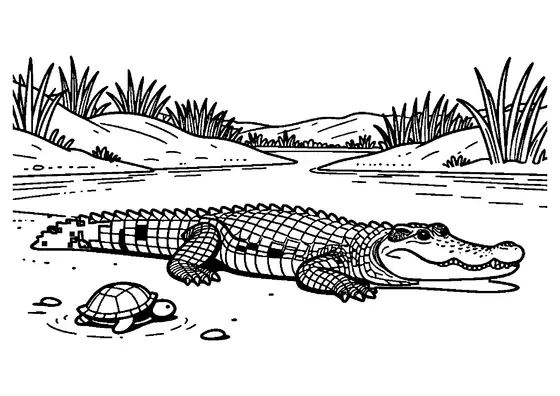
Nile Crocodile on a Sandy Riverbank
A large Nile crocodile rests on a warm sandy riverbank in its tropical African habitat.

A4 format (landscape), black outlines on a white background · for home and classroom use
All coloring pages: African Animal Coloring Pages
Similar coloring pages: African Animal Coloring Pages




What else can you print? Free, no account needed
Custom Name Coloring Pages
Enter your child's name to generate a custom coloring page featuring large outline letters to color and decorate.
Open generator →Connect the Dots Generator
Eight connect-the-dots pictures across three difficulty levels. Features faint outline guides for younger children and dots only for older kids.
Open generator →Printables
Worksheets, tracing lines, mazes and dot-to-dots in A4.
Browse printables →
The Nile Crocodile Basking on a Sandy Riverbank
The Nile crocodile is one of the largest freshwater reptiles in Africa, frequently seen resting motionless along sandy riverbanks. Emerging from the water onto sunlit shorelines allows the crocodile to regulate its body temperature after long periods spent underwater. Tough, armor-like scales cover its body and tail, protecting the animal while providing texture that blends seamlessly with the surrounding sand and mud.
Remarkable Facts About the Nile Crocodile
Because crocodiles are cold-blooded reptiles, they rely on external heat from the sun to warm up their bodies and boost their metabolism. They often rest on riverbanks with their jaws wide open, a process called gaping that helps them cool down their heads without losing overall body heat. Nile crocodiles have powerful tails that propel them smoothly through freshwater rivers, lakes, and marshlands.
True Colors of the Nile Crocodile and River Habitat
- Crocodile back scales: dark olive green, bronze, or muddy brown
- Crocodile belly: pale yellow or cream
- Crocodile eyes: pale green or yellowish-brown
- Sandy riverbank: beige, golden sand, or dark river silt