
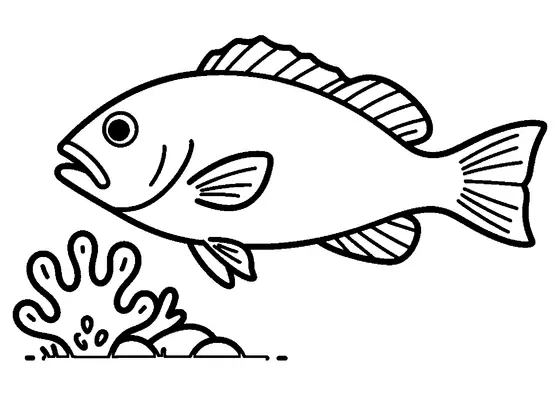
Grouper Fish Angled View
A heavy-bodied marine creature swims gracefully near a rugged seafloor stone in this ocean life illustration.

A4 format (landscape), black outlines on a white background · for home and classroom use
All coloring pages: Fish and Ocean Life Coloring Pages
Similar coloring pages: Fish and Ocean Life Coloring Pages


What else can you print? Free, no account needed
Custom Name Coloring Pages
Enter your child's name to generate a custom coloring page featuring large outline letters to color and decorate.
Open generator →Connect the Dots Generator
Eight connect-the-dots pictures across three difficulty levels. Features faint outline guides for younger children and dots only for older kids.
Open generator →Printables
Worksheets, tracing lines, mazes and dot-to-dots in A4.
Browse printables →
Large Grouper Swimming Over an Ocean Rock
This illustration depicts a stocky grouper fish positioned near an ocean rock. The fish features a broad mouth and smooth, rounded fins, characteristic of its sturdy saltwater body. Groupers often stay low near underwater rocks and sea bed formations, where they spend much of their time swimming slowly or resting near the substrate.
Fascinating Facts About Groupers
Groupers are solitary ocean fish that prefer living around rocky reefs and underwater structures. Instead of constantly swimming in open waters, they hide in rocky crevices and ambush passing food by opening their large mouths to draw in water. Many grouper species can live for several decades and grow to substantial sizes in warm ocean habitats.
Natural Colors of the Grouper
- Body scales: Brown, dark gray, or olive green with natural mottled patterns
- Rounded fins: Dusty gray or muted brown matching the body tone
- Underbelly: Pale off-white, light gray, or soft beige
- Ocean rock: Dark gray, brownish charcoal, or slate with green algae highlights