
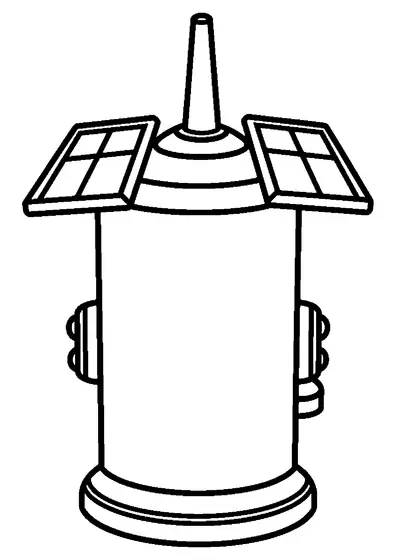
Radio Beacon on a Distant World
A navigational signal transmitter stands firmly on an unfamiliar planetary surface to help guide space explorers.

A4 format (portrait), black outlines on a white background · for home and classroom use
All coloring pages: Planet and Solar System Coloring Pages
Similar coloring pages: Planet and Solar System Coloring Pages



What else can you print? Free, no account needed
Custom Name Coloring Pages
Enter your child's name to generate a custom coloring page featuring large outline letters to color and decorate.
Open generator →Connect the Dots Generator
Eight connect-the-dots pictures across three difficulty levels. Features faint outline guides for younger children and dots only for older kids.
Open generator →Printables
Worksheets, tracing lines, mazes and dot-to-dots in A4.
Browse printables →
Planetary Navigation Radio Beacon
Transmitting equipment located in remote off-world environments provides essential signal markers for arriving science expeditions and surface vehicles. A sturdy base stabilizes the tall structure against strong winds, while antenna arrays and metallic rings broadcast continuous radio signals across vast distances.
Navigational Signals in Space Science
Radio beacons operate by emitting electromagnetic waves that automated receivers can detect even through thick planetary fog or dust storms. Scientists use similar automated transmitters on Earth and in space missions to map terrain boundaries and mark coordinates for landing modules. These instruments often rely on internal radioisotope power sources to remain operational for decades without maintenance.
Real-Life Colors of Space Beacons
- Beacon metallic casing: dark gray or silver stainless steel
- Antenna rods: bright silver or polished aluminum
- Warning signal lights: vivid red or amber yellow
- Planetary ground surface: dusty brown, rust red, or dark charcoal