
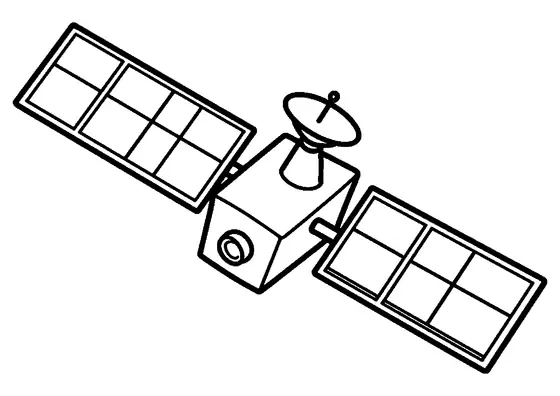
Observation Satellite from the Front
An orbital monitoring spacecraft equipped with optical instruments scans planetary surfaces from high above the atmosphere.

A4 format (portrait), black outlines on a white background · for home and classroom use
All coloring pages: Planet and Solar System Coloring Pages
Similar coloring pages: Planet and Solar System Coloring Pages





What else can you print? Free, no account needed
Custom Name Coloring Pages
Enter your child's name to generate a custom coloring page featuring large outline letters to color and decorate.
Open generator →Connect the Dots Generator
Eight connect-the-dots pictures across three difficulty levels. Features faint outline guides for younger children and dots only for older kids.
Open generator →Printables
Worksheets, tracing lines, mazes and dot-to-dots in A4.
Browse printables →
Orbiting Surface Observation Satellite
Remote sensing satellites travel in stable planetary orbits to capture high-resolution images of landforms and oceans below. The central body houses onboard computers and telemetry systems, while a large optical camera lens points directly toward the target planet and extended solar panels gather power from sunlight.
High-Altitude Planetary Imaging
Orbital observation satellites use specialized lenses capable of photographing terrain features through cloud layers and atmospheric haze. Solar arrays turn sunlight into electricity to power imaging sensors and transmit high-volume image data across millions of miles back to science headquarters. Satellites in polar orbits can scan nearly every region of a planet as the body rotates underneath them over time.
Natural Colors of Space Satellites
- Main satellite body: reflective gold foil or bright white insulation
- Optical camera lens: deep navy blue, glossy black, or dark violet
- Solar panel cells: dark blue or dark teal with silver grid lines
- Solar panel frames: metallic silver or charcoal gray